Clear Sky Science · en
An asymmetric photothermal platform for coupled seawater splitting and desalination
Turning Seawater into Fuel and Freshwater
Coastal regions hold vast amounts of seawater, yet this salty resource is hard to use directly for drinking or as a source of clean fuel. This study shows a way to do both at once: use sunlight to pull hydrogen fuel and drinkable water from seawater using a simple floating device coated with a finely tuned material.
Why Use Seawater and Sunlight
Hydrogen is often promoted as a clean fuel, but making it can still rely on fossil fuels or precious freshwater. Splitting seawater with sunlight could ease pressure on freshwater supplies and cut emissions, but the salt and other ions in seawater tend to corrode common catalysts and slow the reactions. Graphitic carbon nitride, a yellow, carbon based solid, already works better than many materials in salty water, yet it still wastes much of the incoming solar energy and offers too few active sites for making hydrogen efficiently.
Designing a Better Single Atom Catalyst
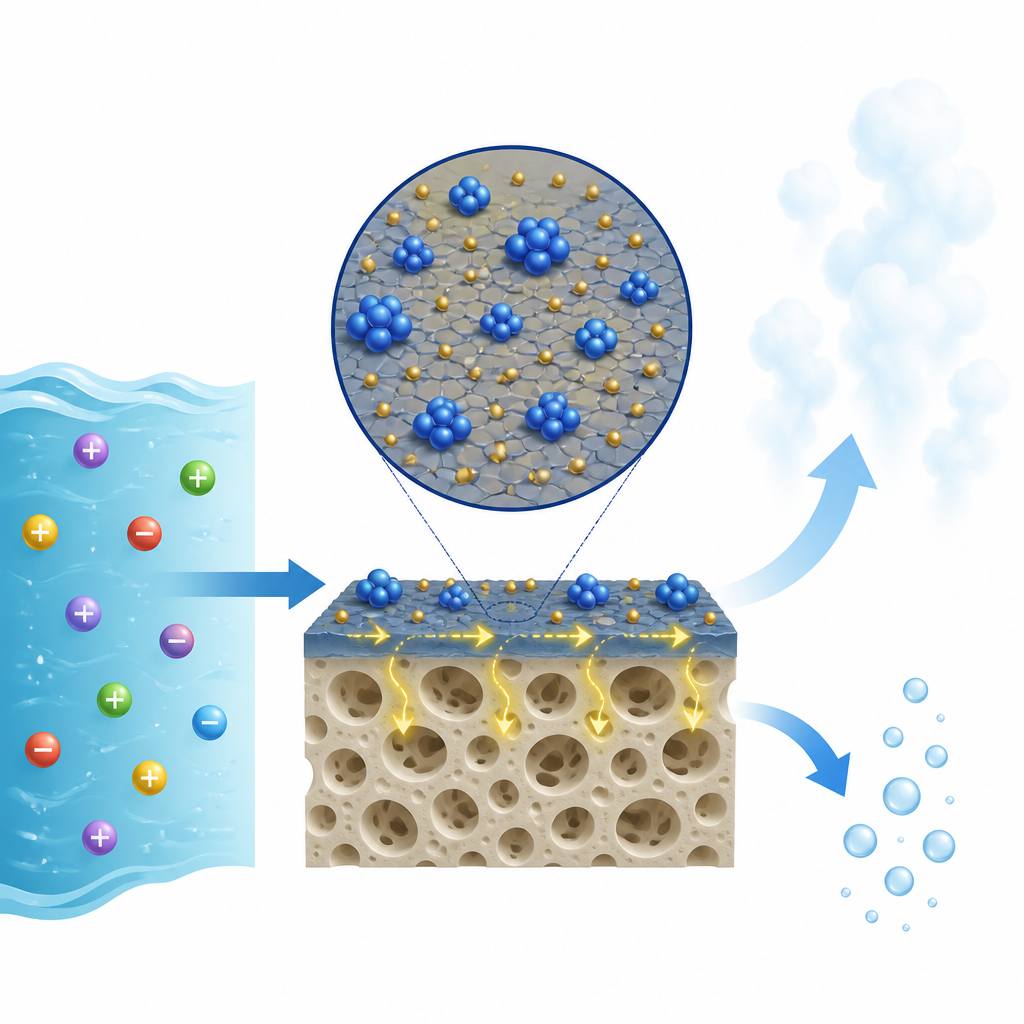
The researchers tackled this by engineering a family of catalysts in which individual cobalt atoms are anchored to the carbon nitride surface in different ways. They created three versions: a symmetric four nitrogen cage around cobalt, a three nitrogen site at a vacancy, and an asymmetric four nitrogen site next to missing carbon atoms. This last design, called CoSA-hCN, reshapes how electrons are shared between cobalt and the surrounding carbon nitride. Advanced microscopy and spectroscopy show that the cobalt stays as isolated atoms and that the nearby carbon vacancies disturb the symmetry of the local structure, creating more unpaired electrons and better pathways for charge to move through the material.
How Asymmetry Boosts Hydrogen Production
The team combined experiments with computer simulations to see how these tiny structural tweaks change performance. Optical measurements reveal that CoSA-hCN suppresses the usual light emission of carbon nitride, a sign that photoexcited charges are less likely to recombine and more likely to drive chemistry. Time resolved tests show the charges move faster, while electrochemical data indicate lower resistance and higher photocurrent. Under visible light, CoSA-hCN produces three to four times more hydrogen in artificial seawater than the other two versions. It also encourages the even growth of tiny platinum particles that act as powerful helpers for turning protons into hydrogen gas. Calculations and ion adsorption studies suggest that the asymmetric structure attracts positively charged seawater ions more than chloride, which helps steer charges in useful directions and limits corrosive side reactions.
A Floating Sponge that Makes Fuel and Freshwater
To move beyond small lab cells, the authors mounted their best catalyst onto a commercial sponge that floats on seawater. Sunlight both drives the photocatalyst and gently heats the sponge surface, which speeds up reactions and causes seawater to evaporate at the interface. In a covered tank, clean vapor condenses on a cool surface and is collected as fresh water, while hydrogen bubbles form at the catalyst layer. On a 60 square centimeter sponge platform under standard sunlight, the system delivered strong hydrogen output along with high rates of seawater evaporation using both artificial and natural seawater. The collected water met international guidelines for key salt levels, and the catalyst remained stable over repeated runs.
What This Means for Future Coastal Energy
By carefully arranging single cobalt atoms and nearby vacancies in carbon nitride, the study shows how atomic scale asymmetry can control charge motion, manage salty ions, and support efficient hydrogen production. When this tailored material is combined with a simple floating photothermal sponge, it creates a compact platform that can sit on real seawater and simultaneously generate hydrogen fuel and clean water. While this is not yet a commercial system, it lays out design rules for future solar devices that help address both energy and freshwater needs in coastal and arid regions.
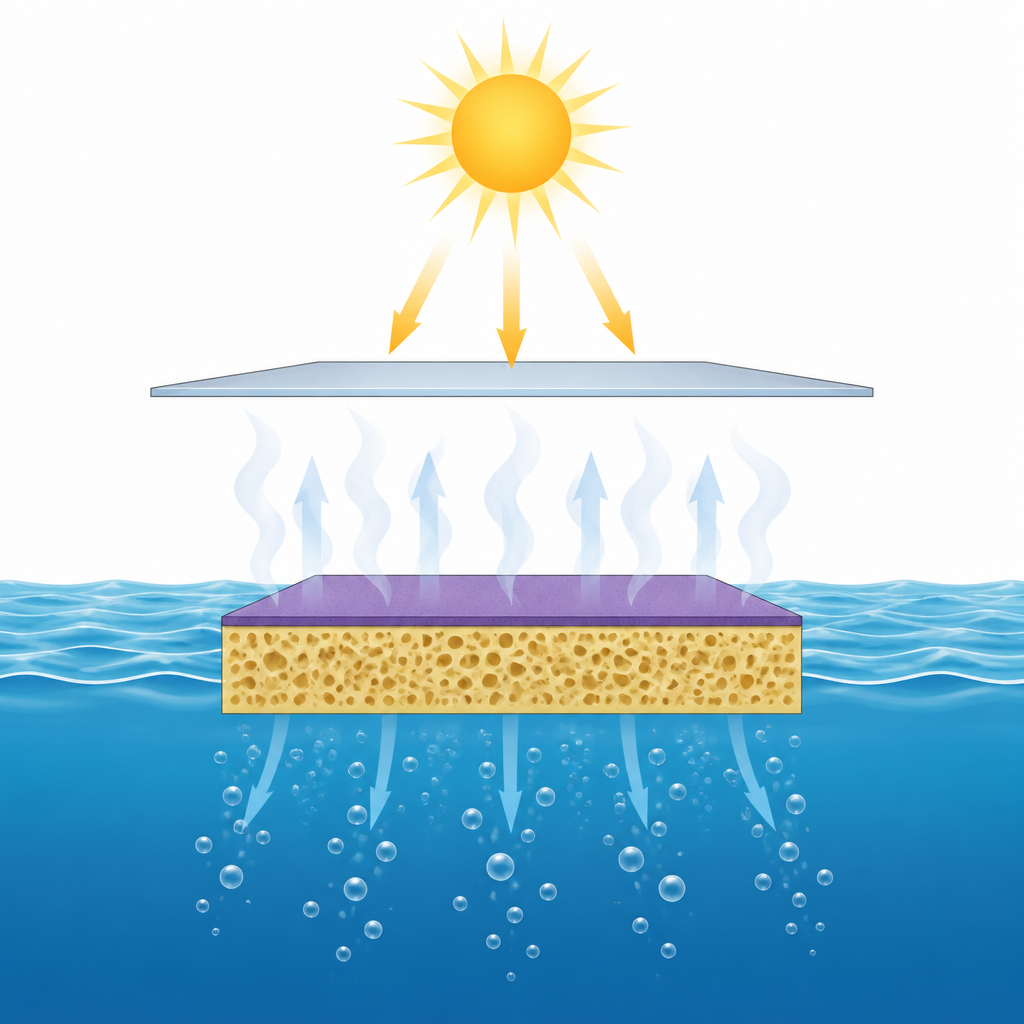
Sun Powered Seawater Converter
Citation: Lin, J., Xu, H., Tian, W. et al. An asymmetric photothermal platform for coupled seawater splitting and desalination. Nat Commun 17, 4503 (2026). https://doi.org/10.1038/s41467-026-71139-y
Keywords: seawater splitting, hydrogen production, desalination, photocatalyst, carbon nitride