Clear Sky Science · en
Identification of a universal three-body s-wave resonance in 10He
A new look at fragile atomic nuclei
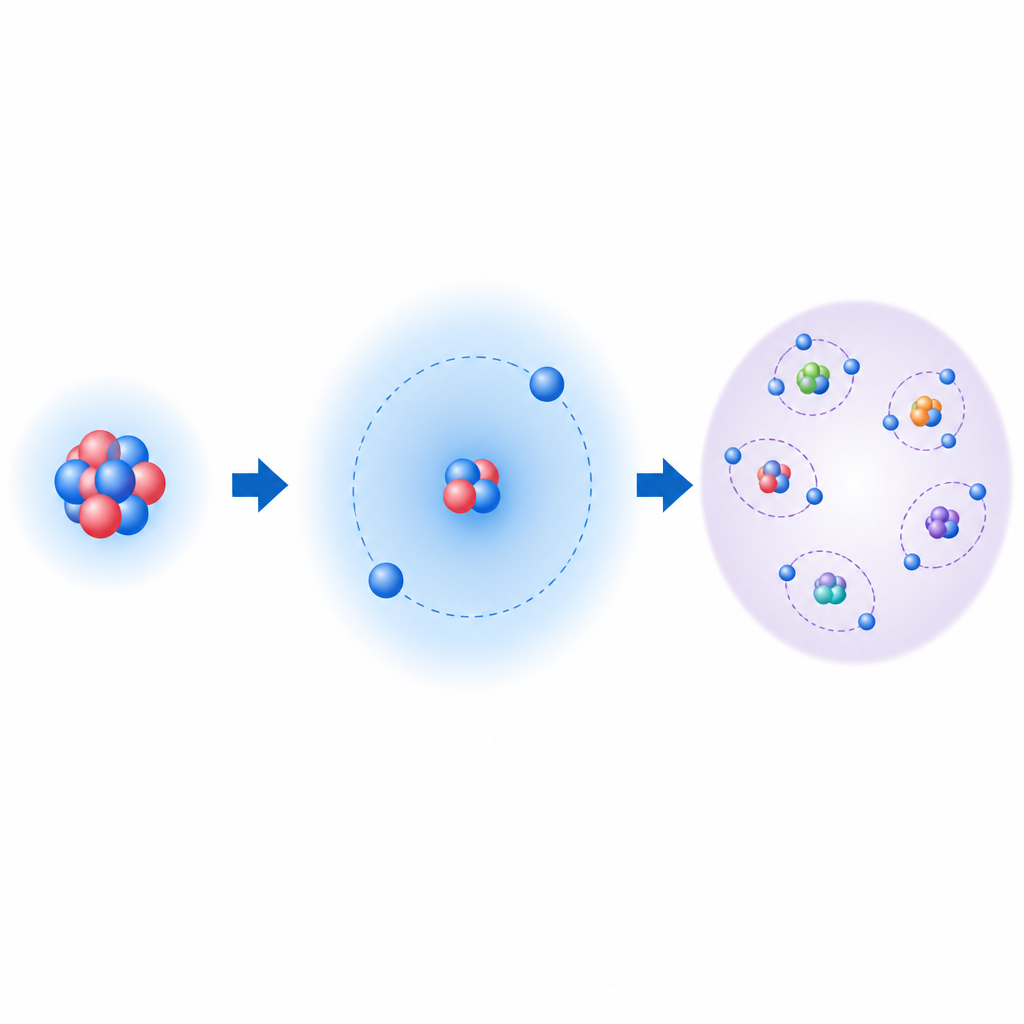
Most of the matter around us is built from tightly packed atomic nuclei, but a few rare nuclei live right on the edge of stability, with one or two extra neutrons hovering far from the core like a ghostly mist. These delicate systems, called halo nuclei, give physicists a unique window into the strange rules that govern matter at very low energies. In this study, researchers show that an extremely short‑lived form of helium, known as helium‑10, hosts a special kind of three‑body state that seems to follow the same simple rules as very different quantum systems, from ultracold atoms to exotic particles.
Why universality in tiny systems matters
Physicists have long been fascinated by “universality” the idea that very different systems can behave in nearly the same way when viewed at the right scale. One famous example is the Efimov effect, where three particles with the right kind of interaction can form a ladder of bound states whose sizes and energies follow simple patterns, regardless of the microscopic details. Efimov states have been seen with ultracold atoms trapped and cooled by lasers, but finding the nuclear counterpart has been difficult. Nuclei are ruled by the strong force, and additional electric repulsion between protons usually hides the delicate three‑body effects that universality relies on.
A special case in helium with two extra neutrons
The nucleus at the heart of this work, helium‑10, is made of a compact helium‑8 core plus two extra neutrons. It does not live long enough to be bound in the usual sense it immediately breaks apart into helium‑8 and the two neutrons. For years, experiments disagreed on how much energy this breakup required, and on the detailed structure of the lowest state. Some measurements pointed to a peak around 1.5 million electron volts, while others favored a higher value near 2 million electron volts. Theoretical models suggested that two different “zero‑spin” states might lie close together, one with the extra neutrons in an inner shell and one with them in a more distant orbit, but the data were not precise enough to untangle them.
Sharper measurements of a short‑lived nucleus
In the new experiment, scientists smashed a beam of helium‑11 nuclei into a thick hydrogen target at high energy, knocking out a proton to form helium‑10 for an instant before it fell apart. Sophisticated detectors then tracked the outgoing helium‑8 fragment and the two neutrons, allowing the team to reconstruct the energy of the original helium‑10 using the invariant‑mass method. Thanks to higher beam intensity, improved neutron detection, and careful correction for background events where a single neutron fakes two signals, the researchers obtained a much cleaner picture of the breakup energy spectrum, especially at very low energies close to the decay threshold.
Two nearby states and a three‑body halo
The refined spectrum shows a clear shoulder below 1 million electron volts and a broader peak around 1.5 million electron volts, followed by additional strength near 2 million electron volts. By comparing the data with detailed three‑body calculations that model the helium‑8 core and its two neutrons, the authors conclude that helium‑10 indeed has two low‑lying zero‑spin states. The lower one, just under 1 million electron volts above the breakup threshold, corresponds to a configuration where both extra neutrons occupy an s‑orbit, meaning they move with zero angular momentum relative to the core and to each other. The higher state, near 2 million electron volts, has the neutrons in a p‑orbit, carrying one unit of angular momentum.
A universal three‑body push instead of a pull
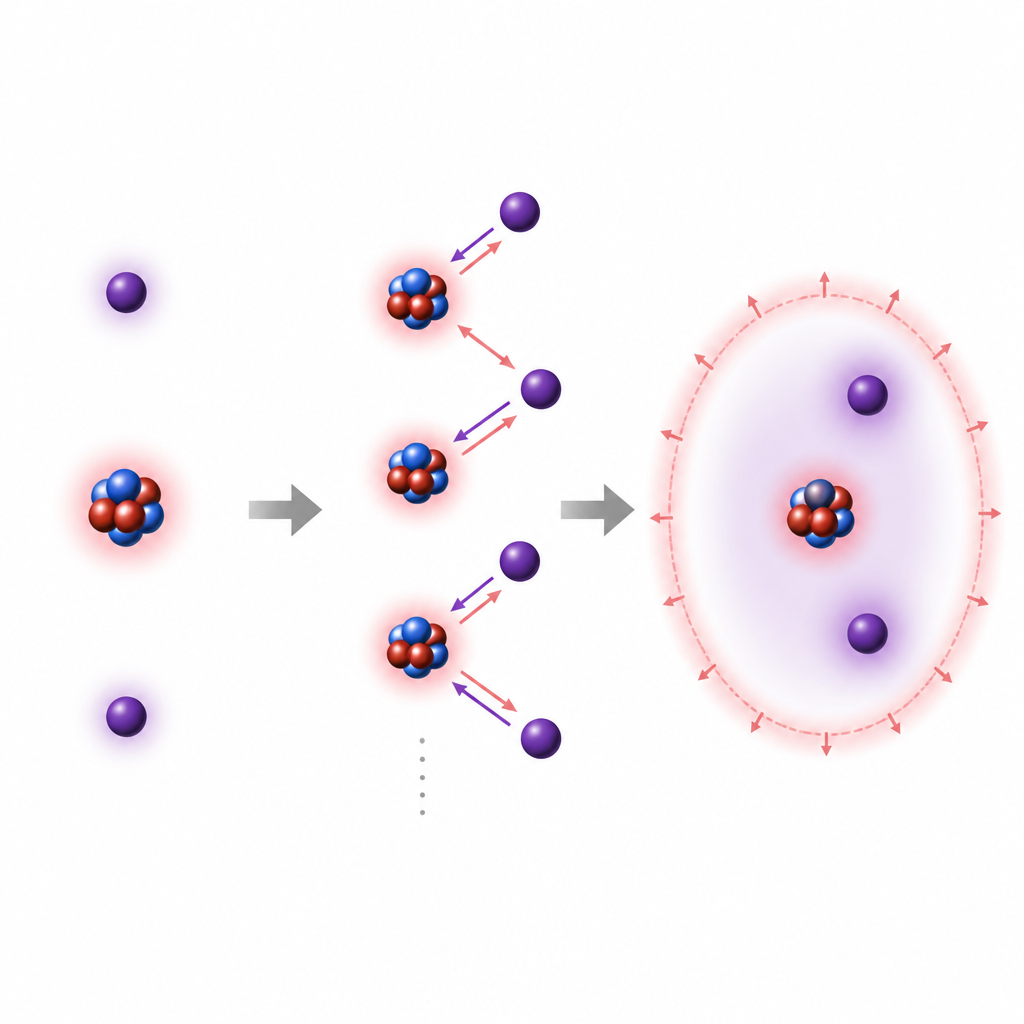
The most intriguing result is that the lower, s‑orbit state behaves like a three‑body resonance that cannot be explained by any two‑particle pair alone. In a simple two‑body system, an s‑wave “virtual” state near zero energy shows up only as a subtle distortion at threshold, not as a clear peak. Here, however, the three particles together produce an effective long‑range repulsion that shapes a distinct resonance a kind of temporary halo where the neutrons linger at large distances before escaping. By extracting how strongly neutrons scatter from the helium‑8 core, the team finds that this repulsion matches theoretical predictions of a new universal class of three‑body halo states, different from the attractive Efimov ladders but governed by similarly simple rules.
What this means for quantum halos
To a non‑specialist, the message is that helium‑10 behaves like a tiny laboratory where the same basic quantum patterns appear that also emerge in clouds of ultracold atoms and possibly in exotic particles. The ground state of helium‑10 is not a conventional tightly bound arrangement, but a fleeting three‑body halo held together and shaped by a universal repulsive effect that only shows up when all three components are considered at once. This discovery not only resolves a long‑standing puzzle about the structure of helium‑10 but also points the way to a unified understanding of fragile quantum halos across nuclear, atomic, and condensed‑matter systems.
Citation: Sun, Y.L., Kikuchi, Y., Corsi, A. et al. Identification of a universal three-body s-wave resonance in 10He. Nat Commun 17, 4674 (2026). https://doi.org/10.1038/s41467-026-71138-z
Keywords: helium-10, three-body halo, Efimov physics, neutron-rich nuclei, ultracold atoms