Clear Sky Science · en
Defective three-dimensional covalent organic frameworks for enhanced hydrogen peroxide photosynthesis and organic transformation
Turning Light and Air into Useful Chemicals
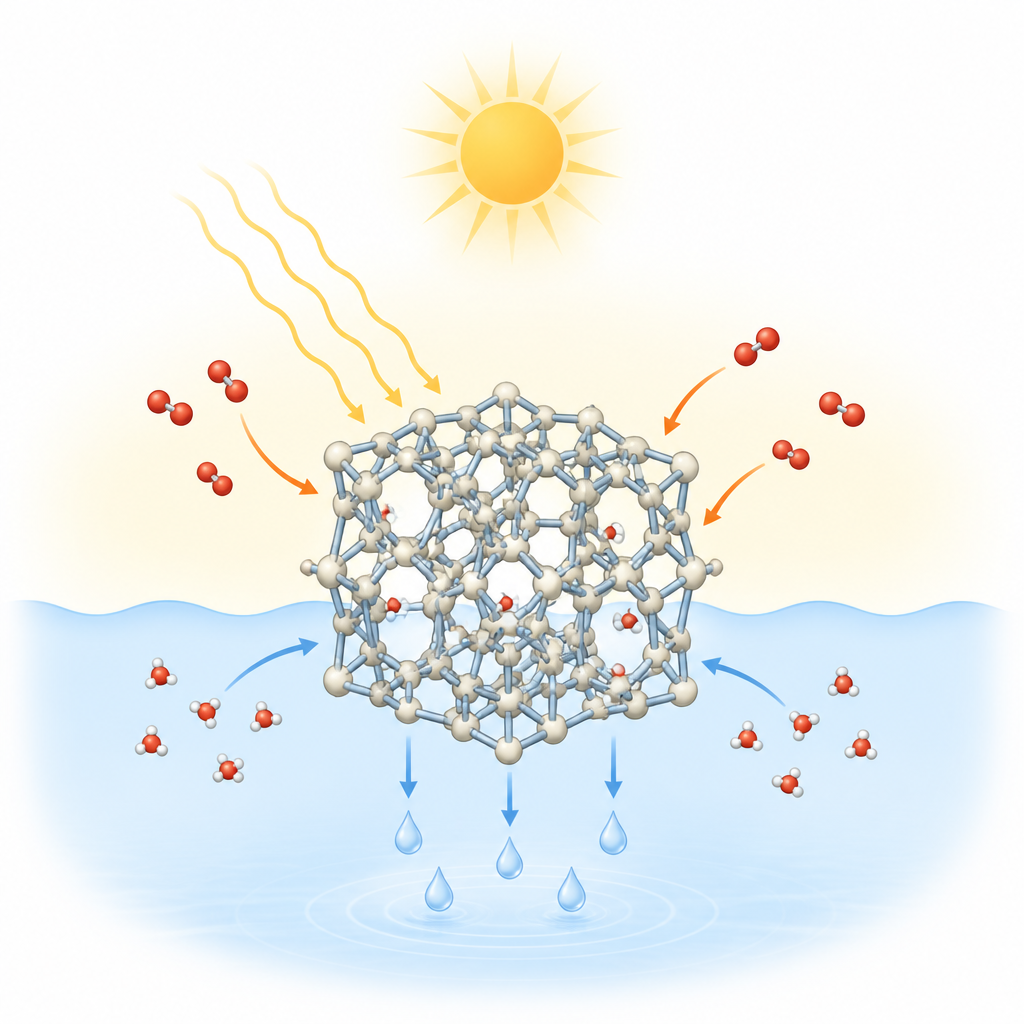
Hydrogen peroxide is best known as a fizzy disinfectant in the medicine cabinet, but it is also a workhorse chemical in water treatment and many manufacturing processes. Today it is mostly made in huge plants using an energy‑hungry method that produces unwanted waste. This study explores a cleaner pathway: using special porous crystals called covalent organic frameworks and sunlight to turn water and oxygen into hydrogen peroxide and to drive other valuable chemical reactions.
A Porous Scaffold Built for Sunlight
The researchers focus on three‑dimensional covalent organic frameworks, or 3D COFs, which are rigid, sponge‑like networks of organic molecules. Their many tiny channels allow gases and liquids to flow through, making them attractive as miniature chemical factories. However, common 3D COFs absorb light poorly and do not handle electric charges efficiently, which limits their performance as solar‑driven catalysts. The team set out to redesign the building blocks of these frameworks so they would capture more visible light while still keeping a sturdy 3D structure.
Adding Helpful “Defects” on Purpose
Instead of relying only on bulky, three‑dimensional connector units, the scientists deliberately swapped some of these units for flatter, triangle‑shaped ones that soak up light more effectively. This controlled swapping creates what they call defects, but rather than damaging the material, these changes open extra space in the pores and provide new sites where reactions can occur. At the same time, they mixed in different straight linker molecules decorated with electron‑withdrawing or electron‑donating groups. By choosing which versions to add, they could fine‑tune how easily electrons move through the framework once sunlight hits it.
Tuning the Flow of Energy and Charges
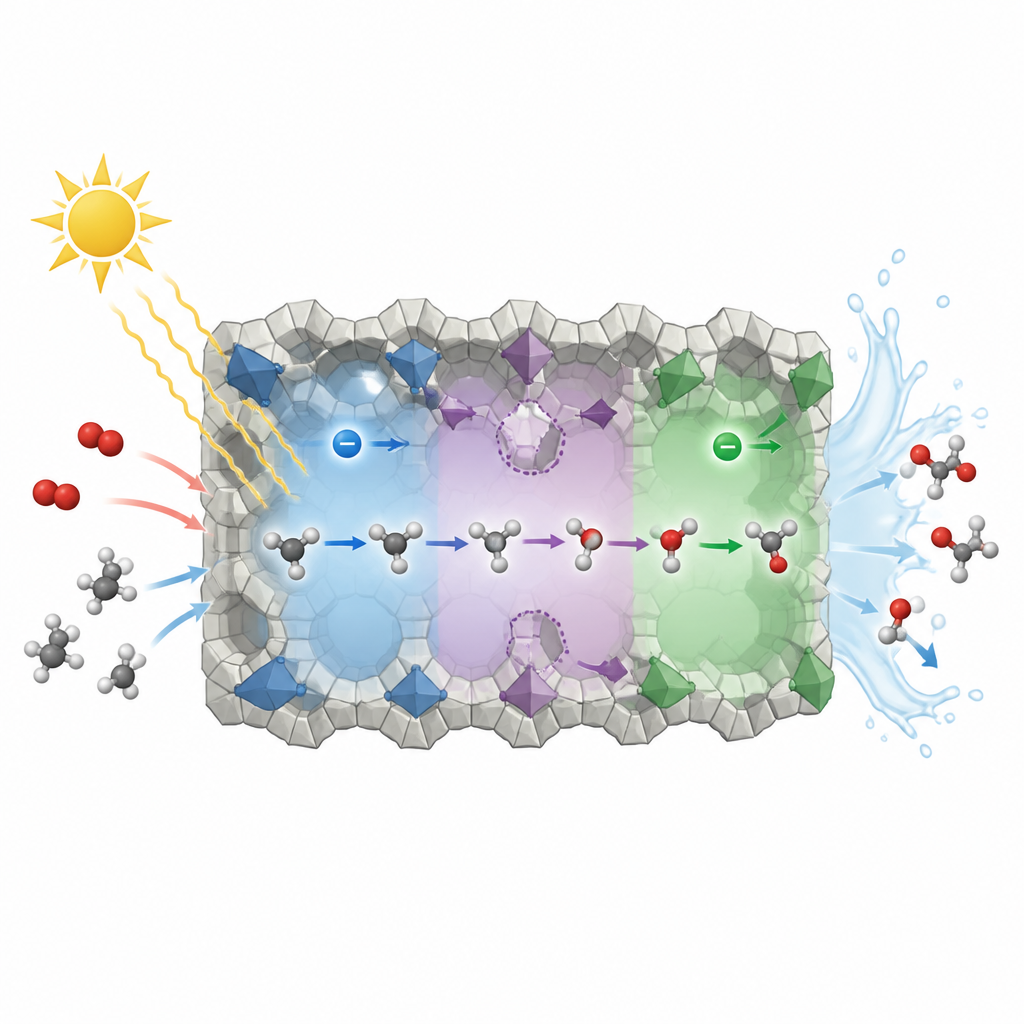
Detailed tests showed that the modified frameworks absorb redder, more energetic parts of the visible spectrum compared with the original material. Measurements of electrical response under light revealed that charges created by sunlight live longer and are less likely to recombine uselessly. Computer simulations supported this picture, showing that electrons and positive charges are pulled toward different regions of the framework. This built‑in separation encourages oxygen molecules to grab electrons at specific sites, forming reactive intermediates that eventually combine into hydrogen peroxide while organic molecules are oxidized at other sites.
Making Peroxide and Upgrading Organic Molecules
Using benzyl alcohol as a helper substance that donates electrons, the best performing material, called COF‑300‑D‑F, produced hydrogen peroxide at a rate far higher than the original framework and many similar materials. It also worked, though more slowly, in pure water without any added organic helper. The solid catalyst remained stable for at least four days of continuous operation and across a wide range of acidity levels. Beyond hydrogen peroxide production, the same material efficiently joined benzylamine molecules together using oxygen from the air, an important type of reaction in fine chemical and pharmaceutical synthesis.
What This Means for Cleaner Chemistry
For non‑specialists, the key message is that tiny changes in the geometry and decoration of a porous organic crystal can greatly improve how it harvests sunlight and shuttles charges. By deliberately building in certain defects and electronic patterns, the authors turned a weakly active material into an efficient, long‑lived photocatalyst that makes hydrogen peroxide from air and water and powers useful organic reactions. While still a laboratory system, this design strategy could guide future materials that support cleaner chemical manufacturing and greener ways to produce everyday oxidants like hydrogen peroxide.
Citation: Dong, T., Xu, X., Chen, L. et al. Defective three-dimensional covalent organic frameworks for enhanced hydrogen peroxide photosynthesis and organic transformation. Nat Commun 17, 4505 (2026). https://doi.org/10.1038/s41467-026-71137-0
Keywords: hydrogen peroxide photocatalysis, covalent organic frameworks, solar chemical conversion, porous materials, organic oxidation