Clear Sky Science · en
A parallel magnetic tunnel junction-based probabilistic Ising processor for efficient quadratic optimization
Why faster problem solving matters
From planning delivery routes to arranging machines on a factory floor, many everyday tasks hide a deep puzzle at their core: how to pick the best arrangement out of an enormous number of possibilities. As these problems grow, even powerful computers can take a long time and burn a lot of energy. This article describes a new kind of specialized hardware that uses tiny magnetic devices and controlled randomness to search for good answers much faster and more efficiently than standard chips, and even competes with modern quantum machines.
A puzzle of matching places and tasks
One of the toughest examples of these puzzles is called the quadratic assignment problem. It captures situations where several facilities must be assigned to several locations, and the cost depends not just on distance but also on how strongly each pair of facilities interacts. Unlike simpler problems where each city or point only worries about a few neighbors, here every pair of choices can affect every other one. This dense web of interactions makes the number of possible arrangements explode, and traditional methods often struggle once the problem is larger than a few dozen facilities. Because similar patterns appear in chip design, data centers and bioinformatics, finding a better way to handle this puzzle could help many industries.

Using magnetism to harness randomness
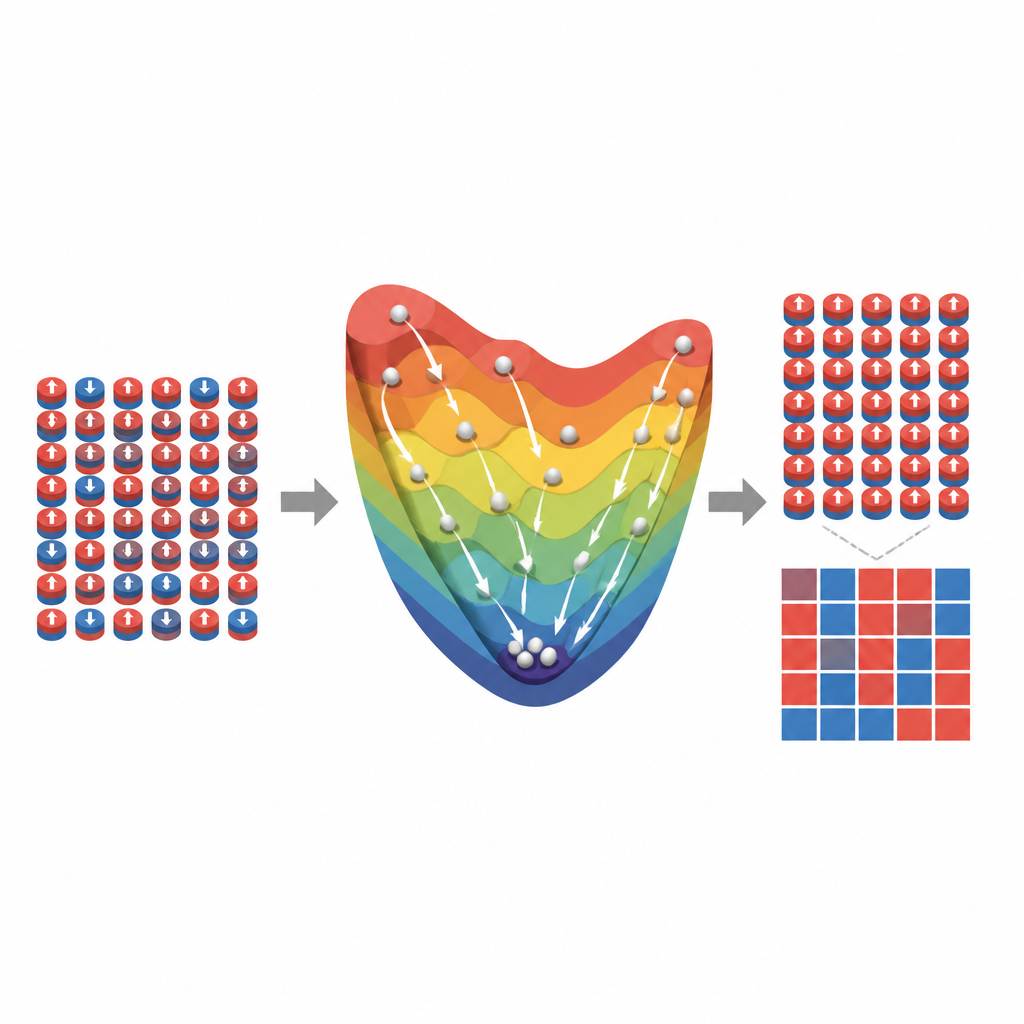
The researchers build on a physical system known as an Ising model, where each variable is like a tiny spin that can point in one of two directions. The best solution to the puzzle corresponds to the lowest energy arrangement of all these spins. To explore different arrangements, their machine uses magnetic tunnel junctions, the same basic elements found in magnetic memory chips. Each junction contains a fixed magnetic layer and a free layer separated by a thin barrier. When a brief voltage pulse is applied, the free layer can flip direction in a random but controllable way. By tuning the pulse, the team can set how likely each element is to switch, effectively turning these junctions into both random number generators and decision makers that follow the rules of the Ising model.
A highly parallel magnetic processor
The heart of the system is a board that houses 144 of these magnetic devices, grouped into processing elements and driven by digital-to-analog and analog-to-digital converters connected to a field-programmable gate array. In each step of the search, the FPGA calculates how the total energy would change if any single spin flipped and translates those values into voltages for all the junctions at once. Each device then independently decides whether to flip, based on its built-in randomness. A clever circuit called an arbiter uses more random bits from additional junctions to choose which accepted flip is actually carried out, so that the overall process still follows the correct statistical rules. Before running problems, the team carefully calibrates each junction so that its switching behavior follows a standard S-shaped curve, improving consistency across the array.
Beating conventional and quantum-style approaches
The authors test their magnetic processor on a suite of assignment problems of increasing size, comparing it with software running on a high-end central processing unit, a powerful graphics card, and commercial quantum annealing hardware from D-Wave. Using a scheme called parallel-trial annealing, where many candidate flips are evaluated at once, their system reaches near-optimal answers up to 123 times faster than a standard simulated annealing algorithm running on the same hardware, while using 98.3 percent less energy. Compared with a carefully coded version on a conventional processor, it still delivers more than three times speedup and large energy savings. For the quantum machines, the study finds that they can only handle the very smallest test cases reliably for this fully connected problem, often failing to return valid solutions as the size grows, while the magnetic processor maintains high solution quality across the whole range.
What this means for future computing
The work shows that by tightly coupling physics and algorithms, it is possible to build compact, energy-efficient hardware tailored to a specific class of hard problems. As magnetic memory technology matures and millions of these junctions can be packed onto a single chip alongside standard electronics, similar processors could tackle much larger real-world tasks in scheduling, routing and design. Rather than replacing general-purpose or quantum computers, such probabilistic magnetic machines offer a practical near-term path to faster optimization by letting nature itself explore the landscape of possibilities.
Citation: Yang, S., Bao, Y., Humianto, E. et al. A parallel magnetic tunnel junction-based probabilistic Ising processor for efficient quadratic optimization. Nat Commun 17, 4616 (2026). https://doi.org/10.1038/s41467-026-71128-1
Keywords: probabilistic computing, magnetic tunnel junctions, quadratic assignment problem, Ising machine, hardware optimization