Clear Sky Science · en
Single-molecule neuromorphic device with aJ-level power consumption per switching
Thinking Machines That Sip Power
As artificial intelligence grows more capable, its computers also grow more power hungry. This study describes a tiny electronic device built from a single molecule that behaves a bit like a brain cell connection while using almost unimaginably little energy. Such devices could one day help run smart technologies with a fraction of today’s electricity use.
Why Tiny Brain Like Switches Matter
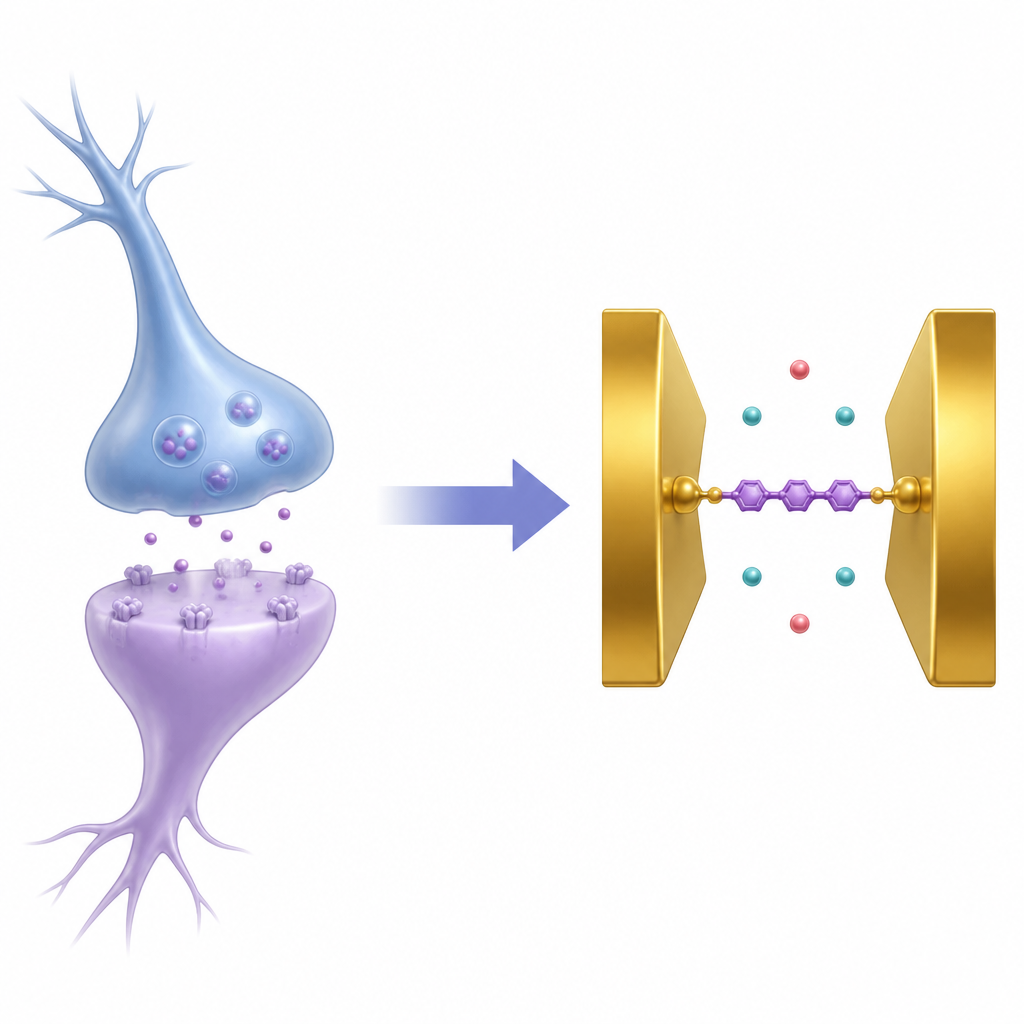
Modern AI relies on vast networks of artificial “neurons” running on conventional chips. Training these networks can require as much energy as thousands of households use, raising cost and environmental concerns. Biological brains, in contrast, carry out rich learning and memory tasks using only the power of a dim light bulb. Engineers therefore hope to mimic some features of real synapses, the junctions between neurons, directly in hardware. The work reported here pushes this idea to the extreme, shrinking a synapse like element down to a single molecule while still allowing it to store and process information.
A Single Molecule That Remembers
The researchers built their device around one organic molecule suspended between two gold electrodes in a liquid containing mobile charged particles, or ions. By applying tiny electrical pulses, they could nudge positively charged ions toward or away from the molecule. These ions subtly twist or straighten the molecule, changing how easily electrons flow through it. Each distinct level of flow acts like a different memory strength. In tests, the device reliably switched among more than ten such levels and did so using about 6.34 attojoules of energy per operation, far below the already efficient experimental devices based on larger structures.
Copying How the Brain Learns
Real synapses grow stronger or weaker depending on how often and how closely in time they are activated, a property known as plasticity. The single molecule device shows similar behavior. When the team sent pairs or trains of electrical pulses, the conductance of the junction rose sharply and then either faded quickly, like short term memory, or settled into long lasting states, like long term memory. They could reproduce classic learning patterns such as “paired pulse facilitation,” in which a second signal arriving soon after the first has a boosted effect, and “learn forget relearn,” in which a previously trained connection can be retrained more quickly the next time.
Teaching the Device to Associate and Recognize
To highlight practical uses, the authors programmed pulse patterns that mimic Pavlov’s famous dog experiment. One pattern played the role of a neutral cue, like a bell, and another imitated an unconditioned event, like seeing food. When both patterns were applied together repeatedly, the molecular synapse later responded strongly to the cue alone, just as the dog learns to salivate at the sound of the bell. The device also distinguished short and long pulses that encoded dots and dashes in Morse code, allowing it to recognize simple sequences. Parameters measured from the device were then used in a computer model of a spiking neural network, which achieved high accuracy when classifying handwritten digits.
How Ion Motion Drives the Effect
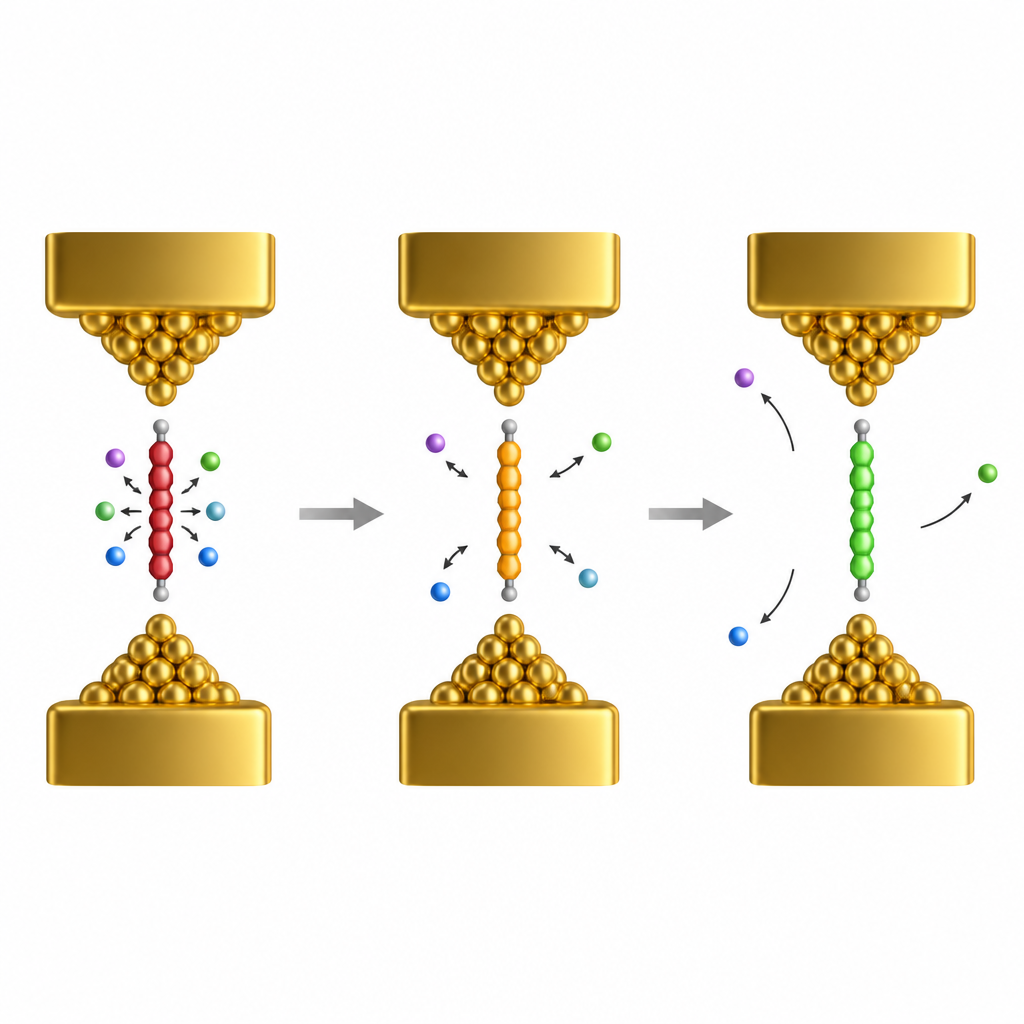
Behind these behaviors lies a delicate dance of ions and molecular shape. Computer simulations and control experiments showed that when certain bulky positive ions cluster near the molecule, they disrupt weak sulfur oxygen attractions within it, twisting the structure and lowering conductance. Electrical pulses push these ions away or draw them back, guiding the molecule through several stable shapes that correspond to the different memory levels. The energy needed to move each ion agrees well with the measured switching energy, supporting this picture of ion controlled conformations as the heart of the device’s function.
Toward Greener Artificial Intelligence
In plain terms, this work demonstrates that a single molecule can act like a tiny, adjustable brain connection and do so using an almost vanishing amount of energy. While such devices are still laboratory demonstrations, they point toward future hardware for AI that packs many synapse like elements into a very small space while keeping power needs low. If scaled up, this approach could help make advanced computing more energy efficient and more closely aligned with the way real brains handle learning and memory.
Citation: Zhang, H., Ye, J., Gao, M. et al. Single-molecule neuromorphic device with aJ-level power consumption per switching. Nat Commun 17, 4655 (2026). https://doi.org/10.1038/s41467-026-71127-2
Keywords: neuromorphic device, single-molecule electronics, synaptic plasticity, low-power AI hardware, ion-controlled conductance