Clear Sky Science · en
Pathways to cost-optimal and net-zero emissions irrigation in the United States
Feeding people while protecting the planet
Farmers depend on irrigation to keep crops alive when rain fails, but pumping all that water typically burns a lot of fossil fuel. This study asks a simple question with big consequences: how can the United States water its fields in a way that is both affordable for farmers and far cleaner for the climate, and what would it really take to reach net-zero emissions from irrigation?
Why irrigation energy matters
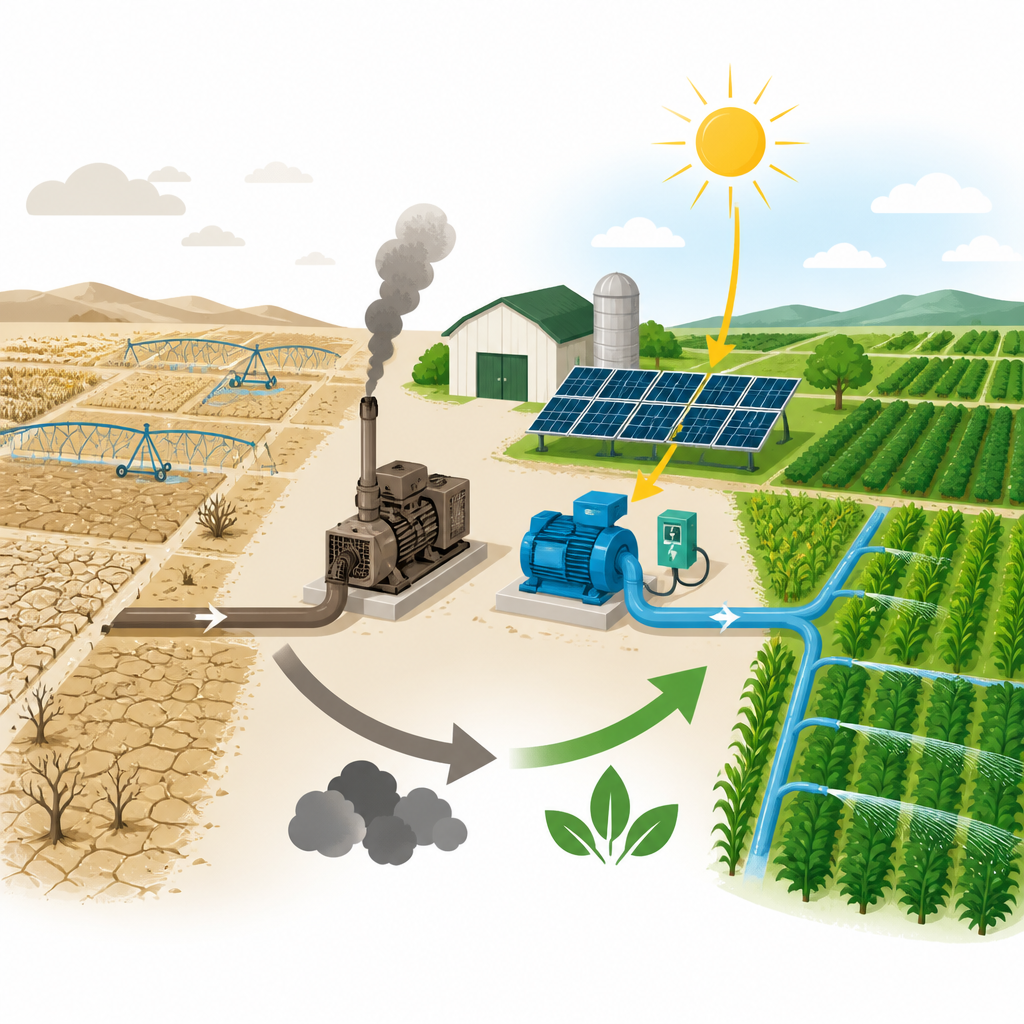
Most of the world’s farmland still relies on rainfall, leaving harvests vulnerable to drought and shifting weather. Irrigated fields can produce more food and better withstand heat and dry spells, but at a cost. Moving water from rivers or deep underground to crops already uses about 90% of global water withdrawals and releases hundreds of millions of tons of carbon dioxide each year, mainly from diesel and grid electricity used to run pumps. In the United States, irrigation energy emissions are tied to which crops are grown, where they are located, how deep the water table is, and whether pumps run on diesel or electricity. As climate change tightens water supplies, figuring out how to power irrigation more cleanly becomes essential for both food security and climate goals.
Testing cleaner paths for pumping water
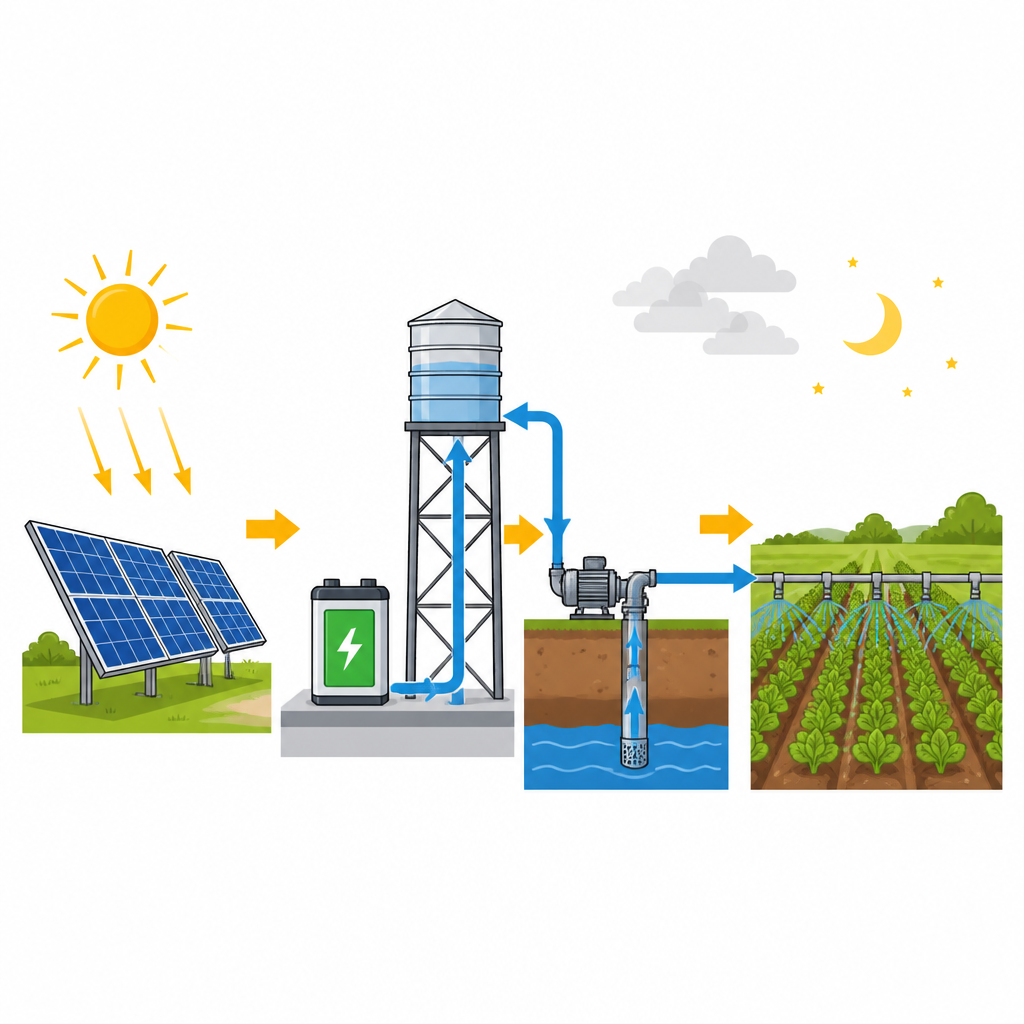
The authors bridge two worlds that are rarely combined: detailed energy system modeling and water management. They examine 774 U.S. counties that together account for 98% of national irrigation withdrawals. For each county, they reconstruct how much water is pumped, how much energy that requires, when during the day water is needed, and how much sun is available to run solar panels. They then build an optimization model that chooses among diesel pumps, electric pumps, grid power, on-farm solar panels, batteries, and water tanks. The model searches for the least-cost mix of equipment and operations while meeting hourly water needs, and can also be asked to meet stricter and stricter limits on carbon emissions, up to a fully net-zero system.
Cheaper and cleaner without trying too hard
Compared with today’s practices, the results show that U.S. irrigation is far from efficient. In a business-as-usual case, existing diesel and electric pumps keep running as they do now, costing about 3.8 billion dollars per year and emitting about 9.9 million tons of carbon dioxide. When the model is allowed to choose the cost-optimal setup without any climate rule, it nearly eliminates diesel use in favor of more efficient electric pumps and deploys around 6.6 gigawatts of solar power. Surprisingly, this not only cuts emissions by 39% but also lowers total annual costs by 23%, saving roughly 0.89 billion dollars. Pushing emissions cuts further is still relatively cheap: cutting about 85% of emissions raises total costs by less than one percent over business as usual, suggesting that large climate gains are available with modest financial sacrifice.
The steep climb to net-zero irrigation
Reaching true net-zero irrigation emissions is possible in the model but far more expensive. To avoid any emissions from the power grid, the system must shift entirely to on-farm solar, dramatically expand electric pump capacity, and add large amounts of battery and water storage to smooth out the daily ups and downs of sunlight and water demand. Solar capacity would need to jump from 6.6 gigawatts in the cost-optimal case to more than 42 gigawatts, and water storage volume would exceed that of the largest dam in the United States. These additions more than double annual costs relative to business as usual. The burden would not fall evenly: states like California, Arkansas, Nebraska, and Idaho account for a large share of costs and would see big shifts as diesel is phased out and solar takes over.
Limits, local choices, and future options
The study also probes how sensitive its results are to uncertain inputs like solar panel prices, pump efficiencies, and future grid emissions. Solar technology costs emerge as the most important factor: cheaper solar makes low-carbon irrigation even more attractive, while much higher costs slow adoption and raise emissions. In contrast, uncertainties in diesel prices and pump costs barely change the optimal decisions, confirming that diesel is a poor performer across a wide range of assumptions. The authors note that their analysis is based on current irrigation patterns, ignores the costs of bringing new power lines to remote fields, and treats each county as a single large system, which may underestimate real-world complications on individual farms.
What this means for farmers and climate
For a non-specialist, the main takeaway is that cleaner irrigation is not just a climate issue, but also a money issue. Simply replacing inefficient diesel pumps with electric ones and adding a modest amount of solar power can save farmers and society money while sharply reducing emissions from watering crops. Going all the way to net-zero is much harder and costlier, demanding major investments in solar panels, batteries, and water tanks and careful use of land and materials. The work suggests a practical path: harvest the large, low-cost emission cuts available today through electrification and solar-powered irrigation, while planning thoughtfully for if and when the final push to net-zero makes sense in different regions.
Citation: Späte, J., Mingolla, S. & Rosa, L. Pathways to cost-optimal and net-zero emissions irrigation in the United States. Nat Commun 17, 4504 (2026). https://doi.org/10.1038/s41467-026-71122-7
Keywords: irrigation energy, solar pumping, agricultural emissions, water management, net zero farming