Clear Sky Science · en
Structure-adaptive single-atom nickel catalysts for pure hydrogen peroxide electrosynthesis at industrial current density
Cleaner bleach and disinfectant for everyday life
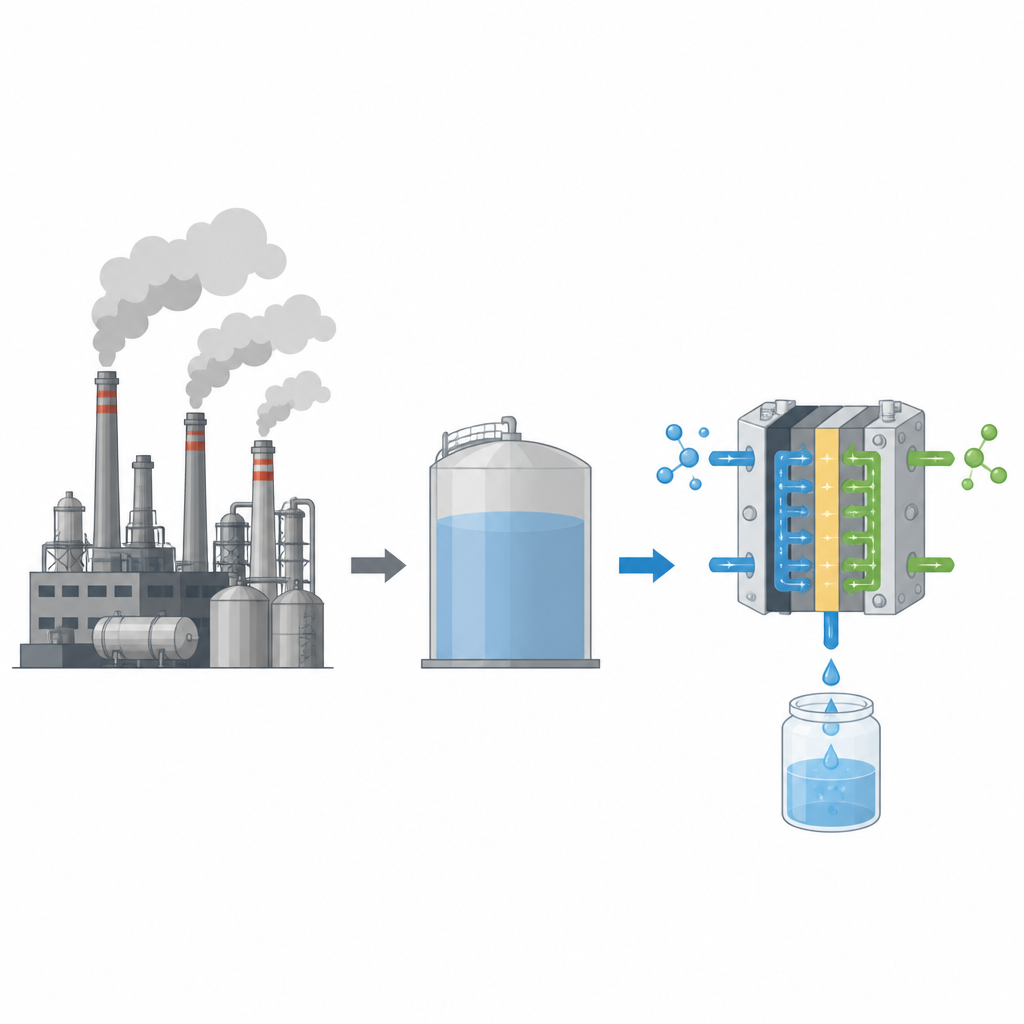
Hydrogen peroxide quietly supports modern life, from paper bleaching and wastewater cleanup to disinfecting medical tools. Today it is mostly made in huge chemical plants and then shipped around the world, which costs energy and creates safety and pollution concerns. This study explores a new way to make hydrogen peroxide directly from air and water in a compact device, using a smart nickel-based material that can adapt its own structure while it works.
Why we need a new way to make this common chemical
The standard industrial route to hydrogen peroxide relies on an older process that uses petroleum-derived liquids, consumes a lot of energy, and requires careful handling during storage and transport. In contrast, electrochemical production uses electricity to combine oxygen from air with water to form hydrogen peroxide on demand. If powered by renewable energy, such systems could provide clean, local supplies for factories, hospitals, and treatment plants. The main obstacle has been finding a catalytic material that is both efficient and long-lived when driven at the high current levels required in real industrial settings.
A single-atom nickel scaffold that reshapes itself
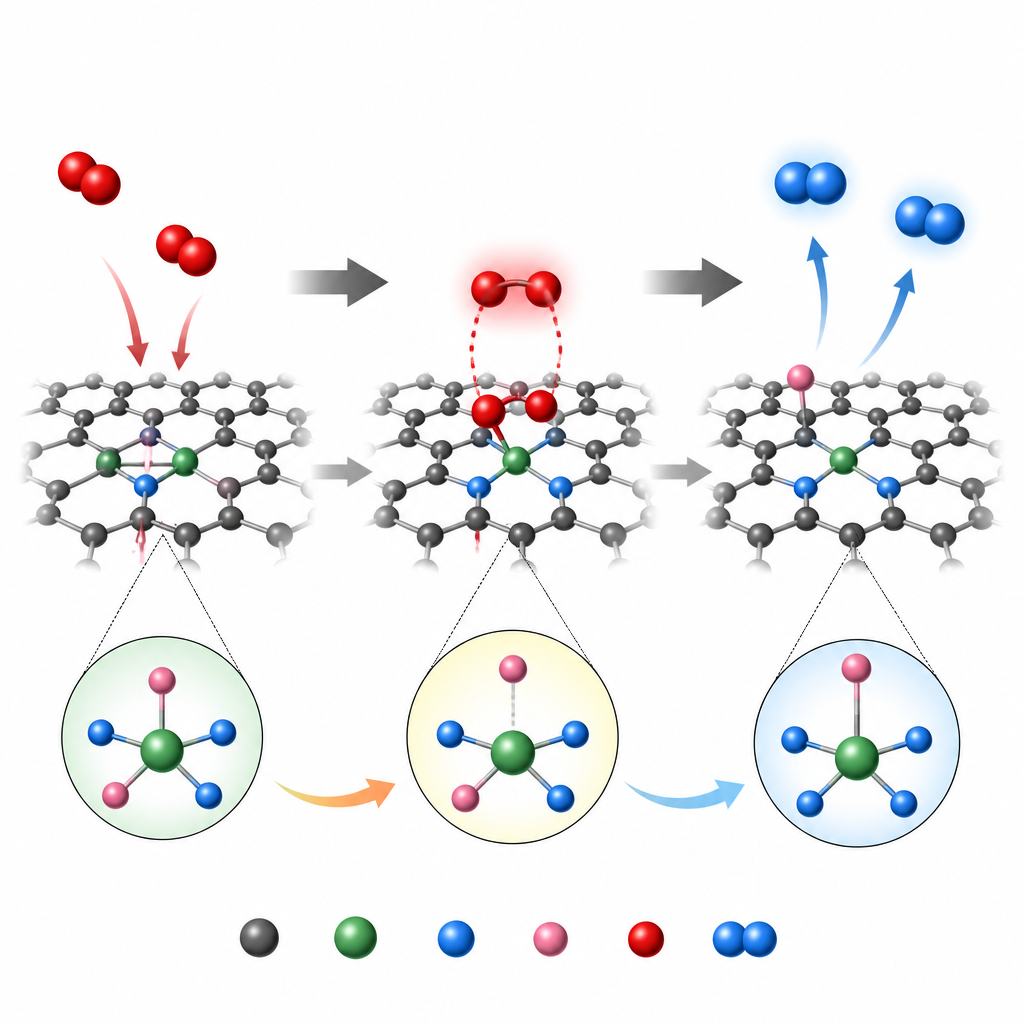
The researchers designed a catalyst in which individual nickel atoms are anchored to a porous carbon surface and surrounded by nitrogen and boron atoms. These carefully arranged surroundings control how each nickel atom interacts with oxygen during the reaction. At rest, the nickel sits in a configuration the team calls NiB2N2, reflecting two nearby boron and two nitrogen neighbors. Under operating voltage, one nickel–boron link gently breaks and the structure shifts into a new pattern, NiB1N2, that binds reaction intermediates more strongly. This shift happens without the nickel atoms clumping together, which is a common failure mode in many single-atom materials.
How the catalyst steers oxygen toward hydrogen peroxide
In electrochemical cells, oxygen can follow several reaction paths, including one that turns it fully into water and another that stops halfway at hydrogen peroxide. The new nickel sites are tuned to favor the two-electron route that ends at hydrogen peroxide, and to hold an important intermediate species just tightly enough to let the reaction proceed efficiently. Advanced X-ray and Raman measurements taken while the device was running show that the nickel atoms keep nearly the same charge state, even as the lengths of their bonds to boron and nitrogen subtly expand or contract. Computer simulations reveal that this bond flexing redistributes electrons around the nickel center, acting like a built-in buffer that stabilizes the desired pathway.
Turning air and water into concentrated peroxide
To test real-world performance, the team built a solid-electrolyte cell in which oxygen flows past the nickel catalyst on one side, while water and ions move through special membranes in the middle. This layout allows hydrogen peroxide to form and collect as a nearly pure liquid, instead of being mixed into a large volume of supporting salt solution. Using their structure-adaptive nickel material, the researchers reached production rates far above those of comparable catalysts, and maintained high efficiency over a wide range of operating conditions. At current levels similar to those used in industry, the device generated about 5 percent hydrogen peroxide solution continuously for more than 300 hours with little loss in output.
What this means for future green chemistry
In simple terms, this work shows that it is possible to build a catalyst that can “self-tune” its atomic arrangement under working conditions, holding its performance steady instead of slowly degrading. By pairing this shape-shifting nickel material with a carefully engineered cell design, the researchers demonstrate a path toward compact units that can make clean hydrogen peroxide directly where it is needed. If scaled up, such systems could reduce reliance on large centralized plants and cut the environmental footprint of a chemical that underpins many everyday products and water treatment technologies.
Citation: Wang, Z., Jia, H., Xie, A. et al. Structure-adaptive single-atom nickel catalysts for pure hydrogen peroxide electrosynthesis at industrial current density. Nat Commun 17, 4431 (2026). https://doi.org/10.1038/s41467-026-71120-9
Keywords: hydrogen peroxide, electrocatalysis, nickel catalyst, single-atom catalyst, green chemistry