Clear Sky Science · en
Metal-dependent and metal-free mechanisms of peptide condensate catalysts
Tiny droplets that act like simple enzymes
Chemists are searching for cleaner, smarter ways to speed up reactions in water, without relying on bulky enzymes or harsh conditions. This study shows that very short peptides, when they gather into tiny liquid droplets, can act as miniature reaction vessels that help break apart ester bonds, a common type of chemical link found in many materials and pollutants. Remarkably, the same droplets can use either metal ions or only their own built-in chemistry to get the job done.
Building liquid droplets from short peptides
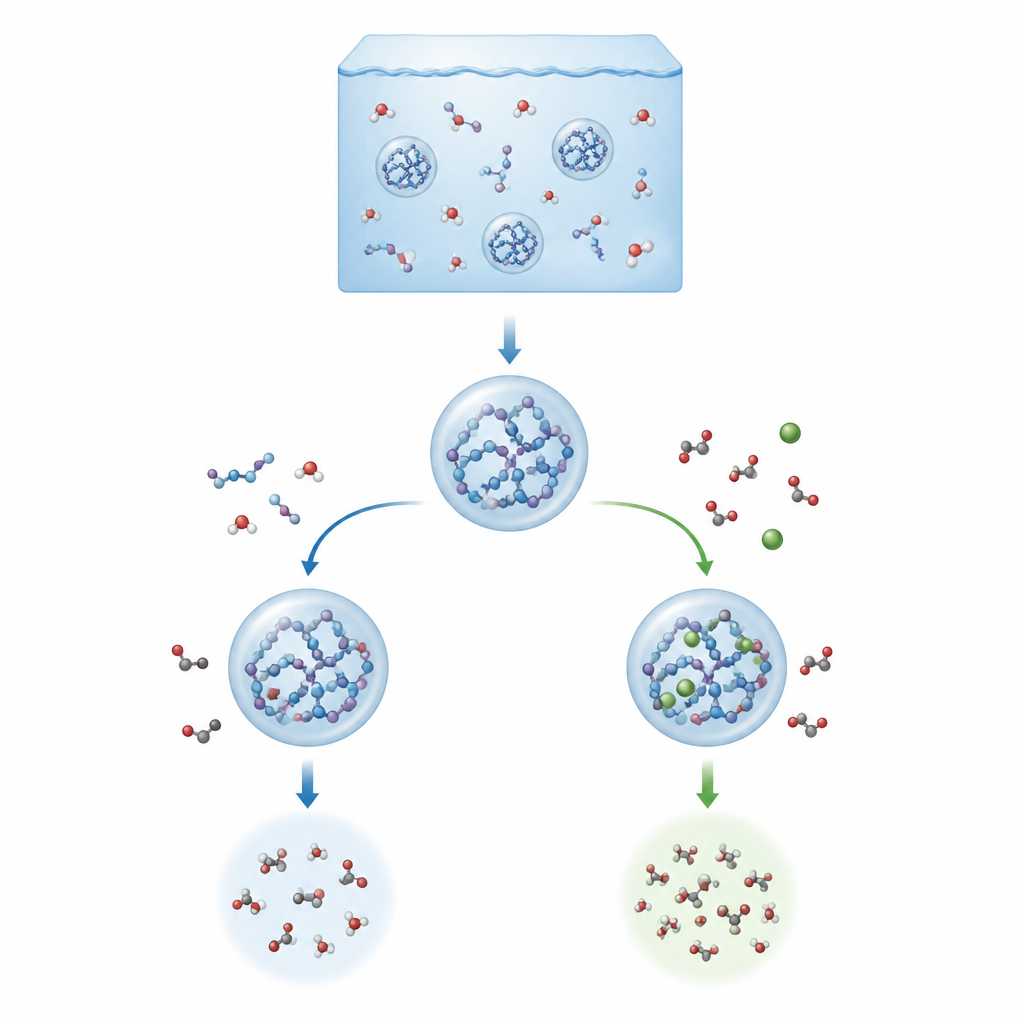
The researchers designed minimal peptides made from just a few amino acids, including histidine, which often plays a starring role in natural enzymes. When positively and negatively charged versions of these peptides are mixed in water, they can separate into two phases, forming dense liquid droplets suspended in a more dilute solution. These “condensates” resemble membraneless compartments inside cells and create concentrated pockets of reactants. The team chose an ester compound that releases a fluorescent product when cut, allowing them to track how quickly the reaction proceeds inside and outside the droplets.
When metal ions help and when they hinder
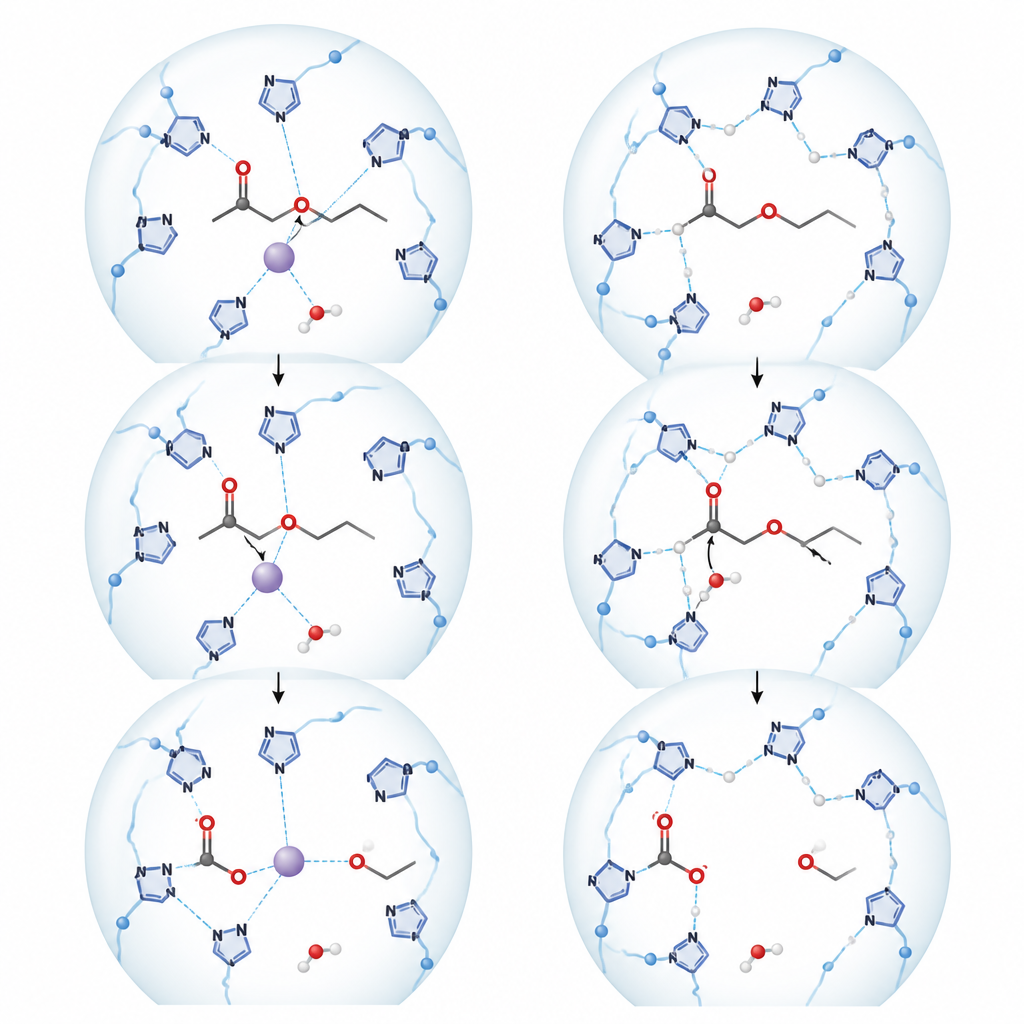
In one mode, zinc ions join the peptides inside the droplets and help organize a tiny reaction center. Zinc tethers several histidine side chains and activates a nearby water molecule, turning it into a powerful attacker of the ester bond. Experiments showed that zinc not only triggers droplet formation but also tunes their internal properties, such as how basic (alkaline) the droplets are and how easily molecules can move inside them. At low zinc levels, droplets remain fluid and strongly basic, conditions that favor fast hydrolysis. As zinc concentration rises, however, the network becomes more tightly crosslinked, diffusion slows, the interior becomes less basic, and the catalytic rate actually drops, even though more zinc is present.
Catalysis without metals inside soft droplets
The team then explored what happens when no zinc is added. Under these conditions, different peptide combinations still form liquid droplets, now driven mainly by the way tyrosine, arginine, and histidine residues attract one another. These zinc-free condensates turned out to be even better catalysts. The more histidine the droplets contained, the faster they broke down the ester. Computer simulations and detailed quantum calculations indicated that pairs of histidine side chains can cooperate through especially strong hydrogen bonds. These bonds stabilize reactive hydroxide ions formed from water, lowering the energy barrier for the ester to be attacked and cleaved.
How droplet structure shapes reaction speed
Beyond the chemistry at the reaction site, the physical nature of the droplets also matters. Measurements revealed that the droplets are basic inside, which already favors ester hydrolysis. They also concentrate the water-insoluble product, increasing its signal and preventing crystals that would otherwise form in solution and interfere with the reaction. Tests showed that isolated peptides, which form only small nanostructures or stay dissolved, are less effective than full droplets at boosting reaction rates, underscoring how phase separation, mobility, and partitioning work together to control catalysis.
Why these findings matter
The study demonstrates that simple peptide droplets can act as adaptable catalytic materials, switching between metal-dependent and purely organic mechanisms. To a non-specialist, this means that chemists can now design soft, liquid-like microreactors that choose different “tricks” to activate water and cut chemical bonds, depending on whether metals are present. Such systems could inspire greener catalysts for breaking down esters in industrial processes, cleaning up pollutants, or releasing useful molecules in a controlled way, all by tuning the sequence of tiny peptides and the conditions under which they condense.
Citation: Massarano, T., Yang, Y., Baruch Leshem, A. et al. Metal-dependent and metal-free mechanisms of peptide condensate catalysts. Nat Commun 17, 4548 (2026). https://doi.org/10.1038/s41467-026-71117-4
Keywords: biomolecular condensates, peptide catalysts, liquid liquid phase separation, ester hydrolysis, histidine networks