Clear Sky Science · en
Spontaneous crack healing in calcite reveals the influence of dynamic strain evolution and surface chemistry
Why tiny cracks in rock matter
Deep underground, our energy resources often move through tiny fractures in rock. Whether a geothermal reservoir keeps flowing, or an oil or gas field slowly clogs, depends on how these cracks open and close over time. This study looks at a common rock mineral, calcite, and shows that its cracks can partially heal themselves at room temperature, guided by internal stresses and a thin film of water. Understanding this quiet repair process helps us predict how underground reservoirs and fault zones evolve.
Watching a crack close by itself
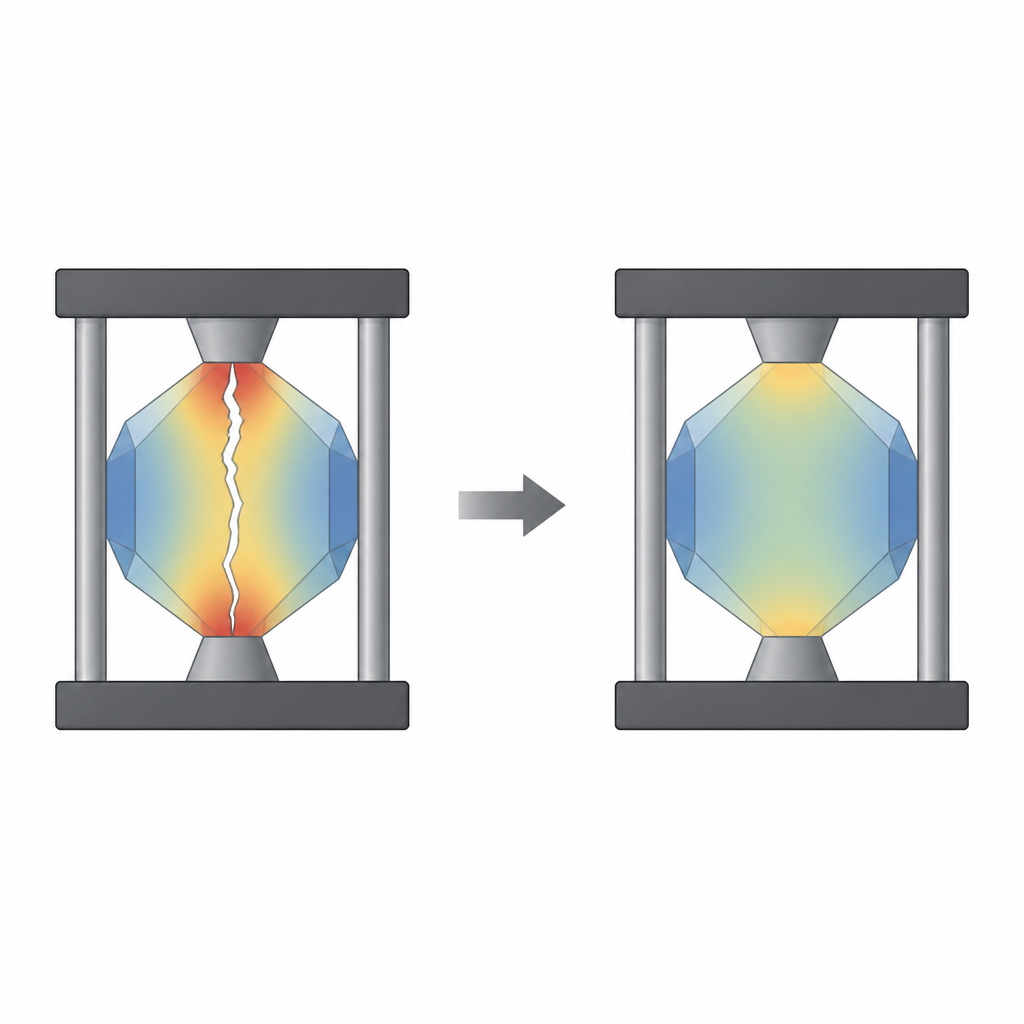
The researchers began with a thin, clear slice of calcite, the mineral that makes up limestone and marble. Using a special loading device, they opened a controlled crack along one of calcite’s natural weak planes, similar to splitting a tile. After growing the crack under steady force, they then reduced the load and watched what happened over the next 44 hours. Remarkably, the visible tip of the crack pulled back and the once open line became almost indistinguishable from the surrounding crystal, a sign of spontaneous, partial healing without added heat, pressure, or liquid water.
Probing hidden stresses inside the crystal
To see what was happening inside the crystal during this healing, the team used a powerful X-ray beam at a synchrotron facility. By scanning the beam across the region where the crack tip had been and recording how the crystal diffracted the X-rays, they built maps of tiny distortions inside the mineral. Over time, they saw compressive strain building up across the former crack plane and tensile strain along the crystal thickness. These patterns indicate that internal stresses were rearranging themselves in a way that squeezed the fracture shut, even after the external load was removed.
Microscopic movement and a hidden water film
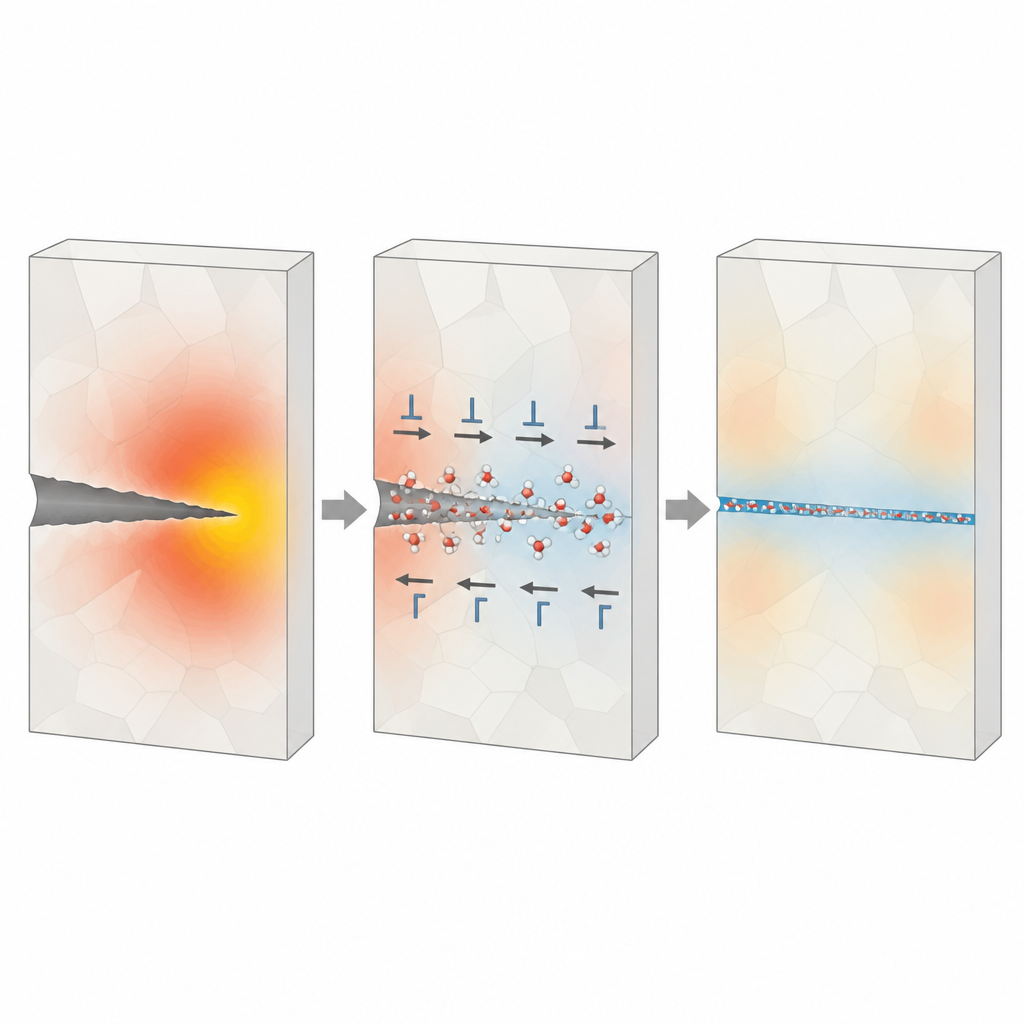
Crack healing is not just about elastic bending; it also involves permanent changes in the crystal. The X-ray data showed subtle widening of diffraction peaks near the crack, a fingerprint of dislocations and other defects that mark local plastic deformation. As the hours passed, these broadened regions shrank and concentrated near the crack plane, suggesting that defects were moving toward the fracture and being absorbed there. Later, infrared imaging of the same area revealed a narrow band rich in water along the healed interface, extending a few micrometers into the crystal. No water was added during the test, so this film likely comes from ambient humidity that became strongly bound at and near the damaged zone.
Stress, water, and rock healing underground
Taken together, the evolving stress maps, the shifting defect signatures, and the trapped water band point to a coupled mechanical and chemical healing process. Residual stresses drive dislocations toward the crack, helping the faces press back into contact, while water anchored at the interface modifies the surface and may assist bonding. The healed region does not fully recover its original strength, but it becomes tighter and less permeable than an open fracture. For subsurface rocks made of calcite, this means that fractures can slowly close and stiffen even under mild conditions, reducing fluid pathways and changing how faults and reservoirs behave over time.
Citation: Devoe, M., P. Lisabeth, H., Nakagawa, S. et al. Spontaneous crack healing in calcite reveals the influence of dynamic strain evolution and surface chemistry. Nat Commun 17, 4703 (2026). https://doi.org/10.1038/s41467-026-71110-x
Keywords: calcite, crack healing, geothermal reservoirs, residual stress, rock fractures