Clear Sky Science · en
Single-cell phenotypic heterogeneity shapes quorum signaling dynamics in Pseudomonas aeruginosa
How Bacteria Coordinate as a Community
Many bacteria act less like isolated microbes and more like a bustling town hall, coordinating when to release toxins, build protective films, or conserve resources. This study looks at how the human pathogen Pseudomonas aeruginosa uses chemical “conversations” to make group decisions, and why not every cell speaks or listens in quite the same way. Understanding this hidden diversity could reshape how we think about infections, antibiotic tolerance, and microbial cooperation.
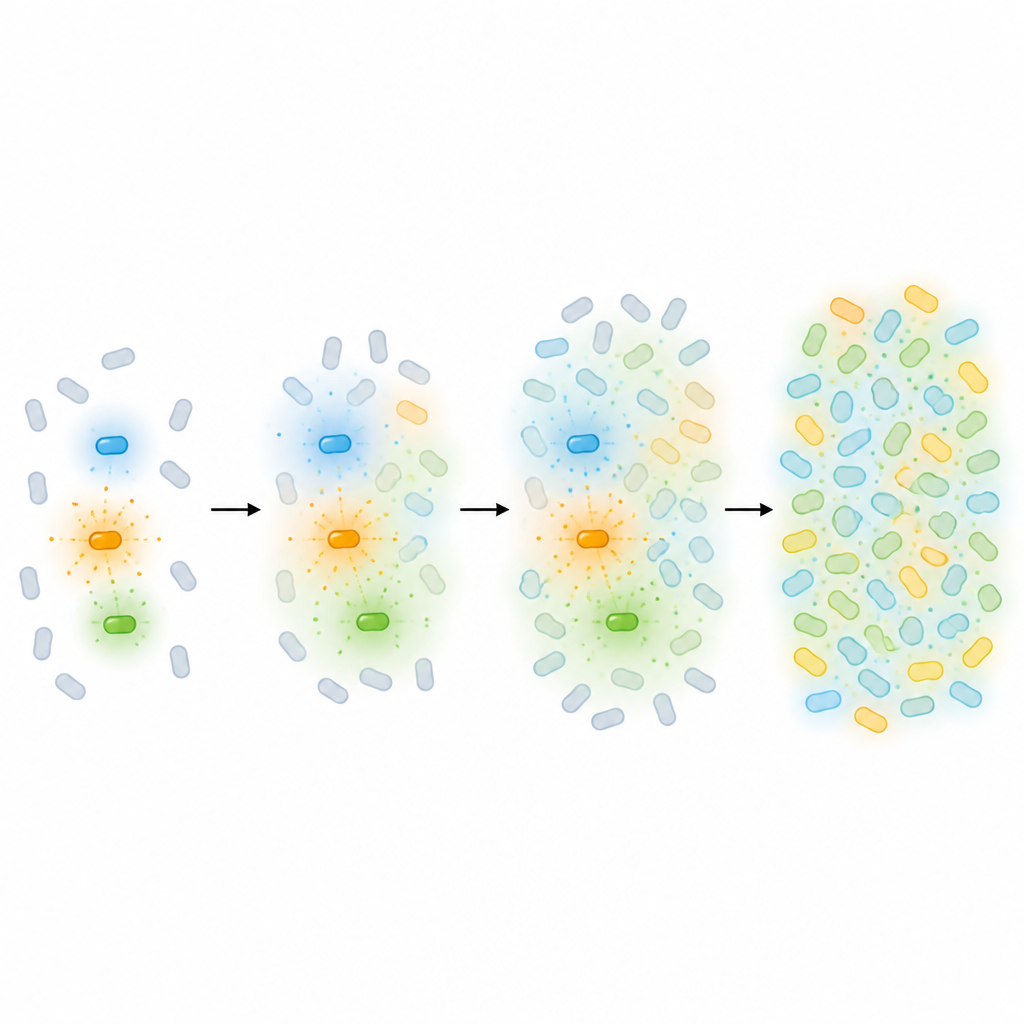
Talking in Crowds with Chemical Signals
Pseudomonas aeruginosa relies on a process called quorum sensing, in which cells release and detect small molecules that reflect how crowded the population is. When enough signal builds up, the group can collectively switch on costly activities, such as secreting enzymes and pigments that damage host tissues or scavenge scarce nutrients. Classic textbook descriptions treat this switch as near-uniform: once a threshold is reached, everyone turns on together. Yet previous hints suggested reality is messier, with some cells contributing more than others. The authors set out to map this uneven participation across many genes at once and to ask whether it arises purely from random noise or from active division of roles.
Watching Individual Cells in High Detail
To do this, the researchers used a powerful imaging method that measures RNA molecules within thousands of individual bacteria over time. They followed cells as they grew from low to high density in lab medium, tagging 144 genes involved in signal production, signal detection, metabolism, stress, and virulence. This let them see when key signaling systems turned on and how strongly each cell joined in. The average behavior matched earlier bulk studies: one signal system (Las) activated first, others (PQS and Rhl) followed, and major secreted products appeared only at high density. Crucially, the single-cell data revealed how many cells were actually expressing each gene and how widely their contributions varied.
Unequal Sharing of Cooperative Work
At first glance, cooperation seemed widespread: at high density, the vast majority of cells expressed at least one gene for shared products such as enzymes and toxins. But when the team ranked cells by expression level, a striking pattern emerged. For several public goods, a small minority of “overachiever” cells produced far more than their fair share, often making many different secreted factors at once. These hyper-cooperating cells did not show a broad slowdown in other activities, suggesting they were not obviously sicker or weaker. Meanwhile, most other cells contributed modestly, benefiting from the shared pool of products without bearing the same production load. Statistical analysis indicated that this skewed sharing for downstream products can be explained largely by the natural randomness of gene activity, rather than by a dedicated regulatory program.
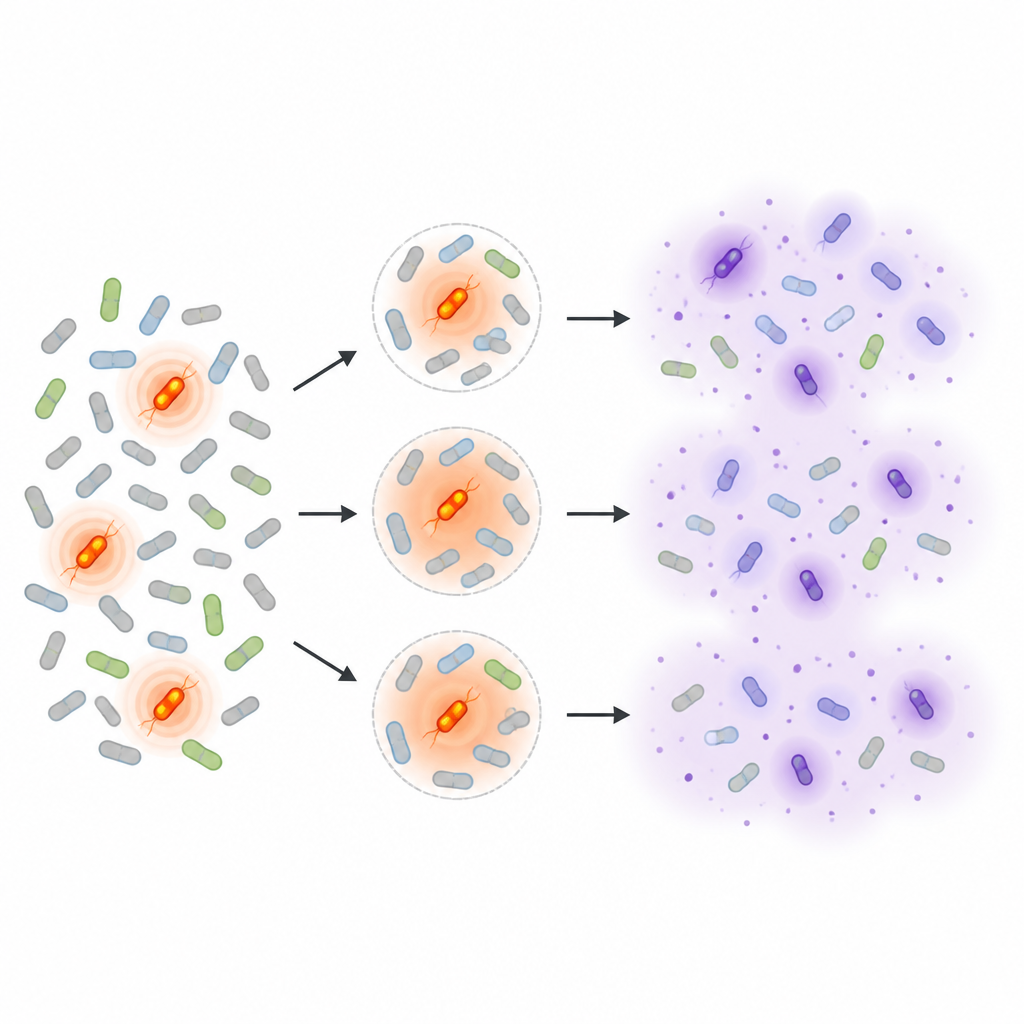
Specialist Signal Senders in the Crowd
The story was different for the genes that make the signals themselves. The main signal makers in the Las and PQS systems showed extreme cell-to-cell variability, higher even than classic examples of bacterial subgroups specialized for movement or acute virulence. These peaks in variability appeared exactly when each system first turned on, then faded as the population fully activated. This suggests that early in the process, only a small set of cells act as strong signal senders, kickstarting the chemical buildup that eventually recruits the rest of the population. In contrast, signal receptor genes and many target genes were much more uniform, implying that once signals spread, most cells are ready to respond similarly. The authors also observed similar signal-maker subpopulations in several different lab and clinical strains, despite their differing outputs, hinting that this division of labor is evolutionarily conserved.
Memory, Environment, and Internal Control
The team then asked whether this pattern depends on what cells “remember” from previous growth cycles or on how much signal is already present. By starting cultures from either relatively fresh or heavily diluted precultures, they weakened any leftover proteins or signals that might prime cells. This changed the timing of when quorum sensing switched on for the group but did not eliminate the appearance of hyper-signaling minorities. Adding extra signal molecules from outside moved the overall timing as well but again left the variability among signal makers largely intact. These results point to an internal genetic mechanism that deliberately allows some cells to overshoot in signal production, while others stay more cautious.
What This Means for Bacterial Cooperation
Together, the findings paint a picture in which Pseudomonas aeruginosa manages the costs of group behavior through layered strategies. Early on, a purposeful minority of signal specialists takes the risk of producing large amounts of chemical messengers, ensuring that the group can commit to collective action when conditions warrant it. Later, once the signal threshold is passed, most cells help produce public goods, but the unavoidable noise in gene activity leaves a smaller number shouldering a heavier load. For a lay observer, the key conclusion is that even in a “simple” bacterial infection, not all cells are equal: hidden subgroups quietly shape when and how the whole community acts.
Citation: Lange, D.G., Litvinov, V. & Dar, D. Single-cell phenotypic heterogeneity shapes quorum signaling dynamics in Pseudomonas aeruginosa. Nat Commun 17, 4635 (2026). https://doi.org/10.1038/s41467-026-71109-4
Keywords: quorum sensing, Pseudomonas aeruginosa, bacterial cooperation, single-cell analysis, phenotypic heterogeneity