Clear Sky Science · en
In-situ growth of biomimetic ion-selective membranes via confined molecular encapsulation for superior fluoride/chloride separation
Why cleaner ion filters matter
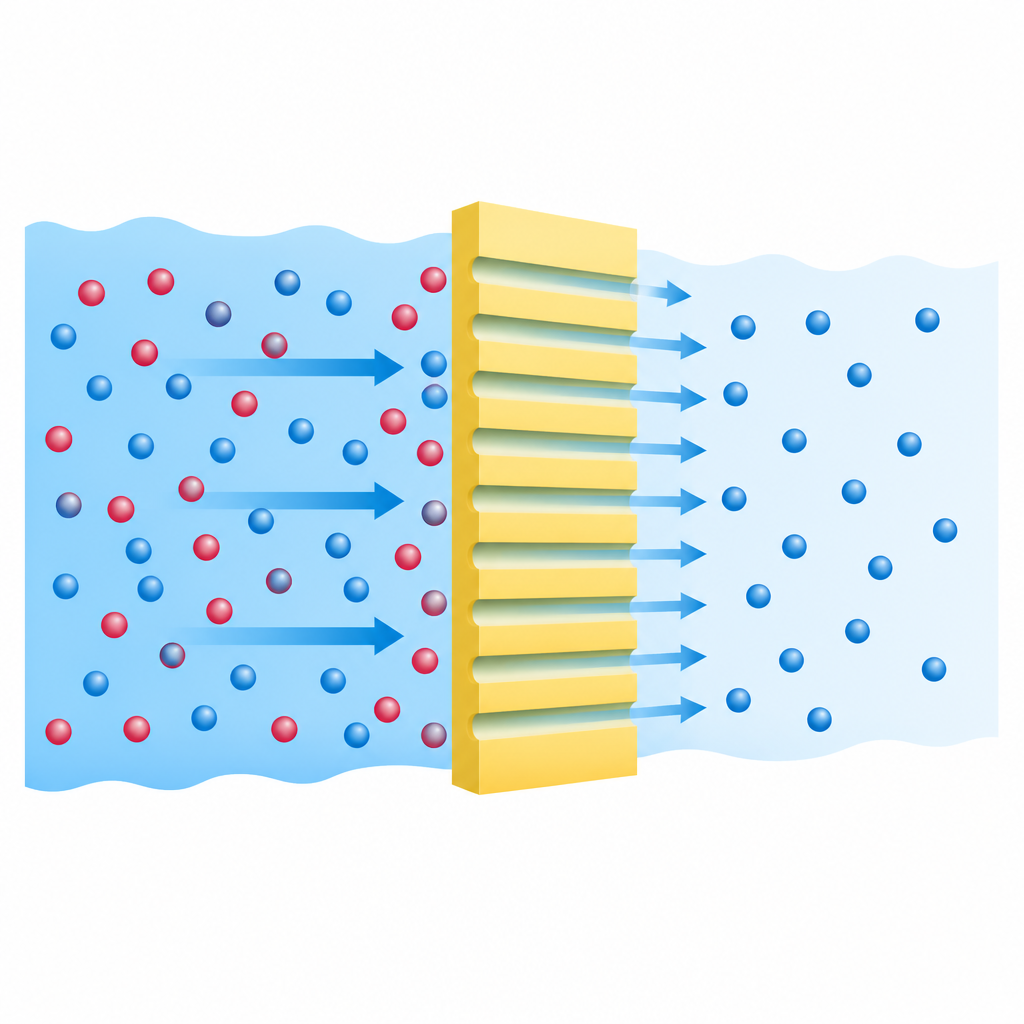
Many communities around the world rely on groundwater that contains too much fluoride. While a little fluoride can help protect teeth, high levels can damage bones and disrupt key chemical reactions in our cells. Unfortunately, fluoride and chloride, another common ion in water, are almost twins in size and charge, so most filters cannot tell them apart. This study reports a new way to build ultra-thin, bioinspired membranes that can strongly prefer fluoride over chloride, pointing toward smarter and more efficient water treatment systems.
Learning from nature’s tiny gates
In living cells, special protein channels act like bouncers at the door, letting some ions pass while keeping others out. Natural fluoride channels are especially skilled at this job, thanks to very narrow passages and carefully arranged chemical groups that grab fluoride more tightly than other ions. The authors aim to imitate these natural channels using solid materials that can be made over large areas. They focus on metal–organic frameworks, a class of porous crystals with angstrom-scale pores that can be tuned chemically, and on mixed matrix membranes, where such crystals are dispersed in a flexible polymer film. The challenge is to place these crystals evenly inside the polymer so that they form continuous, well-behaved ion pathways instead of clumps and defects.
Turning crystal building blocks into soft networks
Standard approaches simply stir pre-made crystals into a polymer solution, but this often leads to poor mixing and broken pathways. The team instead starts from dissolved building blocks of the framework and grows the porous material directly inside the forming membrane. A key twist is that they steer the growth so that the framework first forms a soft, gel-like network, called a metal–organic gel, rather than separate hard particles. This gel weaves through the polymer and interacts strongly with it, slowing down the motion of the building blocks and spreading them more evenly. Simulations and optical measurements show that, compared with normal precursors, the gel precursors diffuse more slowly, bind more tightly to the polymer, and remain more uniformly distributed before they crystallize.
Building ordered channels inside a plastic sheet
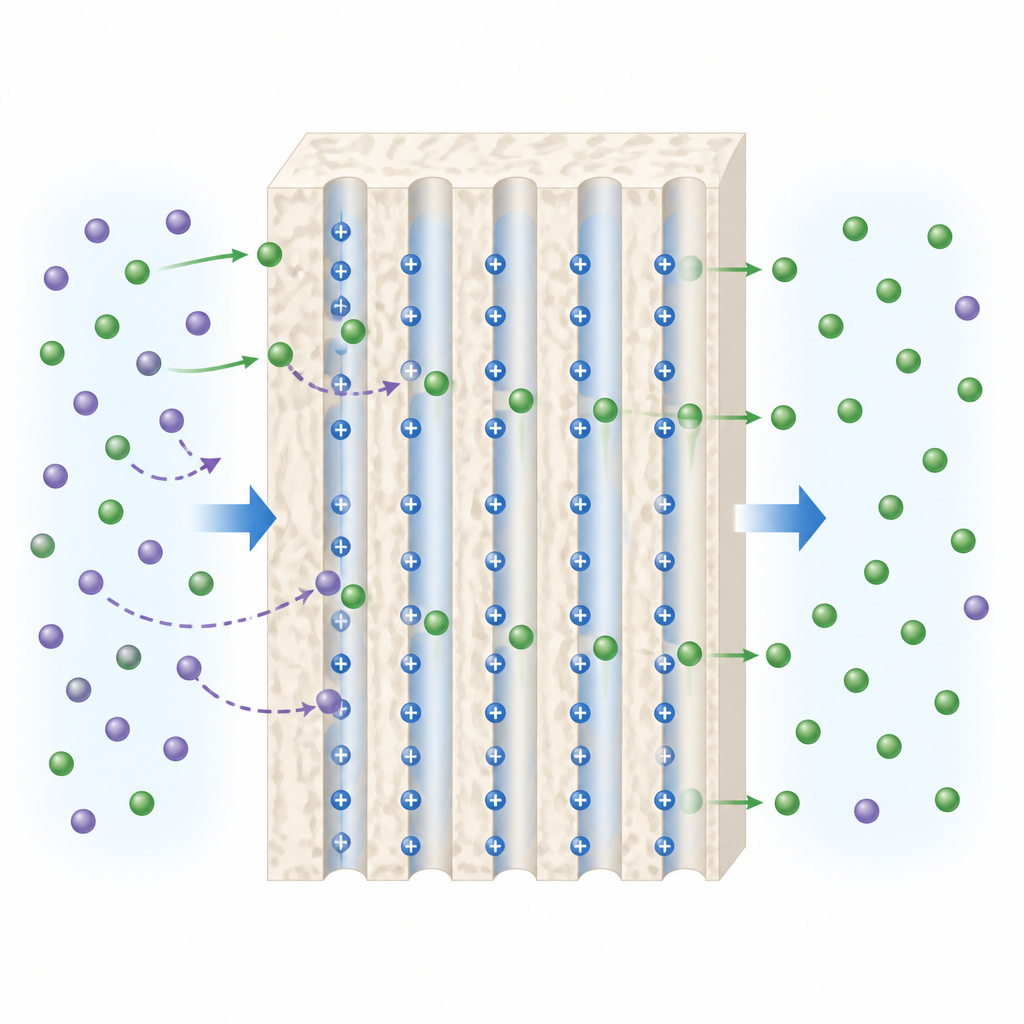
By carefully heating the mixture of polymer and gel precursors, the researchers synchronize two processes: the solidification of the plastic film and the transformation of the gel into ordered crystals. Because the gel already forms a connected network, it acts as a template that guides the crystals into an aligned array of nanochannels running across the membrane. Microscopy images reveal that, under the right loading conditions, the framework particles are evenly spread from top to bottom of the film, without large clumps. The team can also tune the size of the crystals, from about 200 to 1600 nanometers, simply by adjusting how much precursor they add, all while preserving the narrow pores required for ion selectivity.
Guiding ions with shape and charge
To test ion transport, the authors place the membranes between two salt solutions and measure how electric current responds to applied voltage. Membranes made from the gel-based route show a strong preference for fluoride over chloride, with a separation ratio of 32, while those made with conventional precursors show almost no preference. The gel-based membranes also act like ion diodes: current flows more easily in one direction than the other, a sign that the internal channels are both narrow and asymmetric in their charge distribution. Computer simulations confirm that the aligned, positively charged framework pores push positively charged ions away and attract negatively charged ones, and that fluoride interacts more strongly with specific sites inside the pores, leading to an enriched flow of fluoride through the membrane.
What this means for safer water
In simple terms, the researchers have found a way to grow a sponge-like mineral inside a plastic sheet so that it forms neat rows of ultra-narrow tunnels, rather than random clumps. These tiny tunnels grab fluoride more strongly than chloride and guide ions in a preferred direction, allowing the membrane to separate two nearly identical species that most filters treat the same. While more work is needed before such membranes appear in real-world water plants, the approach shows how copying nature’s ion channels with smart chemistry could help deliver safer drinking water and more precise control over ions in future nanofluidic devices.
Citation: Chen, Q., Liu, ML., Jiang, S. et al. In-situ growth of biomimetic ion-selective membranes via confined molecular encapsulation for superior fluoride/chloride separation. Nat Commun 17, 4540 (2026). https://doi.org/10.1038/s41467-026-71107-6
Keywords: fluoride removal, ion-selective membranes, metal-organic frameworks, water purification, nanofluidics