Clear Sky Science · en
Microporous MOF for simultaneous high thermodynamic and kinetic synergistic separation of propylene and propane
Why cleaner plastic production matters
Propylene is a building block for many everyday plastics, from food packaging to car parts. Making high purity propylene usually requires energy-hungry cooling and distillation steps in large industrial towers. This study explores a new sponge-like material that can sort propylene from its close chemical cousin propane in a far more efficient way, potentially cutting energy use and emissions in the production of common goods.
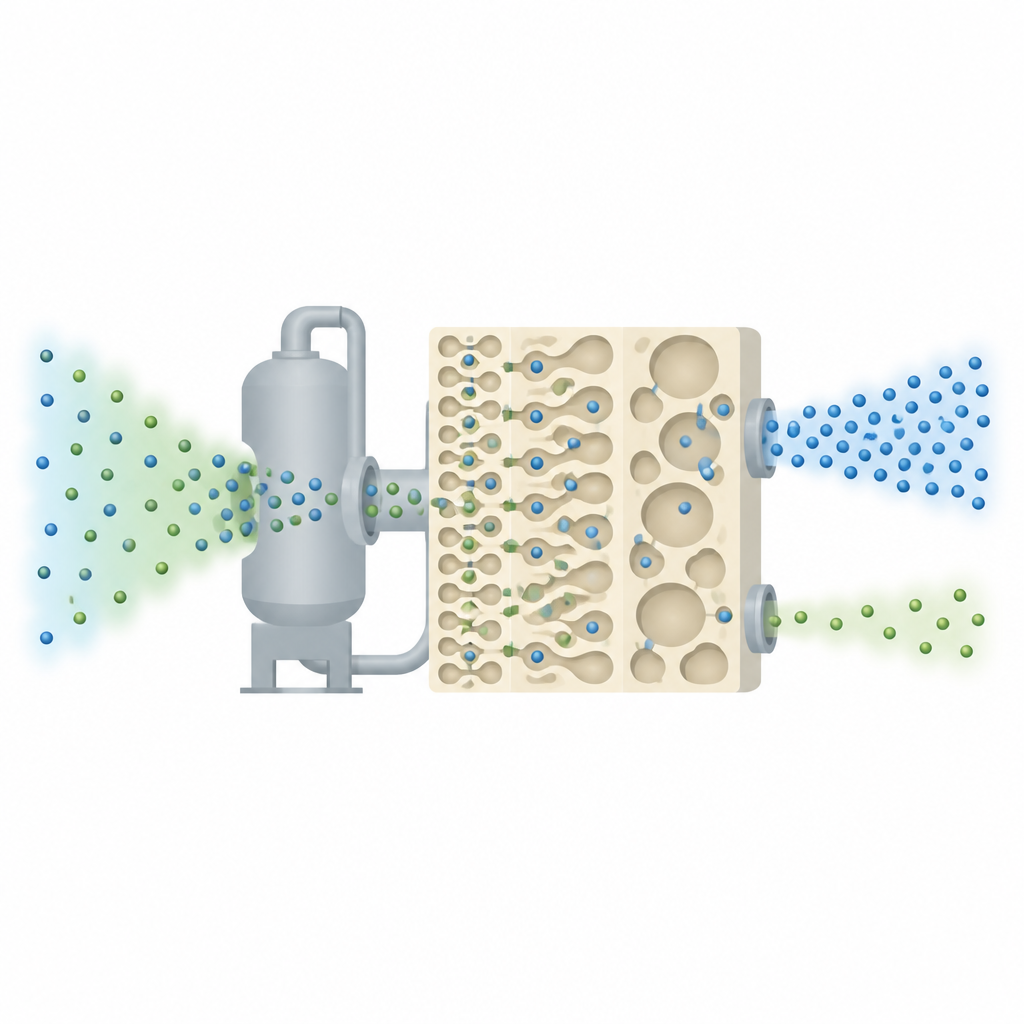
A tiny sieve for a tough sorting job
Propylene and propane are almost the same size and weight, which makes them very hard to separate using standard methods. Today, industry relies on chilling large gas mixtures to low temperatures and distilling them, a process that consumes vast amounts of energy. Scientists have been searching for porous solids that act like reusable filters, grabbing one gas while letting another slip by. Many candidates either hold a lot of gas but release it slowly, or separate gases well but work too slowly for real-world use.
Designing a gate, a hallway, and a storage room
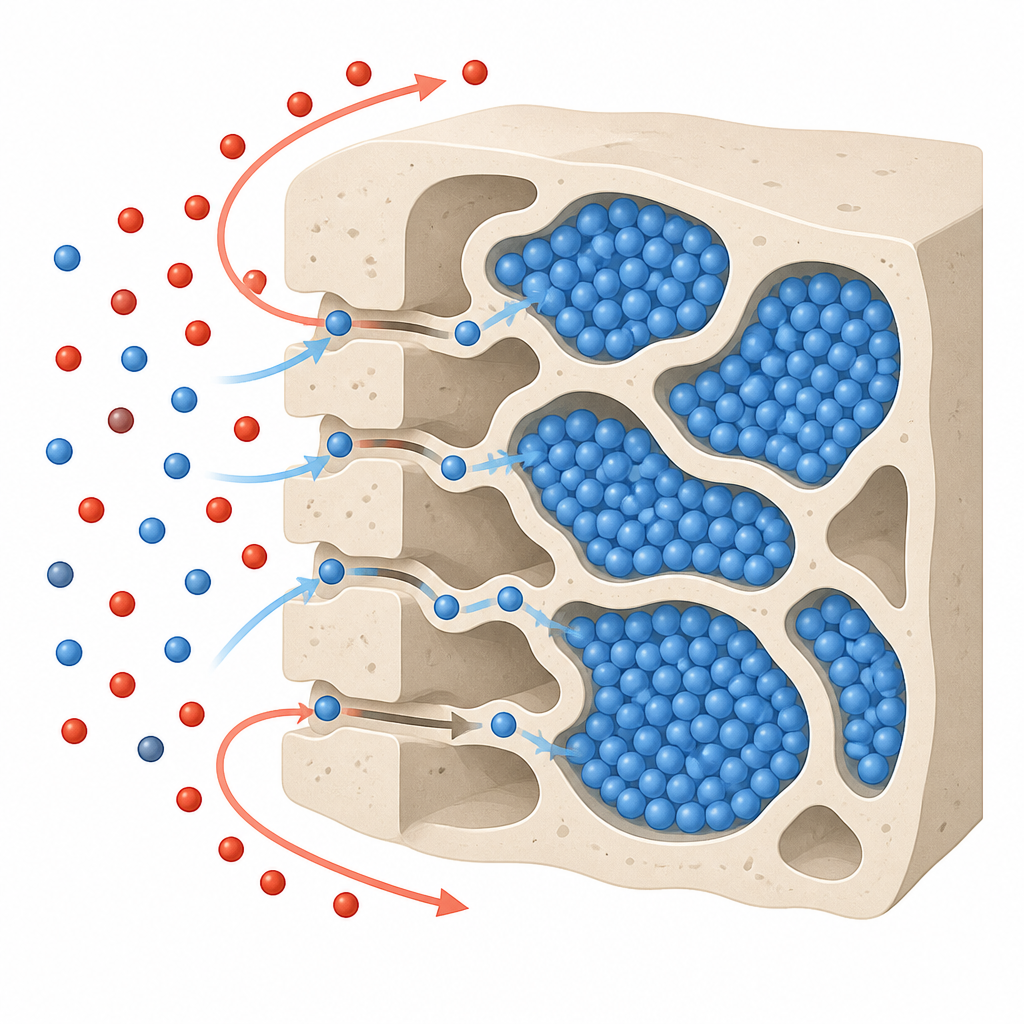
The researchers created a new metal-organic framework, called ZSTU-10, that behaves like a carefully planned building for gas molecules. At the entrance are tiny gates just big enough for propylene but slightly too small for propane. Behind each gate run short channels that let propylene move quickly, leading into larger central cavities where the gas can pack tightly. This three-part layout gate, channel, and cavity allows the material to block propane, speed up propylene movement, and store an unusually high amount of propylene in a small volume.
How well the new filter works
Measurements show that ZSTU-10 can hold nearly as much propylene per unit volume as liquid propylene, even though the gas is stored at room temperature and moderate pressure. At the same time, propane is almost completely kept out. Propylene moves through the material far faster than in most other sieving materials, meaning that gas flows do not get stuck inside. The balance between strong enough binding to hold propylene and weak enough binding to release it later suggests that the material can be reused many times without huge energy costs.
Putting the material to the test
To mimic real industrial conditions, the team sent mixtures of propylene and propane through a packed column filled with ZSTU-10. Propane emerged first, while propylene was held back and then released as a high purity stream, above 99 percent. The amount of propylene captured in each cycle was higher than in several leading rival materials. Importantly, the framework stayed stable in air, water, acids, bases, and common organic liquids, and it kept its performance over repeated capture and release cycles, suggesting it could stand up to demanding plant environments.
What this means for future gas separations
This work shows that carefully shaping pores at the scale of individual molecules can overcome long-standing trade-offs between how much gas a material can hold and how quickly it can move that gas. By combining a size-selective gate, fast channels, and roomy cavities in one solid, ZSTU-10 offers an efficient way to separate propylene from propane at near room temperature. If scaled up, such materials could help chemical plants cut the energy and cost of making the key ingredients for plastics, while providing a general design strategy for tackling other difficult gas separation challenges.
Citation: Wang, X., Bao, L., Li, JH. et al. Microporous MOF for simultaneous high thermodynamic and kinetic synergistic separation of propylene and propane. Nat Commun 17, 4349 (2026). https://doi.org/10.1038/s41467-026-71104-9
Keywords: propylene separation, propane, metal-organic framework, gas purification, molecular sieving