Clear Sky Science · en
RanBP2-dependent annulate lamellae drive nuclear pore assembly and nuclear expansion
Hidden helpers inside our cells
Every cell in our body must constantly move messages and materials in and out of its nucleus, the compartment that holds our DNA. This traffic passes through tiny gateways called nuclear pores. The new study reveals that cells keep a backup stock of partially built pores in the surrounding membrane network and use them to rapidly expand and power up the nucleus, especially just after a cell divides.
Membrane stacks that store nuclear gateways
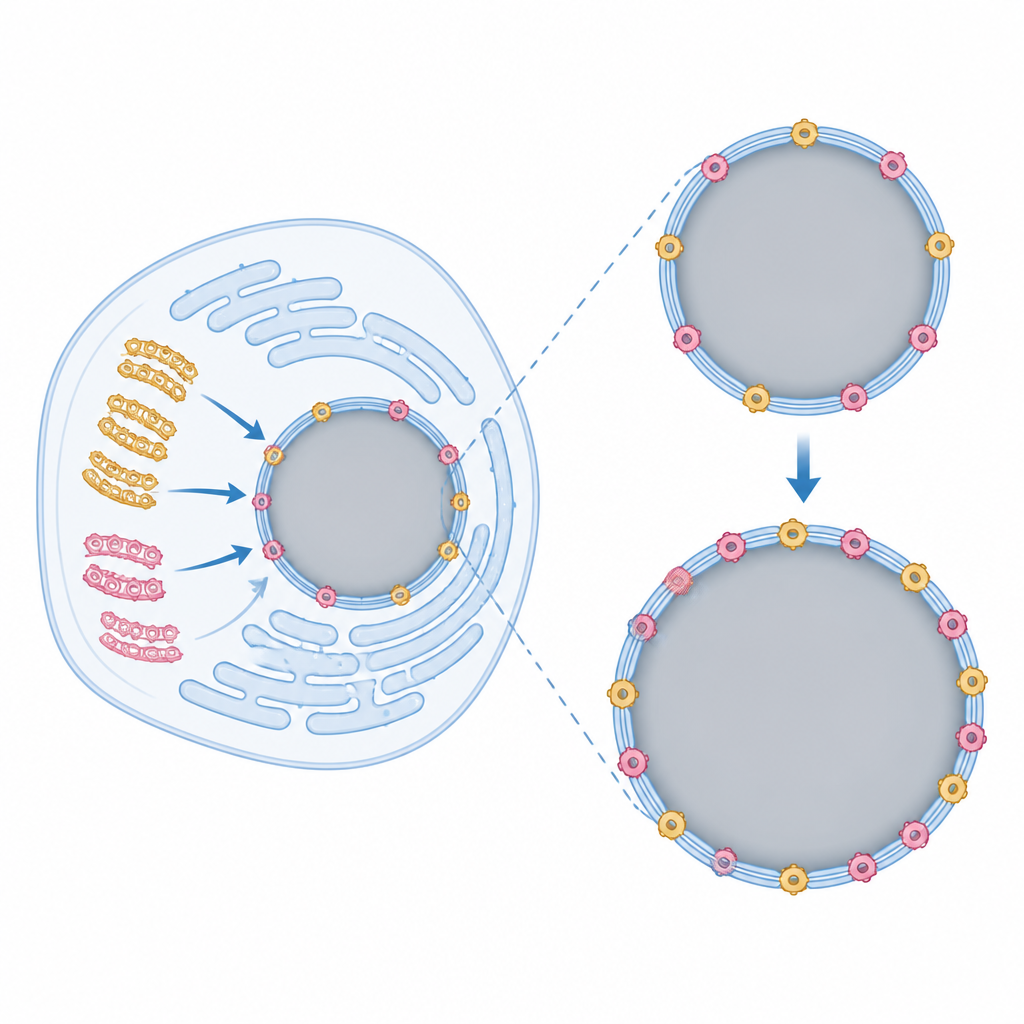
For decades, biologists have seen mysterious membrane stacks in the cell’s interior, called annulate lamellae, but their purpose was unclear. These stacks sit within the endoplasmic reticulum, a sprawling membrane system connected to the nuclear surface. Using advanced imaging, the authors show that these stacks are packed with pore-like structures that closely resemble nuclear pores. Contrary to the old view that such stacks mainly appear in embryos or cancer cells, the work finds them in many ordinary human cell types, from common lab cell lines to non-transformed fibroblasts and even lab-grown neurons. Under normal conditions these stacks are small and scattered, but under stress or in disease models they grow and clump together.
How stored pores feed the growing nucleus
After a cell divides, its new nucleus must enlarge and rebuild thousands of nuclear pores. The researchers tracked the behavior of annulate lamellae in living cells and found that small stacks move along the endoplasmic reticulum toward the nuclear surface. There, they repeatedly touch and finally fuse with the nuclear envelope. Each fusion event delivers several pre-assembled pore units. Although at a single moment the number of stored pores looks modest, the team calculated that during the first phase after division these events cumulatively supply roughly one third of all nuclear pores in a typical human cell, a major contribution to both nuclear pore number and nuclear size.
A scaffolding protein that builds and groups pore units
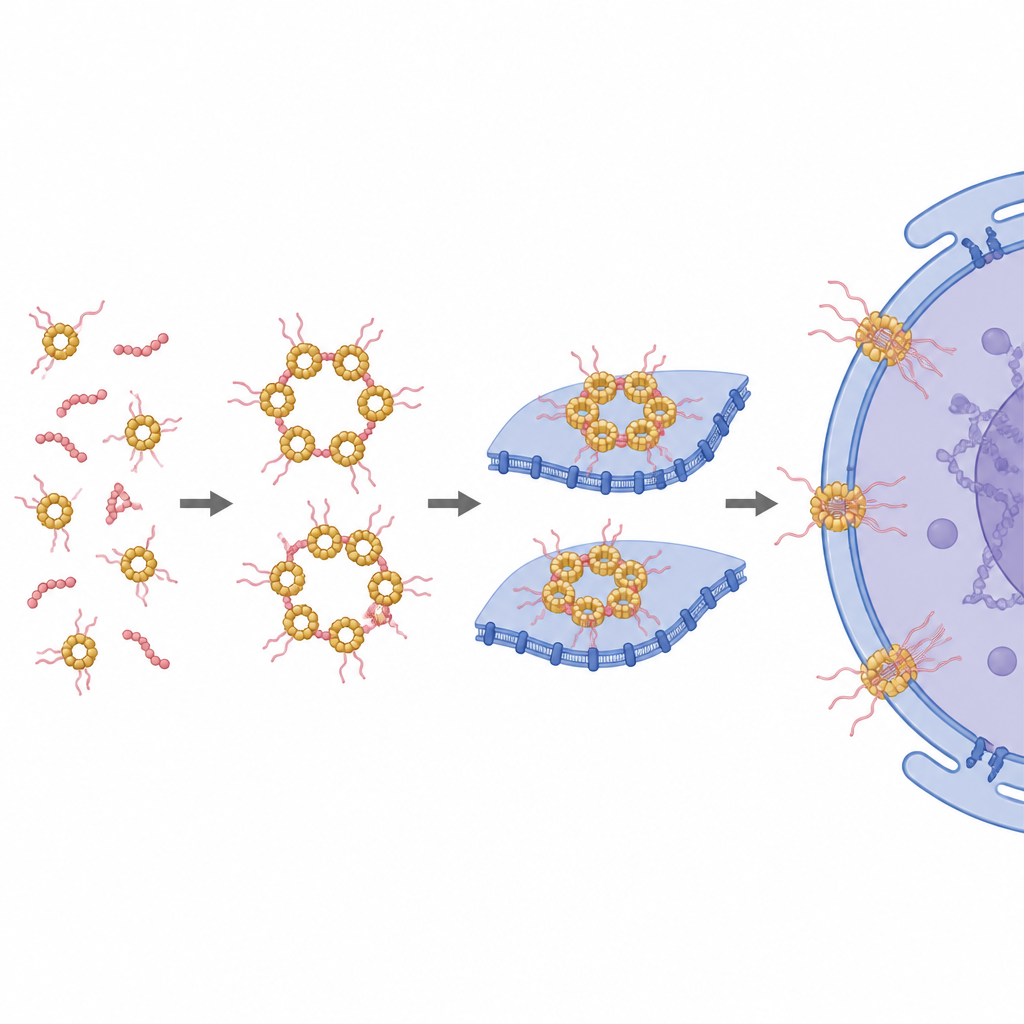
The study identifies a large protein, RanBP2, as a central organizer of these stored pore complexes. RanBP2 normally forms part of the filaments that extend from nuclear pores into the cytoplasm. Here, the authors show it also works away from the nucleus to help assemble pore scaffolds inside the membrane stacks. A flexible stretch of RanBP2 rich in specific small amino acids is crucial: it helps bring together core pore components into ring-like units and then cluster many units into larger stacks. When RanBP2 levels are reduced or the key region is removed, the small stacks in healthy cells shrink or disappear, large clumps fail to form under stress, and fewer pores end up in the nuclear surface. As a result, the nucleus grows less and transport of certain factors between nucleus and cytoplasm becomes less efficient.
Guiding stored pores to the right membrane
RanBP2 is not acting alone. By fishing out RanBP2’s binding partners, the researchers uncovered an important role for Climp63, a membrane protein that shapes flat sheets of the endoplasmic reticulum. RanBP2-rich pore stacks preferentially sit in Climp63-marked regions close to the nucleus. When Climp63 is depleted, these stacks become larger and drift outward into regions that usually contain thin membrane tubes, away from the nuclear surface. Nuclear pores then become scarcer at the envelope, and the nucleus fails to expand properly. This suggests that one set of factors, like RanBP2, builds the pore units, while another, like Climp63, positions them on the right membranes and helps them reach the nuclear boundary.
A third route for making nuclear pores
Previously, scientists had described two main ways that cells build nuclear pores: a rapid burst right after cell division and a slower process during the rest of the cycle. The new work shows that pore delivery from annulate lamellae is a separate, additional route. When the authors dampened this pathway together with either of the known ones, pore numbers fell even further, confirming that all three routes add up rather than replace one another. In simple terms, the cell keeps a mobile warehouse of pre-built pore parts in the surrounding membranes. RanBP2 helps assemble and cluster those parts, Climp63 helps aim them at the nucleus, and together they allow the nucleus to grow and maintain efficient traffic. When this system is disturbed, pore building falters, the nucleus grows poorly, and pore-filled stacks pile up in the cytoplasm, patterns that may be relevant in conditions such as fragile X syndrome, neurodegeneration, and cancer.
Citation: Lin, J., Agote-Aran, A., Liao, Y. et al. RanBP2-dependent annulate lamellae drive nuclear pore assembly and nuclear expansion. Nat Commun 17, 4400 (2026). https://doi.org/10.1038/s41467-026-71101-y
Keywords: nuclear pore complexes, annulate lamellae, RanBP2, endoplasmic reticulum, nuclear expansion