Clear Sky Science · en
Unveiling the biodiversity of large DNA viruses in intertidal mudflats via metagenomics
Hidden life between land and sea
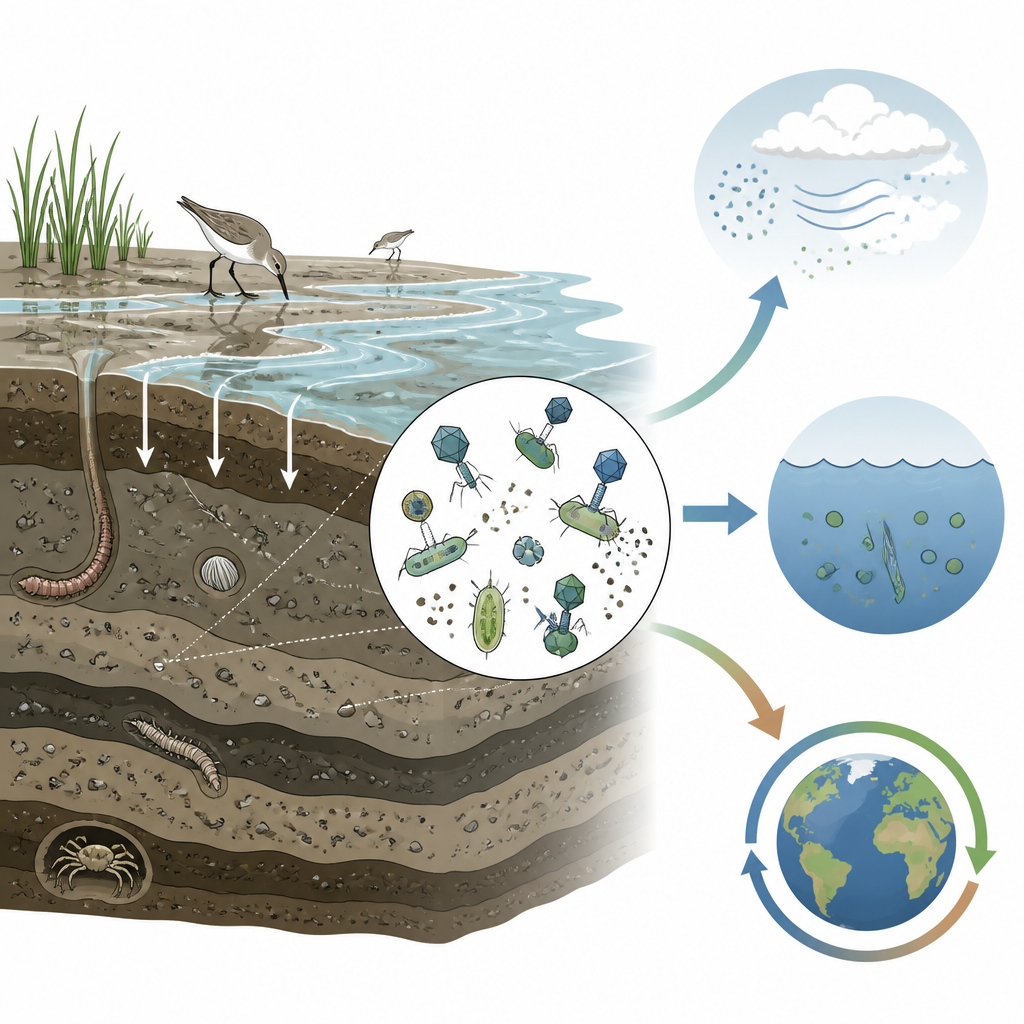
Where waves lap against the shore, vast stretches of mud may look lifeless. Yet these intertidal mudflats are packed with microscopic dramas that quietly help regulate Earth’s climate and nutrient cycles. This study peers into that unseen world and reveals an unexpected cast of major players: huge DNA viruses that infect both single-celled organisms and bacteria, shaping who lives in these muddy zones and how they process key elements like carbon and nitrogen.
Giant viruses in a restless habitat
Intertidal mudflats sit between land and ocean, alternately flooded and exposed as tides rise and fall. Those swings in water, oxygen, and temperature make them some of the most challenging habitats on the planet, yet they support dense communities of microbes, algae, tiny animals, and fungi. Many of these organisms are hosts for large DNA viruses, some with genomes bigger than those of bacteria. Until now, scientists knew little about how such outsized viruses behave in these rapidly changing coastal zones, or how they might influence the local food web and chemical cycles.
Mining terabytes of mud
To uncover this hidden viral world, the researchers collected nearly 200 sediment samples from mudflats along much of China’s coastline. They sampled across broad geographic distances, through the seasons, and down to a meter below the surface. Using powerful sequencing methods, they read the genetic material in these samples and then computationally stitched together viral genomes. From over five terabytes of data, they reconstructed 237 large DNA virus genomes, including both “giant” viruses that infect complex cells and jumbo phages that infect bacteria. Many of these genomes were nearly complete, a leap forward compared with earlier work that captured only fragments.
New branches on the viral family tree
By comparing key marker genes, the team mapped these mudflat viruses onto the broader viral family tree. Most of the giant viruses belonged to a group already common in the open ocean, but in these mudflats they formed distinct lineages, including a previously unrecognized branch likely representing a new virus family. The jumbo phages also fell into several major clades found in many environments worldwide. One particularly stable phage genome turned up again and again across different depths and times at a single site, hinting at a successful long-term survival strategy in the shifting intertidal setting.
Viruses, hosts, and the rules of community
The researchers then asked how these viruses are arranged in space and time, and how they relate to their hosts. Giant viruses and jumbo phages both showed strong changes in community makeup from place to place, over seasons, and with depth. Giant viruses turned over more quickly between locations, whereas large phages showed greater genetic variation within their populations. By linking viral patterns to nearby algae, animals, fungi, and protozoa, as well as to bacteria, the team found many tight associations: where certain hosts were abundant, matching viruses tended to thrive. Statistical tests suggested that chance events, such as random birth and death of small viral populations, play a bigger role than strict environmental filters in shaping these communities, although host abundance can temper that randomness.
Viral tricks for energy and nutrients
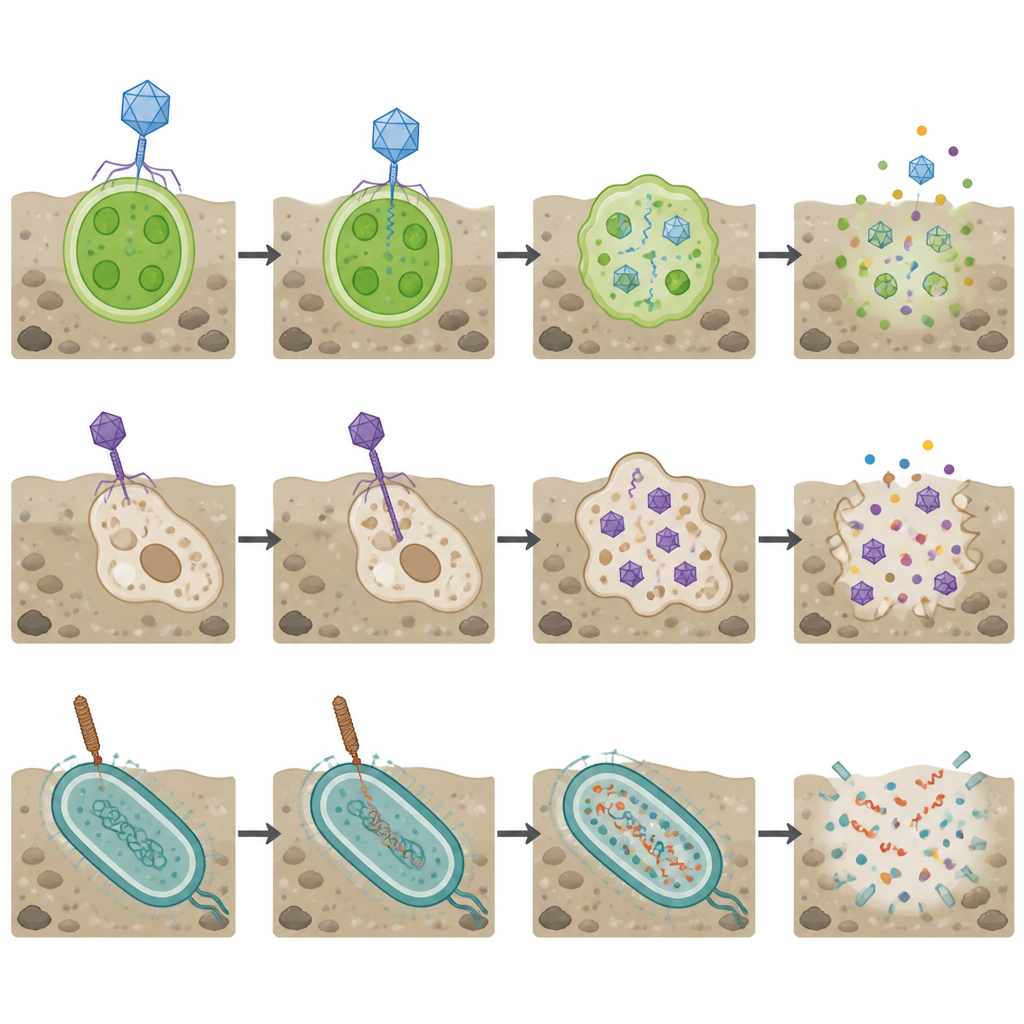
Beyond who infects whom, the study examined what these viruses can do. Many carried genes that tweak core metabolic pathways in their hosts, including those for processing sugars, amino acids, and nucleotides. Giant viruses and jumbo phages shared broad functional themes but favored different details. For example, certain giant viruses carried genes typical of eukaryotic cell surface sugars, while some jumbo phages encoded entire toolkits for making an essential molecule used in energy reactions. Other viral genes were linked to steps in carbon, nitrogen, and sulfur cycling, suggesting that infections can subtly reroute how mudflat microbes handle these elements. Evolutionary signals showed that many genes tied to DNA handling, viral structure, and metabolism are under strong selective pressure, highlighting an ongoing arms race between viruses and their hosts.
Why these mudflat viruses matter
Taken together, the work shows that intertidal mudflats harbor a surprisingly rich and distinctive community of large DNA viruses. These viruses do more than simply kill cells: they help structure which microbes and small eukaryotes dominate, and they carry genes that can nudge host metabolism in ways that influence local nutrient flows. By charting their diversity, host links, and ecological behavior, this study provides a foundation for understanding how unseen viral activity in muddy coastal zones feeds into broader carbon and nutrient cycles that ultimately affect coastal health and, indirectly, the global environment.
Citation: Ji, M., Li, Y., Wang, M. et al. Unveiling the biodiversity of large DNA viruses in intertidal mudflats via metagenomics. Nat Commun 17, 4358 (2026). https://doi.org/10.1038/s41467-026-71095-7
Keywords: giant viruses, jumbo phages, intertidal mudflats, viral ecology, metagenomics