Clear Sky Science · en
Proton signaling links epithelial sensing to neural control of host defense in C. elegans
How tiny worms can teach us about gut health
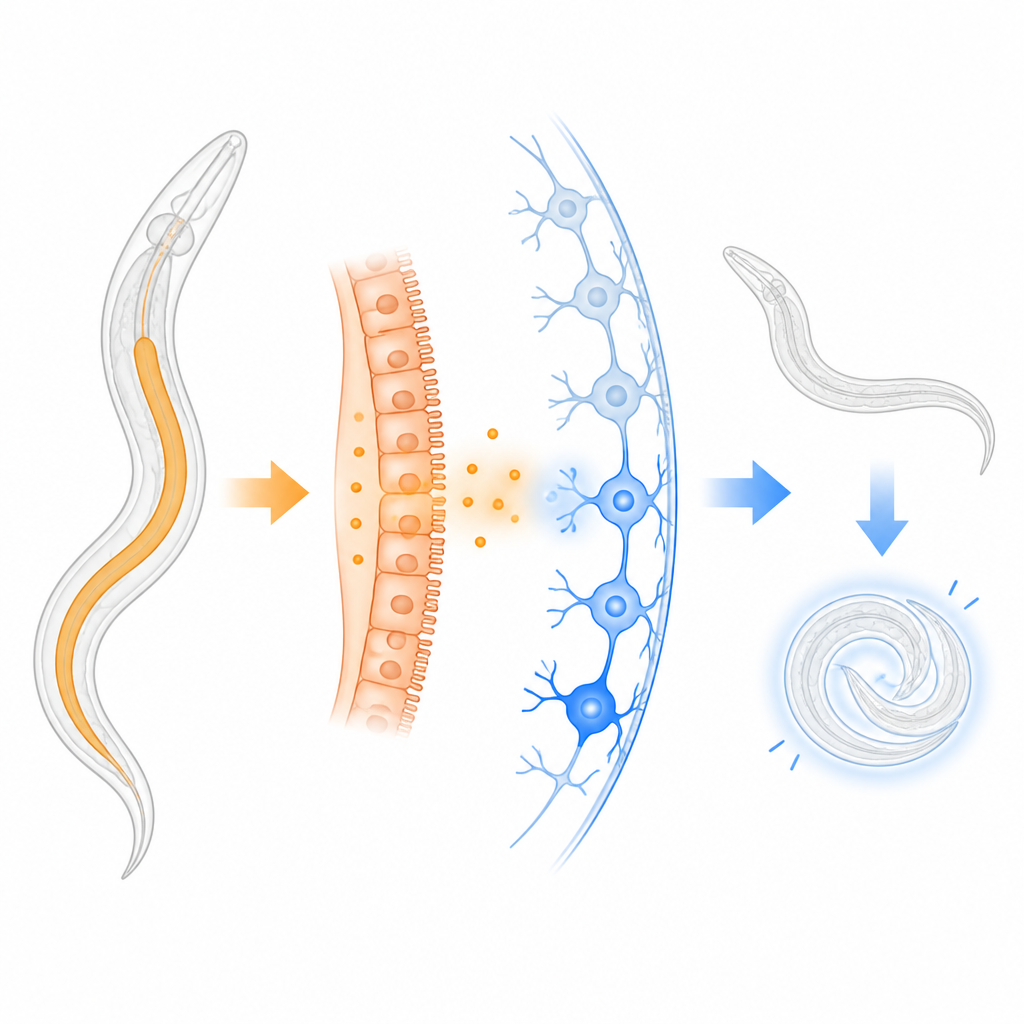
Our intestines constantly confront harmful microbes, and our bodies must quickly decide whether to fight, flee, or both. This study uses the tiny roundworm Caenorhabditis elegans to reveal how signals from the gut surface can rapidly talk to nearby nerves. The work suggests that simple chemical cues, in this case protons, help link what the gut senses to how the whole animal moves and defends itself, in ways that may echo similar systems in larger animals.
A conversation between gut and brain
Animals defend themselves from infection not only by killing germs but also by changing their behavior, such as avoiding contaminated food. For this to work, the gut lining must somehow send danger signals to the nervous system, which then coordinates both movement and immune defenses. In mammals, gut cells and nerves sit side by side, exchanging hormones and messenger molecules. Yet the basic language they use for this rapid conversation has remained unclear. The simple body plan and well-mapped nervous system of C. elegans make it an ideal organism to dissect this gut-to-nerve cross talk cell by cell.
Protons as emergency messengers
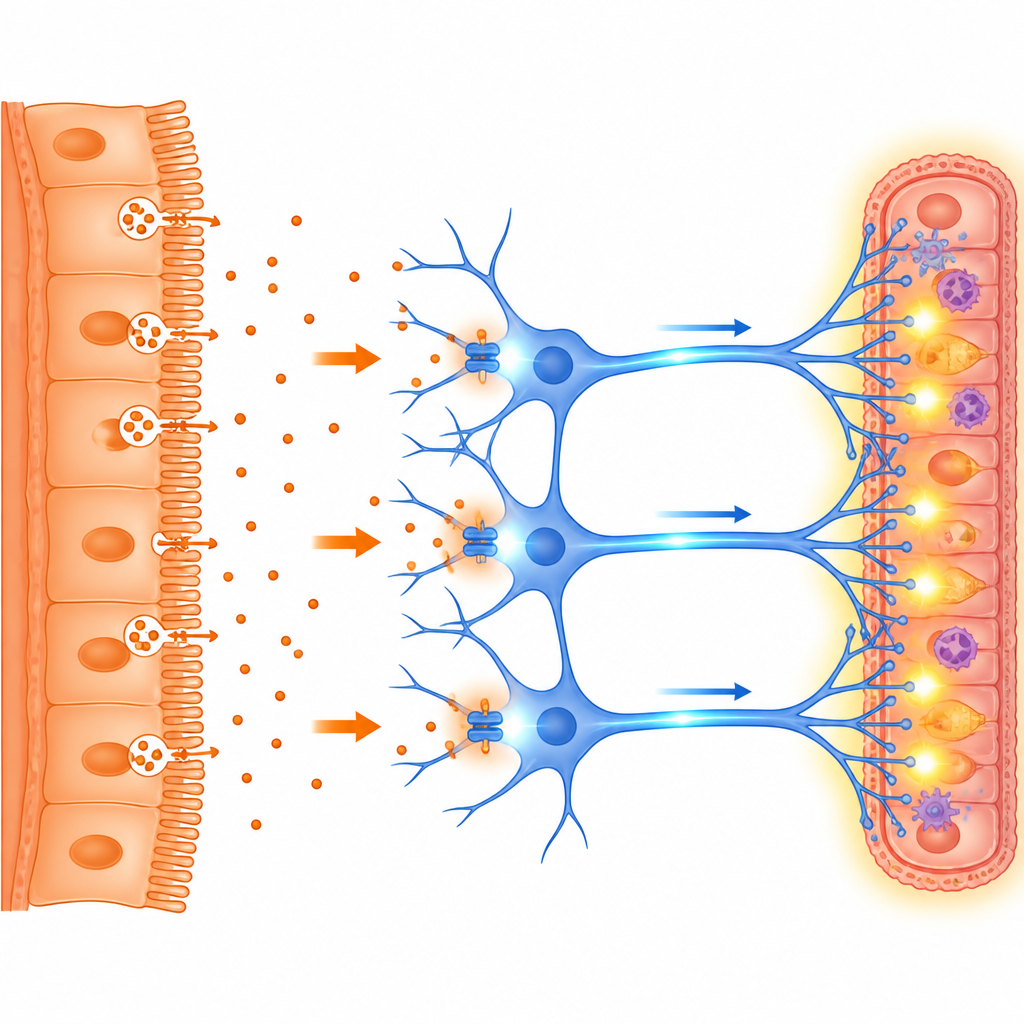
The researchers discovered that when disease-causing bacteria invade the worm’s intestine, the gut lining becomes more mechanically stressed and damaged. This strain opens a specific ion channel called GON-2, letting calcium flood into intestinal epithelial cells. The calcium rise then activates a protein pump, NHX-6, which swaps sodium ions from outside the cell for protons from inside. As a result, protons are released outward on the side of the gut that faces the body cavity, locally acidifying the fluid that bathes nearby nerve fibers. This process depends on the helper protein calmodulin and is switched on only by live, harmful bacteria, not by harmless or dead microbes, indicating that it is a true stress response.
Nerves that feel acid and drive escape
Running alongside the intestine is a row of cholinergic motor neurons that control forward and backward motion. The team showed that these neurons are directly sensitive to acid through an ion channel called ASIC-1. When protons from the gut reach these cells, ASIC-1 opens and boosts their activity. Worms with defective ASIC-1 or NHX-6 no longer show the normal surge in nerve firing when infected and move no faster on dangerous bacteria than on their regular food. In healthy worms, by contrast, infection causes them to speed up and change direction more often, helping them abandon patches of harmful bacteria. Adding extra protons to the environment can restore this avoidance behavior in worms lacking NHX-6, but only if ASIC-1 is intact, underscoring that the acid-sensing step in neurons is crucial.
From movement to stronger gut defenses
Boosted nerve activity does more than alter movement. The same cholinergic motor neurons send a feedback signal right back to the intestine using the neurotransmitter acetylcholine. Intestinal cells detect this signal through muscarinic receptors called GAR-2 and GAR-3. Once activated, these receptors switch on two well-known defense programs inside gut cells, the Wnt pathway and the p38 MAP kinase pathway, which increase the production of antimicrobial proteins. Worms missing the proton pump, the acid sensor, acetylcholine release, or the gut receptors all show weaker immune gene activity, allow more bacteria to build up in their intestines, and die sooner during infection.
A shared design across species
An intriguing twist is that mouse versions of the key proteins, NHE1 and ASIC1a, can replace their worm counterparts and restore normal signaling, behavior, and survival. This cross-species swap shows that the basic toolkit for this proton-based conversation between gut and nerves is compatible across distant animals. To a non-specialist, the take-home message is that simple ions like protons can act as fast emergency messengers, letting the gut warn the nervous system about danger and, in turn, helping the body combine smart escape behavior with a stronger local immune response.
Citation: Lei, Y., Zhan, X., Chen, C. et al. Proton signaling links epithelial sensing to neural control of host defense in C. elegans. Nat Commun 17, 4493 (2026). https://doi.org/10.1038/s41467-026-71088-6
Keywords: gut brain communication, innate immunity, C. elegans, proton signaling, pathogen avoidance