Clear Sky Science · en
CBP phosphorylation maintains intestinal homeostasis by supporting the stem cell niche through versican
Why the gut’s repair crew matters
Our intestines renew themselves constantly, with fresh cells replacing old ones every few days. This silent repair job keeps the gut lining tight and helps fend off disease. In people with inflammatory bowel disease, including ulcerative colitis, this renewal system falters. The study described here uncovers how a single molecular switch inside gut cells helps maintain a healthy repair crew by controlling a key support molecule in the tissue surrounding stem cells.
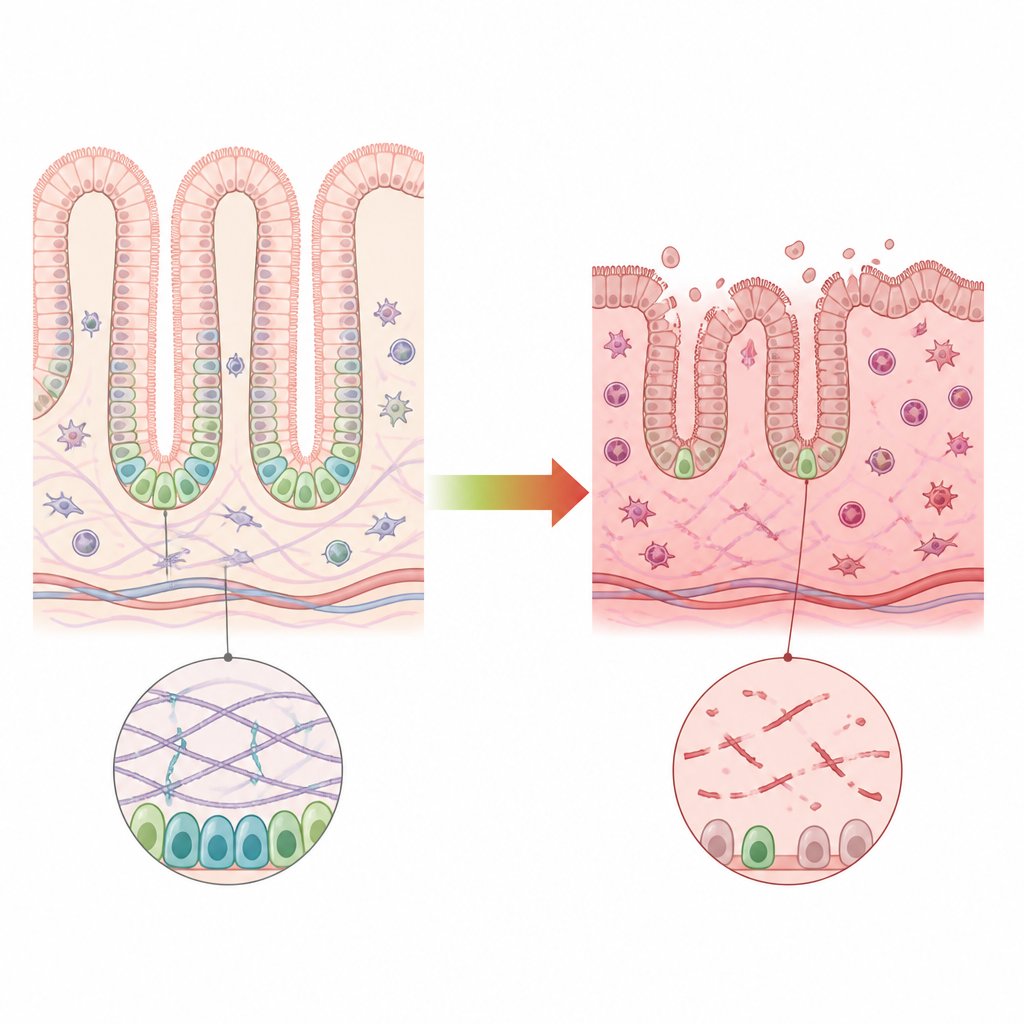
A hidden switch inside gut cells
Deep in tiny pockets of the colon called crypts, intestinal stem cells generate all the different cells that line the gut. Their behavior depends not only on their own genes but also on signals from nearby proteins. One such protein, called CBP, helps turn genes on or off. CBP can be chemically tagged at certain positions, a change known as phosphorylation, which acts like flipping a switch to change which partners it binds. The researchers had previously shown in cell culture that when CBP is phosphorylated it favors signals that promote cell growth, while unphosphorylated CBP leans toward signals that halt growth or trigger cell death.
From altered signaling to fragile colon lining
To explore what this switch does in a living intestine, the team created mice in which CBP could no longer be phosphorylated at two specific sites. These "CBPAA" mice produced normal amounts of CBP, but the protein’s switch was locked in the off position. The animals looked healthy overall yet had shorter colons, traces of blood in their stool, leakier gut barriers, and subtle structural defects in the lower colon. Microscopy and tracking of dividing cells showed that their intestinal lining renewed itself more slowly, with fewer cells actively multiplying and delayed movement of new cells from the crypt base to the surface.
Stem cell support mesh goes missing
The authors then traced how the frozen CBP switch reshaped the local environment of intestinal stem cells. In the mutant mice, CBP bound more strongly to another protein, p53, which is known for slowing cell division. This tighter partnership boosted a p53 target called p21 that restrains growth. At the same time, gene profiling of colon crypts revealed a sharp drop in a large extracellular protein called versican. Versican helps form the surrounding meshwork, or matrix, that physically and chemically supports stem cells and strengthens cell-to-cell junctions in the epithelium. When versican levels fell, organoids grown from mutant mouse crypts were smaller, less numerous, and contained fewer dividing cells, all signs of weakened stem cell function and a struggling repair system.
Rescuing the niche by tweaking signals
To test whether this chain of events could be reversed, the researchers removed p53 specifically from the intestinal lining of the mutant mice. This cut the CBP–p53 partnership, reduced p21 levels, restored versican expression, and largely normalized colon length, stool features, barrier leakiness, and organoid growth. Adding purified versican directly to organoids from mutant mice also revived their size, number, and cell division and helped restore a key adhesion molecule known as E-cadherin. These benefits depended on an epidermal growth factor receptor pathway, suggesting that versican helps deliver growth-promoting cues to stem cells. Finally, introducing engineered versions of CBP that mimic the phosphorylated state into mutant organoids brought versican levels and stem cell activity back up, reinforcing the idea that the CBP switch itself is central.
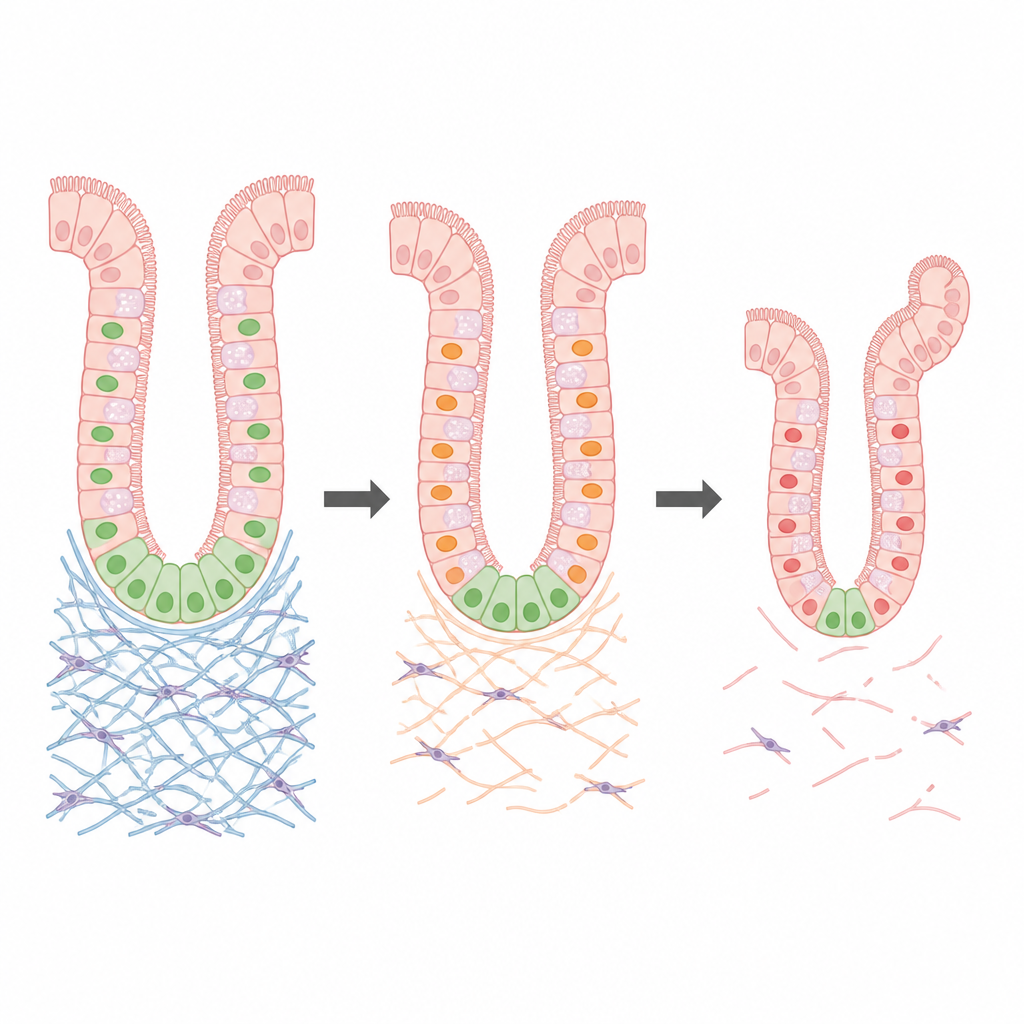
Links to human intestinal disease
Human colon samples told a similar story. Tissue from people with ulcerative colitis showed reduced CBP phosphorylation, stronger binding between CBP and p53, lower versican levels in the supporting tissue, and fewer dividing epithelial cells, together with reduced levels of an upstream enzyme that normally adds the phosphate tags to CBP. In contrast, healthy colon tissue displayed active CBP phosphorylation, preserved versican, and abundant proliferating cells at crypt bases.
What this means for people with gut inflammation
Viewed together, the results point to a simple chain: when the CBP phosphorylation switch works, it limits excessive binding to p53, sustains versican in the stem cell neighborhood, and keeps the gut lining’s renewal machinery humming. When this switch fails, versican fades, the stem cell niche weakens, and the colon lining becomes less able to repair itself, setting the stage for chronic inflammation. While more work is needed before any treatments are developed, the study identifies versican and the CBP switch as promising entry points for strategies aimed at strengthening the gut’s natural repair system in inflammatory bowel disease.
Citation: Lin, YT., Liu, C., Hsu, YH. et al. CBP phosphorylation maintains intestinal homeostasis by supporting the stem cell niche through versican. Nat Commun 17, 4583 (2026). https://doi.org/10.1038/s41467-026-71083-x
Keywords: intestinal stem cells, extracellular matrix, ulcerative colitis, CBP phosphorylation, versican