Clear Sky Science · en
Minimalist terahertz wireless transceiver in integrated photonics
Why smaller, faster wireless links matter
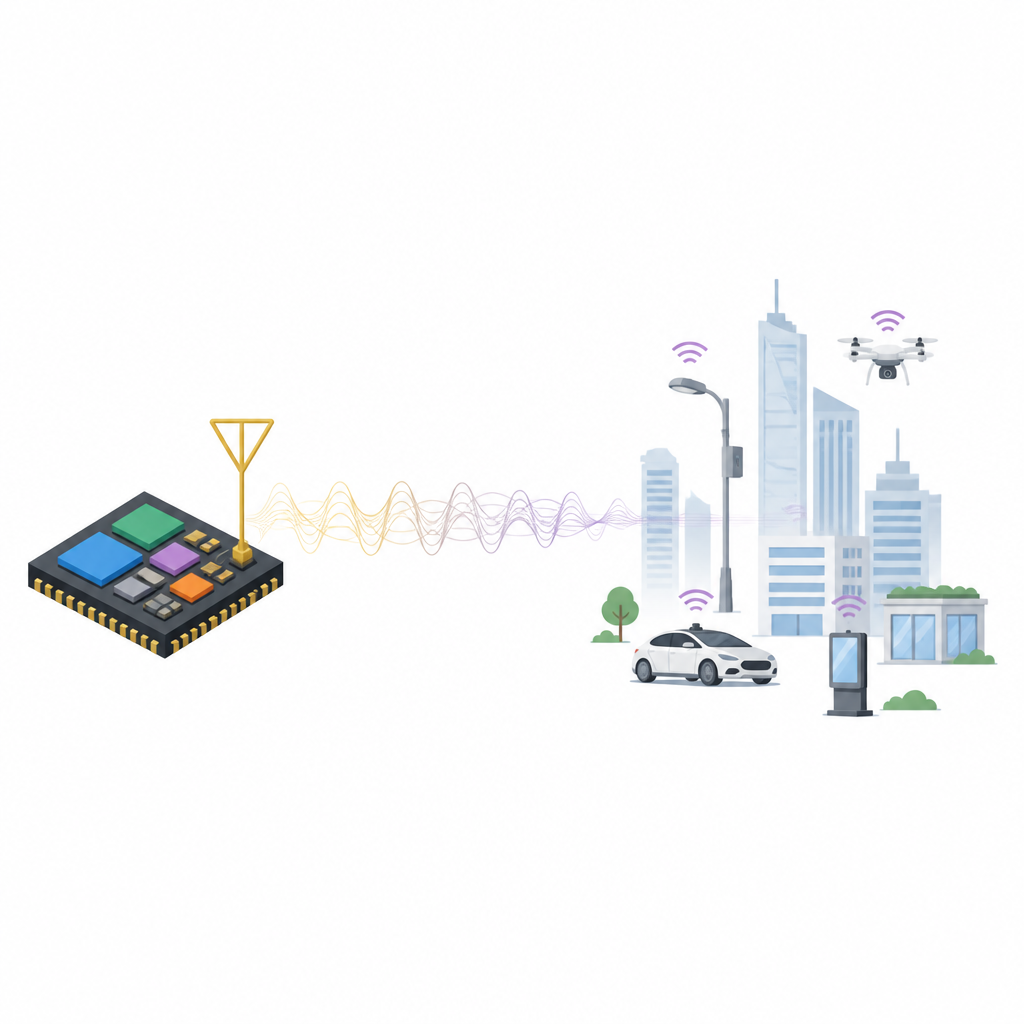
Our daily world is filling up with connected gadgets, from smart cameras in factories to sensors on cars and streetlights. All of this equipment must trade huge amounts of data quickly and reliably, but bulky, power-hungry wireless hardware is hard to squeeze into tiny, battery-powered devices. This research explores a new way to build very fast wireless links using light on a chip, creating a simpler and more efficient building block for future high-speed networks.
Light as a bridge for future wireless
Today’s high-speed wireless systems at extremely high frequencies, such as terahertz bands, often rely on complex electronics that struggle to deliver both wide bandwidth and low cost. Photonics-assisted systems use lasers and optical components to create these high-frequency signals more flexibly, but the hardware is typically large, expensive, and hard to integrate into compact devices. In particular, they often need ultra-clean lasers and heavy digital processing to keep the signal stable, which adds cost, power use, and delay. The authors set out to remove this long-standing trade-off by rethinking both the transmitter and receiver so that simple, inexpensive parts can still support very fast data links.
A stripped-down terahertz radio on a chip
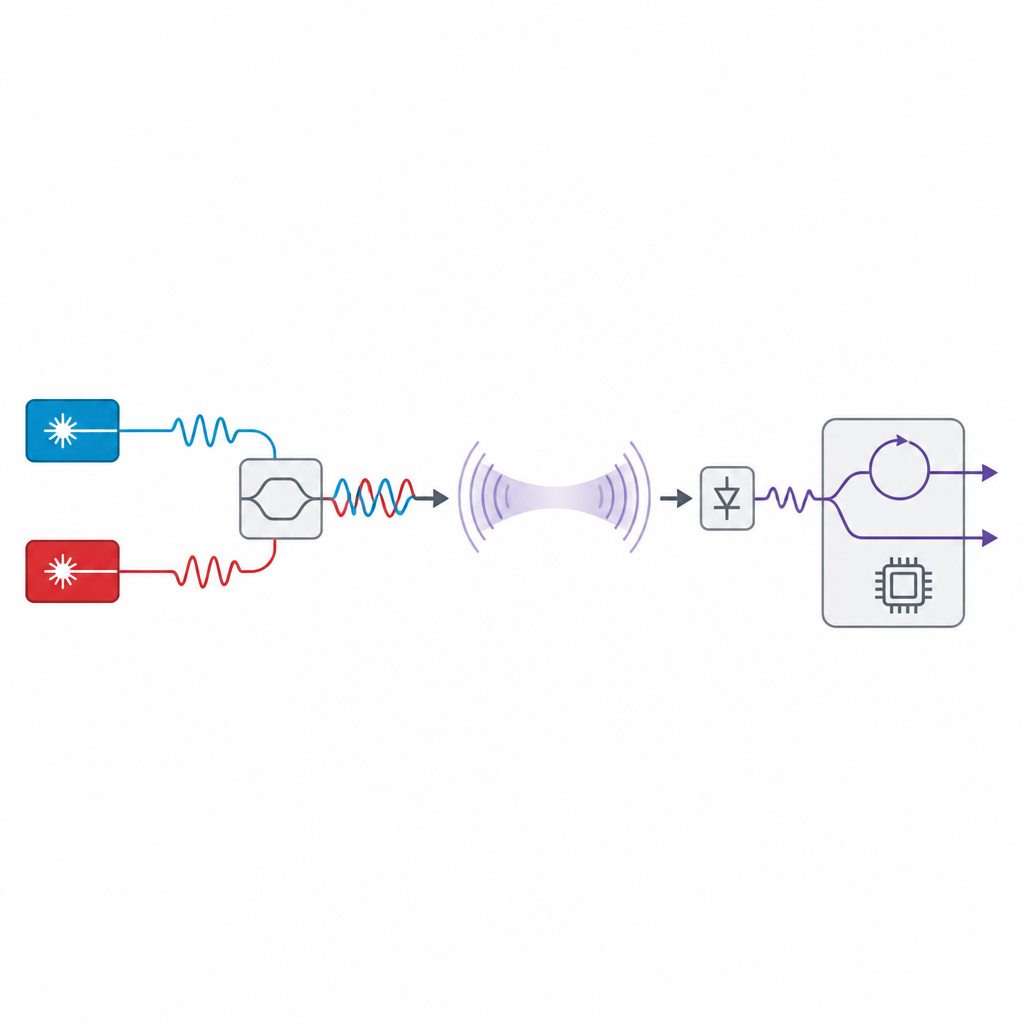
The team designs a minimalist terahertz transceiver built with integrated photonic chips. Instead of using bulky laboratory lasers, they choose common distributed feedback laser chips that have much noisier signals but are cheap and compact. At the sending side, a special way of imprinting data onto light, called residual carrier modulation, keeps a faint copy of the original light wave traveling alongside the data-carrying sideband. Because both pieces of light share the same path, any jitters they pick up remain closely matched. At the receiving side, this faint copy is boosted inside another ordinary laser using a process known as injection locking, which forces the new laser to follow the incoming light very closely in both color and rhythm.
Keeping the signal steady without heavy math
In conventional high-speed systems, the receiver’s local laser is independent from the incoming signal, so their tiny differences in frequency and phase constantly drift. Correcting this requires elaborate digital signal processing that estimates and tracks these changes in real time, consuming power and adding delay. In the new design, the boosted residual carrier already shares the same fluctuations as the signal sideband, and when they are combined on a single photodiode, most of the unwanted jitter cancels out. The researchers show that, under these conditions, the usual digital steps for estimating frequency offset and carrier phase can be turned off while the data still comes through reliably, even though the lasers are far noisier than those used in earlier work.
Fast data with relaxed hardware demands
Using their integrated lasers, modulators, and photodiodes, the authors demonstrate wireless links at a carrier frequency of 200 gigahertz, sending data at up to 144 gigabits per second with advanced modulation formats. They compare noisy 4 megahertz-linewidth laser chips to highly refined laboratory lasers and find similar error rates at the same speeds, confirming that strict laser purity is no longer essential. The system also makes efficient use of spectrum, needing only a small guard band around the signal. Because key parts are already available in wafer-scale photonic platforms, and amplifiers and circulators can also be brought on chip, the approach is well suited for turning into compact modules that fit inside everyday devices.
What this means for future connected devices
By letting simple, inexpensive lasers and a single receiver sensor handle ultra-fast terahertz signals without heavy digital clean-up, this work points to a future where high-performance wireless links can be built into many small, power-limited gadgets. In plain terms, the researchers show how to shrink a complex high-frequency radio into a lean optical engine on a chip, cutting cost and energy use while keeping speed. Such minimalist photonic transceivers could help make dense, responsive networks for smart cities, factories, vehicles, and sensing systems far more practical.
Citation: Guo, Y., Zhang, X., Zhang, Y. et al. Minimalist terahertz wireless transceiver in integrated photonics. Nat Commun 17, 4429 (2026). https://doi.org/10.1038/s41467-026-71081-z
Keywords: terahertz wireless, integrated photonics, high speed communication, low power transceiver, 6G networks