Clear Sky Science · en
Cortex-wide characterization of decision-making neural dynamics during spatial navigation
How the brain steers us through space
Finding your way through a new building or deciding which turn to take while driving feels effortless, but underneath, your brain is juggling memory, senses, and choices. This study uses tiny brain cameras in freely moving mice to reveal how large areas of the brain work together while the animals navigate a maze and decide where to go for a reward.
A tiny maze that demands big decisions
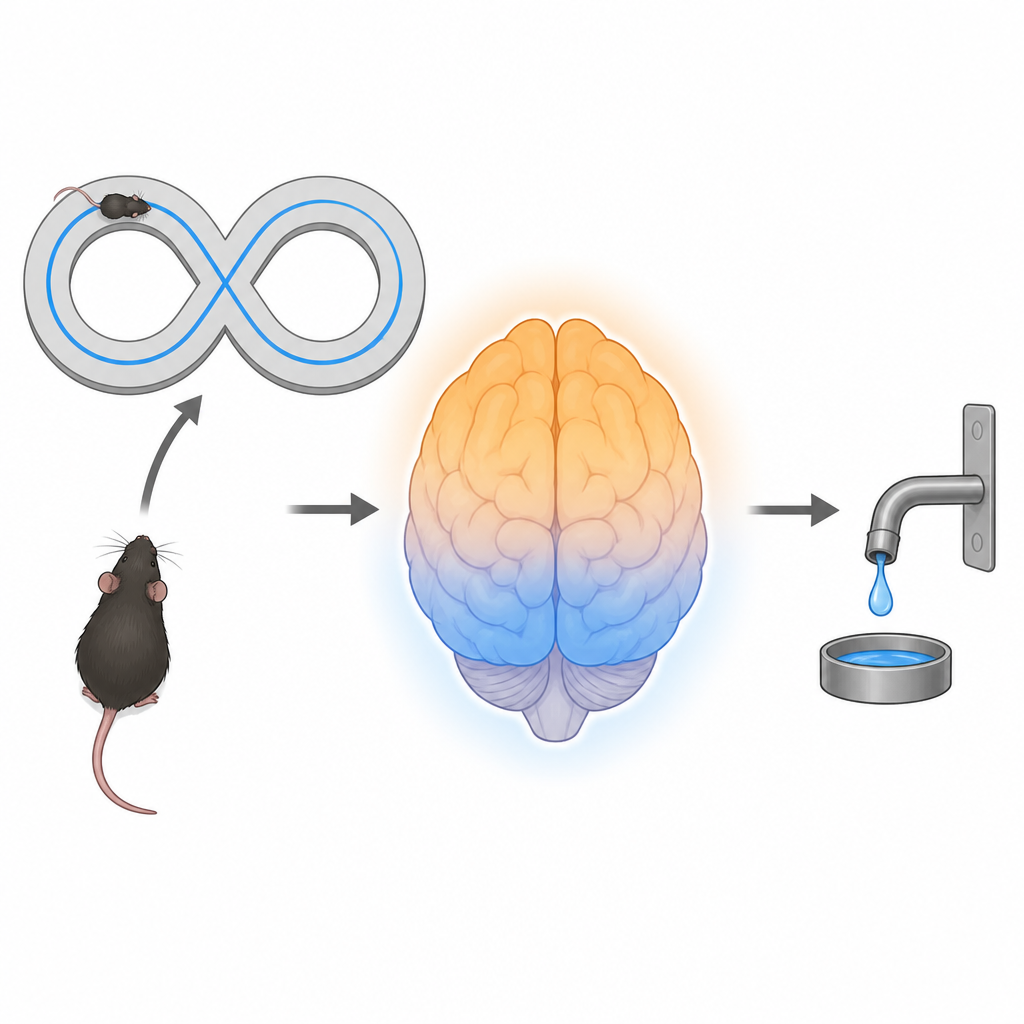
The researchers trained mice to run through a figure-eight shaped maze with a choice point shaped like the letter T. In one version of the task, the animals had to alternate between left and right turns to earn a drop of sugary water. In the second version, the rule suddenly changed so that only left turns were rewarded, even though right turns were still allowed. As the mice ran, a lightweight head-mounted microscope recorded activity from most of the brain’s outer layer, the cortex, by tracking flashes of calcium signals that report when groups of nerve cells become active.
To keep the focus on decision making, the team carefully checked for possible distractions. They tested whether sound cues, features of the maze, changes in running speed, or licking for water might be driving the brain signals. Additional control experiments, including animals that did not express the calcium sensor and mice trained only to lick in response to sounds, showed that these factors could not fully explain the patterns of activity. This gave the researchers confidence that they were watching genuine decision-related signals unfold across the cortex.
Brain-wide activity patterns as “states”
Rather than looking at one small brain area at a time, the scientists grouped similar activity snapshots into recurring patterns they called cortical states. Each state corresponded to a distinct arrangement of active and quiet regions spread across the surface of the brain. Mice used about nine common states while performing the maze task. The probability of being in a given state changed systematically with the animal’s location in the maze and what it was about to do. For example, a state with strong activity in frontal motor regions peaked when the mice reached the reward spout, matching the urge to lick and process the outcome of a choice. States that strongly involved visual and navigation-related areas were most common as the animals approached the T-junction where they had to pick left or right.
By comparing trained mice with naïve mice that simply wandered the maze without rewards, the team found that trained animals used these states in a more structured way. In trained mice, many states rose above chance levels at specific points in the maze, whereas naïve animals showed weaker and less organized patterns. The way states were used also reflected choice, task rule, and success or failure. Certain combinations of frontal, parietal, and visual regions differed when the mouse chose left versus right, when the rule required alternation versus left-only, and when a trial was correct or incorrect. Importantly, errors could often be detected in the state patterns before the mouse arrived at the reward zone, suggesting that the brain “knew” a mistake had been made in advance.
Waves of activity flowing across the cortex
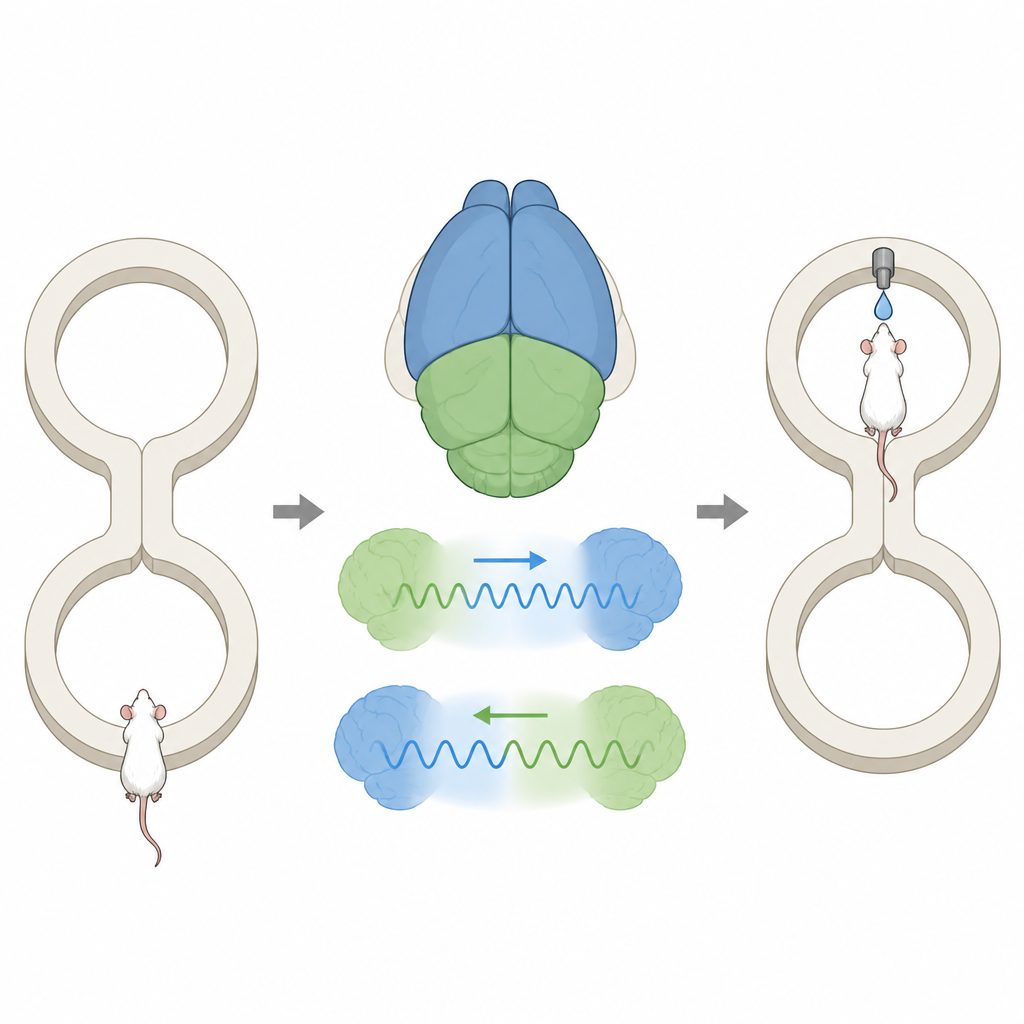
The study went a step further by examining how cortical states followed one another in time, forming sequences or “motifs.” Many of these motifs resembled waves of activity traveling either from the back of the brain toward the front (anterior flow) or in the opposite direction (posterior flow). Anterior flows were more common overall, especially as the mice moved down the central corridor and made decisions at the T-junction or approached the reward spout. This pattern fits with the idea that sensory information from visual and parietal regions is gradually converted into planned movements in frontal motor areas. Posterior flows became more prominent after choices were made, around the time of reward delivery, and during incorrect trials. These reverse waves are consistent with top-down signals from frontal areas sending feedback to visual and navigation regions about what just happened and how to adjust future behavior.
What this means for understanding everyday choices
This work suggests that the brain uses a shifting set of large-scale activity patterns, and waves that sweep across them, to knit together seeing, remembering, and acting during navigation. Different mixtures of these patterns capture whether an animal is turning left or right, following one rule or another, and whether its choice will pay off. For a layperson, the key message is that decisions made while moving through the world are not handled by a single “decision center.” Instead, they arise from coordinated conversations between front and back parts of the cortex, with forward-going flows helping turn sensory clues into action and backward-going flows providing internal feedback about success and failure.
Citation: Haley, S.P., Surinach, D.A., Nietz, A.K. et al. Cortex-wide characterization of decision-making neural dynamics during spatial navigation. Nat Commun 17, 4482 (2026). https://doi.org/10.1038/s41467-026-71074-y
Keywords: spatial navigation, decision making, cortical dynamics, calcium imaging, mouse behavior