Clear Sky Science · en
Violation of detailed balance in non-equilibrium magnons observed by inelastic neutron scattering
Spins Out of Balance
Many of the technologies we rely on, from hard drives to quantum devices, depend on how tiny magnetic moments in solids move and relax. This study shows that under laser driving, these magnetic ripples—called magnons—can be pushed into a long‑lived, “out‑of‑equilibrium” state that breaks a basic rule of thermal physics. By watching this behavior with a powerful neutron microscope, the researchers open a new window on how quantum materials behave when they are driven rather than left at rest. 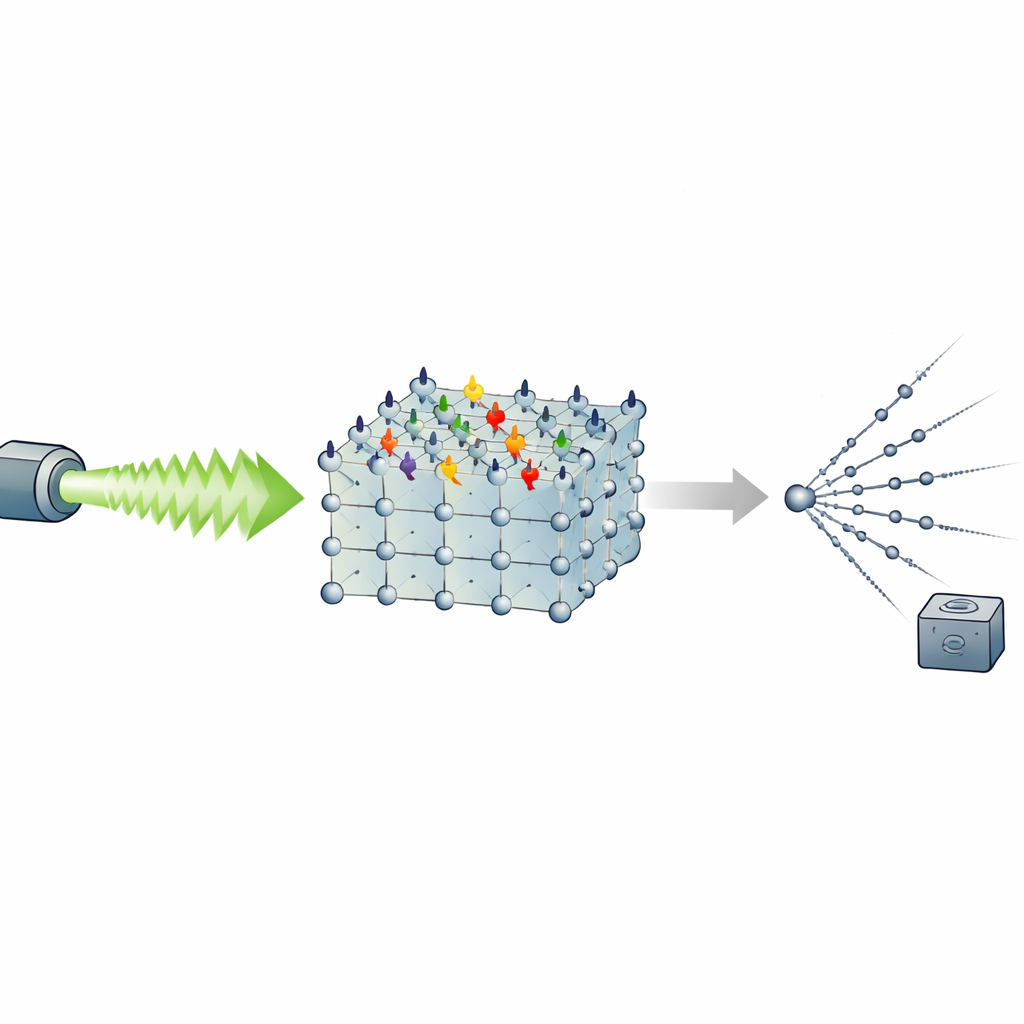
A New Look at Magnetic Ripples
Magnons are collective wiggles of electron spins in a magnet, similar to waves moving across a field of compass needles. In a solid at ordinary thermal balance, magnons are created and destroyed in a way that obeys a strict rule known as detailed balance: for every process that creates a magnon, there is a matching process that removes one, set by the material’s temperature. Inelastic neutron scattering is one of the few tools that can see these processes directly, because neutrons can either give energy to the spins (creating magnons) or take energy from them (annihilating magnons) while their changes in energy and momentum are precisely measured.
Pulsed Light Meets Pulsed Neutrons
The team studied a model magnetic crystal, Rb2MnF4, whose spins form a nearly perfect two‑dimensional checkerboard pattern known as an antiferromagnet. They built a pump–probe setup at a neutron source where short laser pulses periodically excite the spins, while synchronized neutron pulses probe how the spins respond. First, they carefully mapped the magnon spectrum at low temperatures without laser light, confirming that in this quiet state the intensities of magnon creation and annihilation exactly follow detailed balance and match theoretical predictions.
Magnons That Refuse to Settle Down
When the laser is turned on, the picture changes in a subtle but striking way. The neutron data show that the part of the signal corresponding to magnon creation remains essentially identical to equilibrium. In contrast, the signal for magnon annihilation grows: there is a clear excess of magnons available to be removed. This imbalance persists over tens of milliseconds—much longer than the microscopic scattering times in the material—indicating that the magnons have reached a driven steady state rather than simply heating up. The researchers also vary how often the laser pulses arrive and find that the total excess annihilation signal scales inversely with the time between pulses, a hallmark of a steady population maintained by periodic driving.
Why the Extra Magnons Survive
The behavior arises from a hierarchy of relaxation processes in the material. After each laser pulse, energy first flows quickly among electrons and ordinary vibrations of the lattice, bringing those subsystems back near their original temperature within microseconds. Magnons, however, follow stricter conservation rules: dominant magnon–magnon collisions can shuffle magnons in energy and momentum but mostly preserve their total number. In this antiferromagnet, those collisions rapidly push magnons down into the lowest‑energy part of the spectrum, creating a dense pool of low‑energy magnons. Letting these magnons leak away requires slower interactions with the lattice, which occur over hundreds of milliseconds. Because the laser drives the system more frequently than that, the magnon pool never drains completely and a non‑thermal steady state emerges. 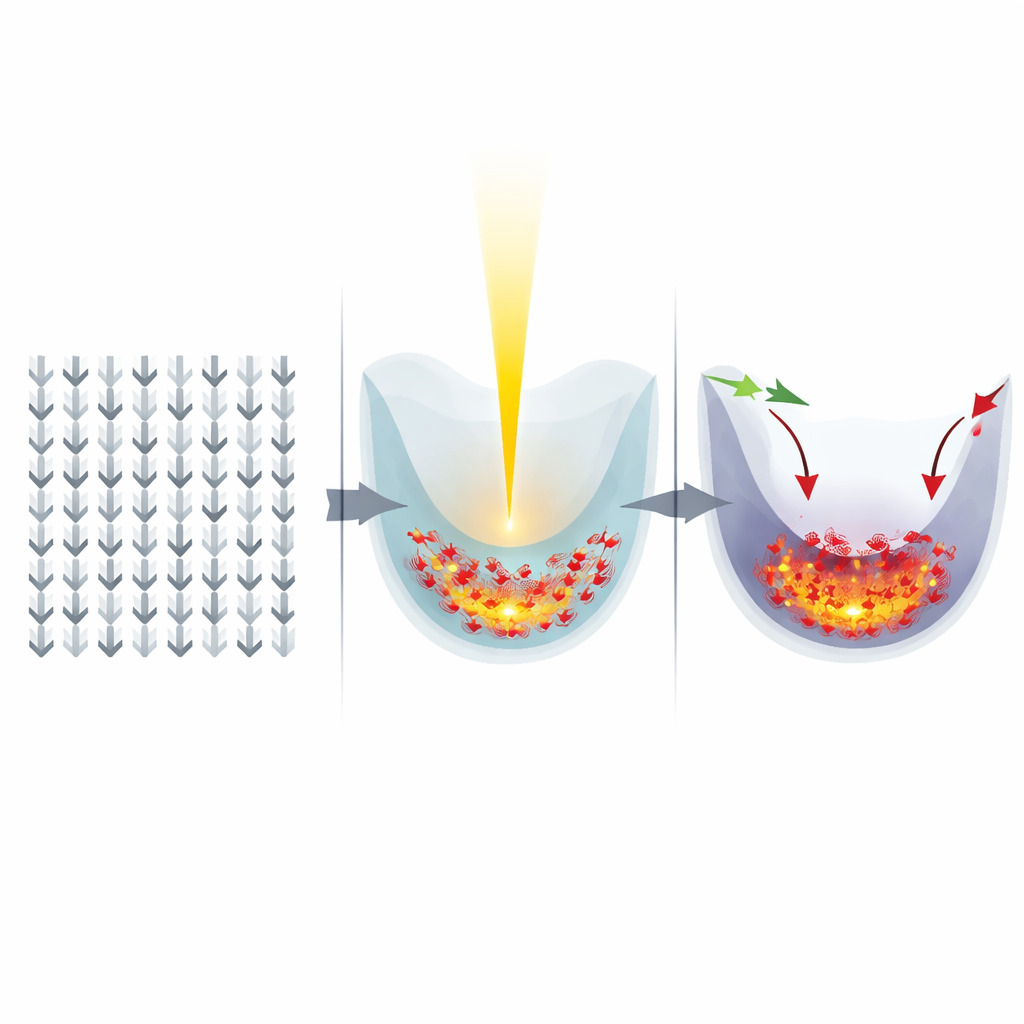
Breaking a Fundamental Rule
At the heart of the work is the finding that the usual temperature‑based description simply fails: the same data cannot be explained by a single effective temperature for both magnon creation and annihilation. Instead, the imbalance reflects genuinely quantum behavior in a driven, dissipative system, tied to subtle time‑ordered correlations between the operators that create and destroy magnons. Using a simple quantum model, the authors show how coupling between spins and a slower “bath” can naturally yield extra intensity on the magnon‑annihilation side, signaling a breakdown of detailed balance. For non‑specialists, the key message is that magnons in this material can be pumped into a robust, long‑lived, non‑thermal state that standard equilibrium ideas cannot capture. This establishes laser‑driven neutron scattering as a powerful way to watch quantum matter operate far from equilibrium, with implications for future low‑loss information transport and quantum technologies.
Citation: Hua, C., Winn, B.L., Sarkis, C. et al. Violation of detailed balance in non-equilibrium magnons observed by inelastic neutron scattering. Nat Commun 17, 3535 (2026). https://doi.org/10.1038/s41467-026-71068-w
Keywords: nonequilibrium magnons, inelastic neutron scattering, quantum spin dynamics, driven steady states, antiferromagnets