Clear Sky Science · en
SNX-mediated biogenesis of a plant-unique vesicle derived from the multivesicular body
How tiny bubbles keep plant cells tidy
Inside every plant cell, a bustling delivery network shuttles proteins to where they are needed and returns reusable parts for another round. This study reveals that plants rely on a previously unseen kind of microscopic bubble to recycle key transport helpers, a process that keeps seeds developing properly and supports healthy growth.
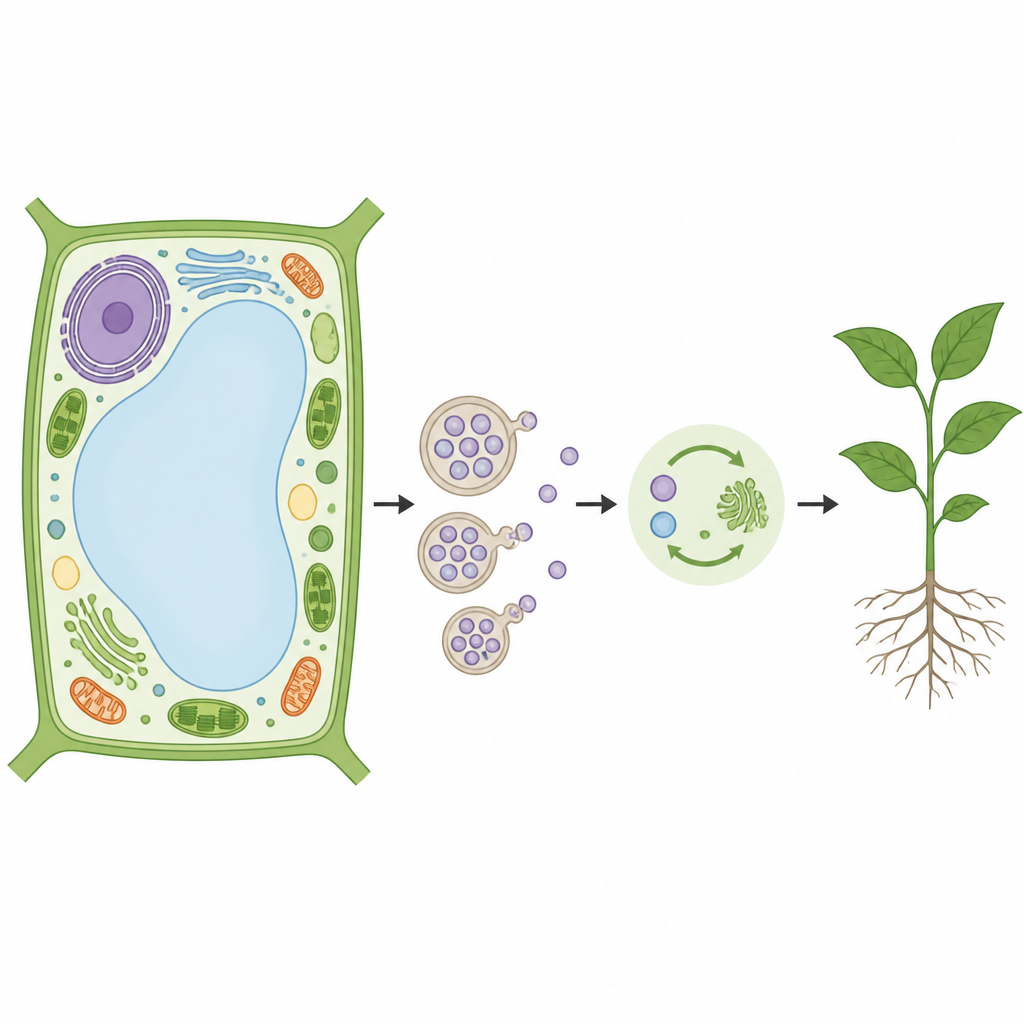
Traffic control inside plant cells
Plant cells contain a large storage compartment called the vacuole that breaks down and recycles cellular materials. To deliver cargo there, the cell uses receptor proteins that recognize the right molecules and escort them to a waystation called the multivesicular body, or MVB. Once they drop off their cargo, these receptors must be returned to earlier stations so they can be reused. Although this backwards, or retrograde, route is vital, scientists did not know exactly what the recycling vehicles looked like or where they came from in plant cells.
A new type of recycling bubble
Using advanced three dimensional electron microscopy on root cells of the model plant Arabidopsis, the researchers spotted many small spherical bubbles, only about thirty to fifty billionths of a meter across, clustered near MVBs. Some appeared still attached, as if just budding from the MVB surface. These bubbles had a clearer interior than typical secretory bubbles, hinting that they carried few bulky cargo proteins. By attaching gold particles to antibodies that recognize known recycling components and receptors, the team showed that these tiny bubbles are rich in both the retromer complex and vacuolar sorting receptors, strongly suggesting they are the long-sought retrograde carriers in plants.
Shaping bubbles instead of tubes
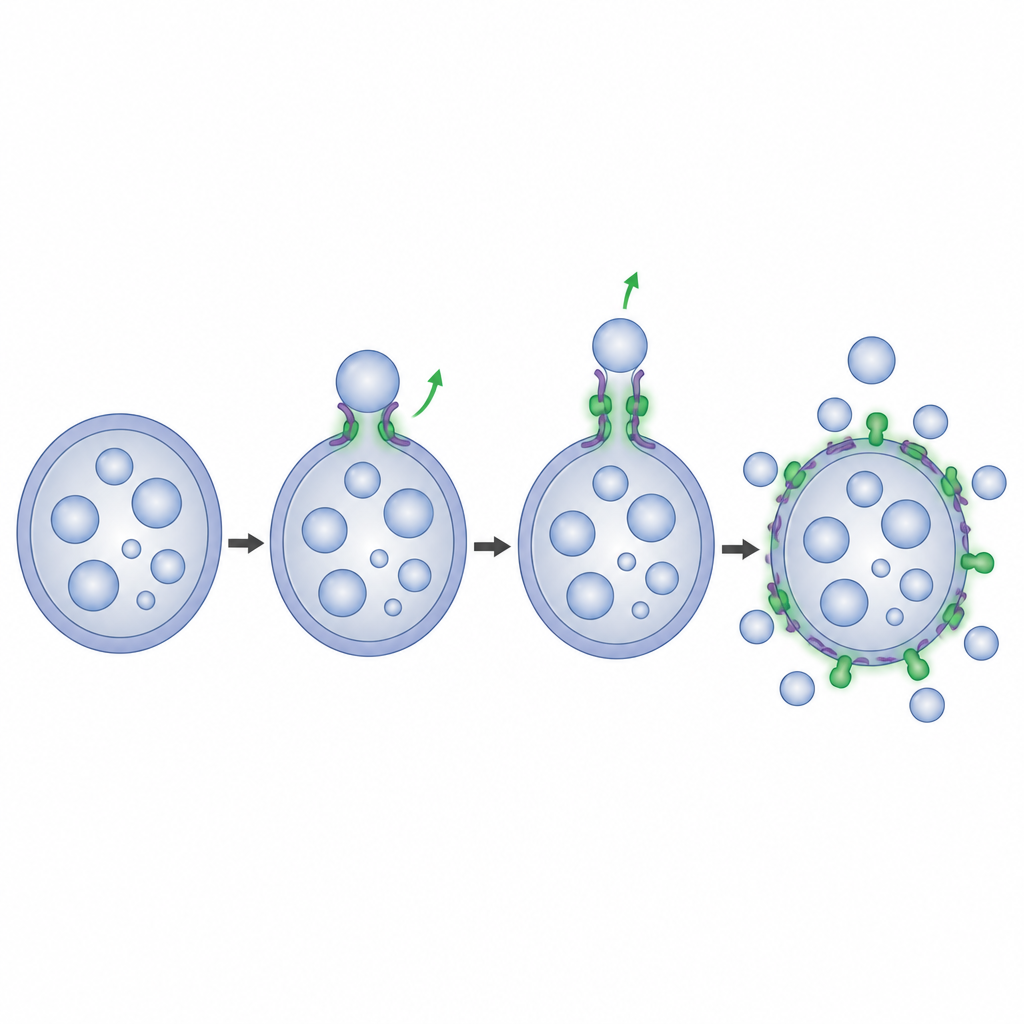
In animals and yeast, similar recycling is handled mostly by long, thin tubes formed by sorting nexin proteins. To learn why plants favor small spheres instead, the authors purified the plant sorting nexin SNX1 and watched how it reshaped artificial membranes. Compared with its mouse counterpart, plant SNX1 formed much shorter tubes. Detailed cryo electron microscopy and computer simulations revealed that a short segment of SNX1 that dips into the membrane, called an amphipathic helix, binds less strongly to the membrane in plants than in animals. This weaker grip makes it harder to stabilize long tubes and instead favors short, curved regions that pinch off as small bubbles.
Two helpers team up to make the bubbles
Plants also produce a related protein, SNX2, which can partner with SNX1. On its own, SNX2 did not remodel membranes, but when combined with SNX1 it generated a mix of bent tubes and budding spheres that closely resembled what was seen near MVBs inside cells. Simulations indicated that this partnership further reduces overall membrane binding, nudging the system toward forming compact spherical bubbles rather than extended tubes. This fine tuning suggests plants have evolved a version of the recycling machinery that is well suited to the cramped space between the giant central vacuole and the cell surface.
Why these bubbles matter for plant life
To test the bubbles’ importance, the team reduced the levels of SNX1 or SNX2 in plant cells. Under these conditions, the receptor GFP VSR2 was misdirected into the vacuole and degraded instead of being recycled. Plants with weakened SNX function showed faulty seed storage compartments, delayed breakdown of seed reserves during germination, smaller rosette leaves, and, when combined with defects in a core retromer protein called VPS29, embryos that died very early in development. Microscopy of these embryos showed enlarged MVBs but many fewer of the small spherical bubbles nearby, linking bubble formation to successful growth.
What this means for understanding plants
This work shows that plants rely on a plant specific class of tiny bubbles that bud directly from multivesicular bodies to recycle key receptor proteins. Guided by sorting nexins SNX1 and SNX2 and the retromer complex, these bubbles return receptors for reuse, ensuring that cargo keeps flowing to the vacuole and that seeds and seedlings develop normally. For a lay reader, the message is that even subtle changes in the shape and behavior of nanometer sized bubbles can have visible effects on how well a plant grows and reproduces.
Citation: Li, Y., Tao, R., Zhang, H. et al. SNX-mediated biogenesis of a plant-unique vesicle derived from the multivesicular body. Nat Commun 17, 4462 (2026). https://doi.org/10.1038/s41467-026-71067-x
Keywords: plant cell trafficking, vesicle recycling, sorting nexins, multivesicular body, Arabidopsis development