Clear Sky Science · en
A molecular switch in NAC prevents mitochondrial protein mistargeting by SRP
How Cells Keep Their Protein Traffic on Track
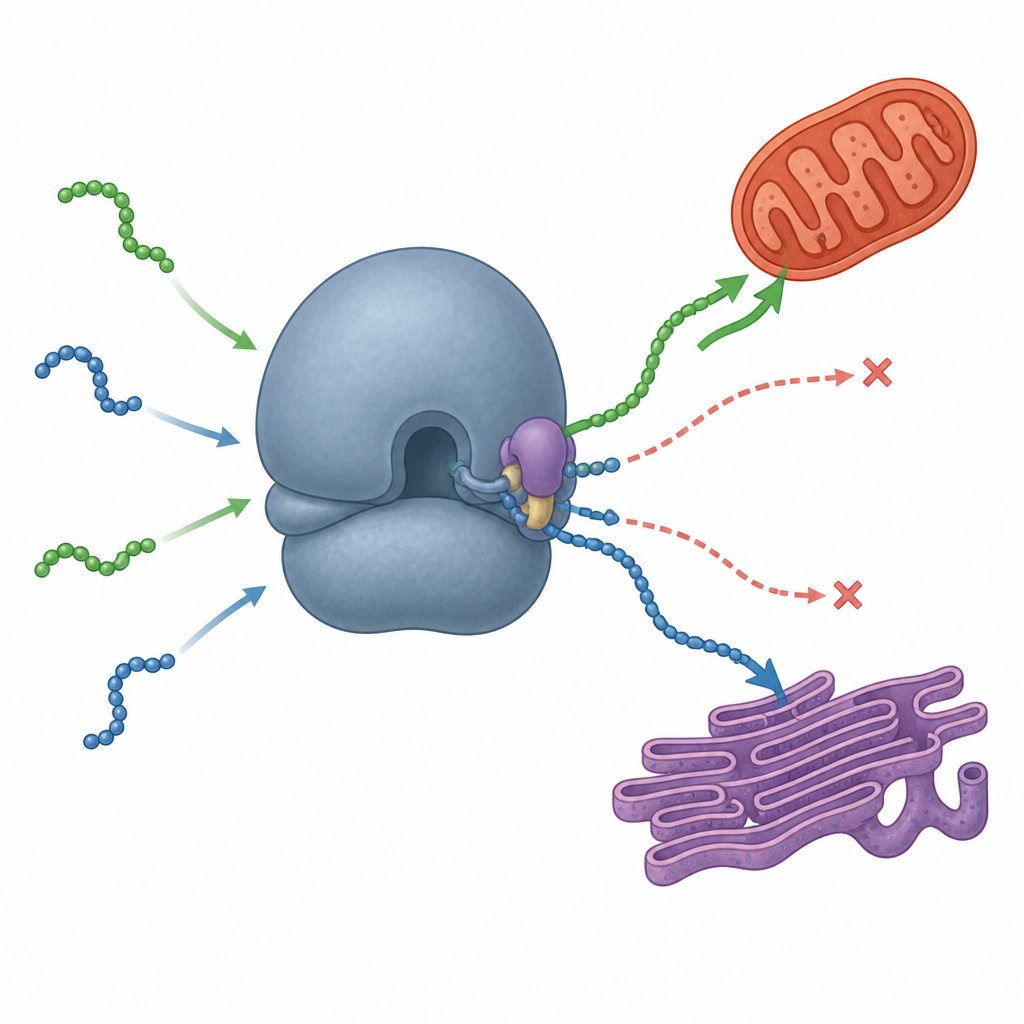
Every second, our cells churn out new proteins that must be delivered to the correct address, such as the energy-making mitochondria or the protein-folding factory called the endoplasmic reticulum (ER). When this delivery system goes wrong, proteins end up in the wrong place, stressing and damaging cells. This study uncovers how a tiny molecular helper, the nascent polypeptide–associated complex (NAC), acts as a safety switch to keep newly made mitochondrial proteins from being hijacked by the wrong delivery route.
A Cellular Quality Control Checkpoint
Protein production begins on ribosomes, the cell’s protein-making machines. As a new protein chain emerges, NAC attaches to the ribosome and “screens” every chain before other transport helpers can act. One such helper, the signal recognition particle (SRP), normally sends proteins to the ER. But many mitochondrial proteins are made in the cell fluid and bear a short “address tag” at their beginning, called a mitochondrial targeting sequence. If SRP mistakenly grabs these chains, they can be dragged to the ER instead of mitochondria, disturbing the balance of the cell. Until now, it was unclear how NAC recognizes these mitochondrial address tags early enough to keep SRP away.
A Shape-Shifting Switch on NAC
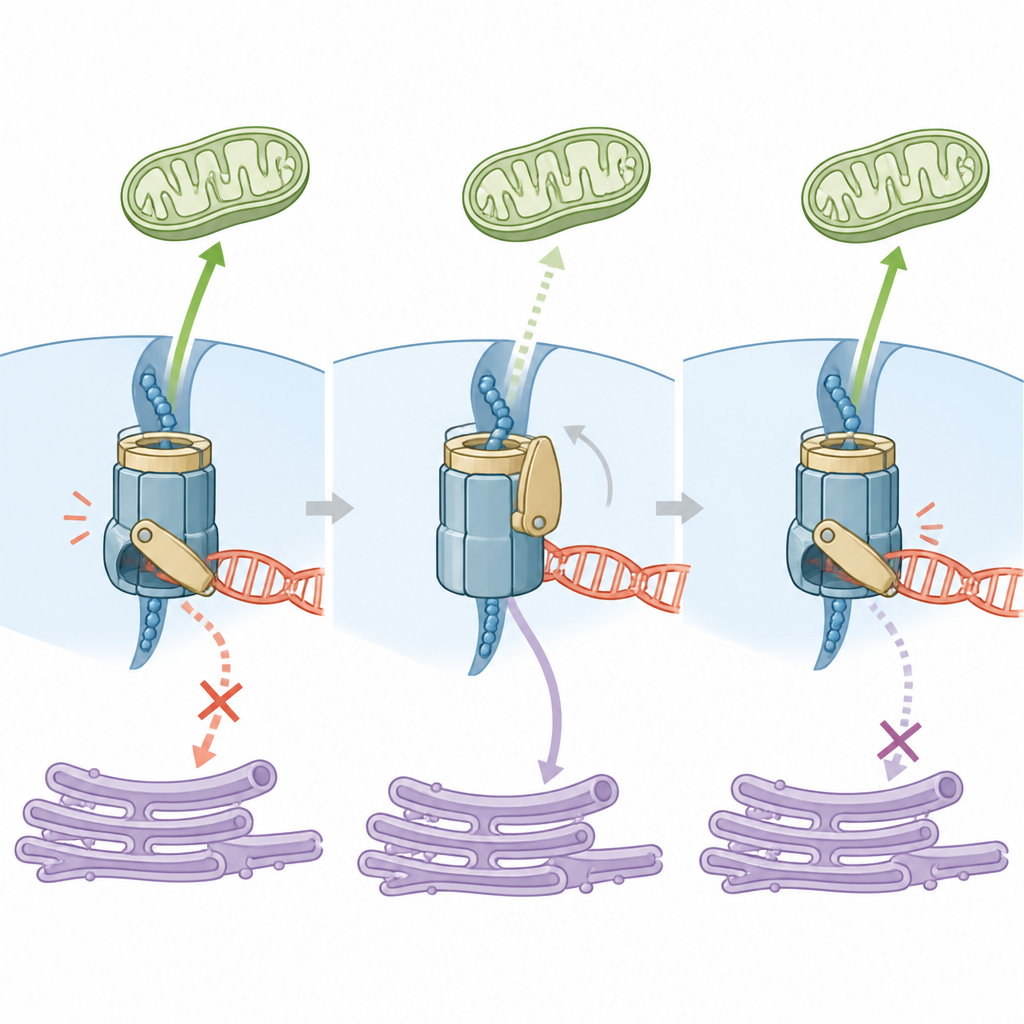
Using high-resolution cryo–electron microscopy, the researchers captured human NAC bound to ribosomes making mitochondrial proteins. They discovered that NAC’s central barrel-shaped region can adopt a special, stabilized pose when a mitochondrial targeting sequence is present. In this pose, the barrel docks against a specific piece of ribosomal RNA known as helix 59. A small cluster of amino acids in the NAC beta subunit acts as a molecular switch that locks the barrel into this position. This rearrangement pulls the barrel slightly away from the ribosome’s exit tunnel while at the same time tightening its grip through new contacts with ribosomal proteins and RNA.
When the Switch Fails, the Guard Weakens
The team then introduced precise mutations either in the mitochondrial targeting sequence of the nascent protein or in NAC’s switch region. Using single-molecule fluorescence techniques, they showed that these mutations made the NAC barrel much more mobile on the ribosome surface and less likely to stay in the stabilized, helix-59–docked pose. Biochemical tests confirmed that mutant NAC bound ribosomes less strongly. Under these conditions, SRP could more easily approach the ribosome exit site and adopt its “active” conformation, which promotes delivery of ribosome–protein complexes to the ER. In cultured human cells lacking functional NAC beta, mitochondrial proteins became misdirected to the ER, acquired sugar modifications typical of ER-resident proteins, and triggered signs of ER stress. Reintroducing normal NAC beta reduced this stress, whereas switch mutants did not.
How Mitochondrial Tags Keep SRP at Bay
Further analysis showed that an intact mitochondrial targeting sequence is necessary to favor the stabilized docking state of the NAC barrel. Removing its characteristic amphiphilic helical segment or replacing it with a classic ER signal sequence destabilized NAC at the exit tunnel. Structural analysis of these altered complexes revealed that NAC could now flip between the helix-59–docked pose and an “undocked” pose closer to the tunnel, similar to what is seen when the ribosome makes ER-bound proteins. In this more dynamic situation, SRP gains access to the tunnel exit and can be activated even on mitochondrial precursors, increasing the risk that they will be drawn toward the ER rather than mitochondria.
Why This Molecular Switch Matters
Together, the findings paint NAC as a gatekeeper that reads early address tags on new proteins and responds by toggling its barrel into a protective conformation. When NAC’s switch is engaged by a mitochondrial targeting sequence, the barrel docks at a specific ribosomal site and forms a barrier that keeps SRP from inappropriately latching on. When the switch is broken, this barrier weakens, mitochondrial proteins are more easily misrouted, and cells experience stress in the ER. This work provides a structural and functional explanation for how cells preserve protein targeting accuracy, which is essential for maintaining healthy protein balance and overall cellular health.
Citation: Maldosevic, E., Gora, R.J., Lin, L.L. et al. A molecular switch in NAC prevents mitochondrial protein mistargeting by SRP. Nat Commun 17, 4495 (2026). https://doi.org/10.1038/s41467-026-71061-3
Keywords: protein targeting, mitochondria, endoplasmic reticulum, nascent polypeptide-associated complex, signal recognition particle