Clear Sky Science · en
Adding 161Dy-Mössbauer spectroscopy to a multitechnique investigation of magnetic transitions in a {CoIII3DyIII3} Single-Molecule Toroic
A Tiny Magnetic Ring with a Hidden Twist
Most of today’s digital memory relies on magnets that behave like tiny bar magnets, pointing either “up” or “down.” But there is another, more subtle way to store information: by arranging magnetic moments in a closed loop, like a microscopic whirlpool. This paper describes a new molecule that hosts such a whirlpool-like magnetic state and shows how a powerful X‑ray technique can reveal exactly when this hidden pattern suddenly flips into an ordinary magnetic state. Understanding and controlling this behavior could one day help engineers design ultra‑compact, robust bits of information at the level of single molecules.
A Molecular Triangle that Acts Like a Ring
The researchers built a complex metal cluster containing three dysprosium ions (the main magnetic actors) arranged as an equilateral triangle and three surrounding cobalt ions that are magnetically quiet but help hold the structure in place. At low temperatures, each dysprosium ion prefers to point its tiny magnetic moment along a particular direction, rather than freely rotating. In this molecule, those preferred directions are arranged so that the three moments circle around the triangle like blades of a propeller, forming what physicists call a toroidal state: the magnetic field curls around inside the molecule and largely cancels out outside it, so the whole object appears almost non‑magnetic even though each ion is strongly magnetic. 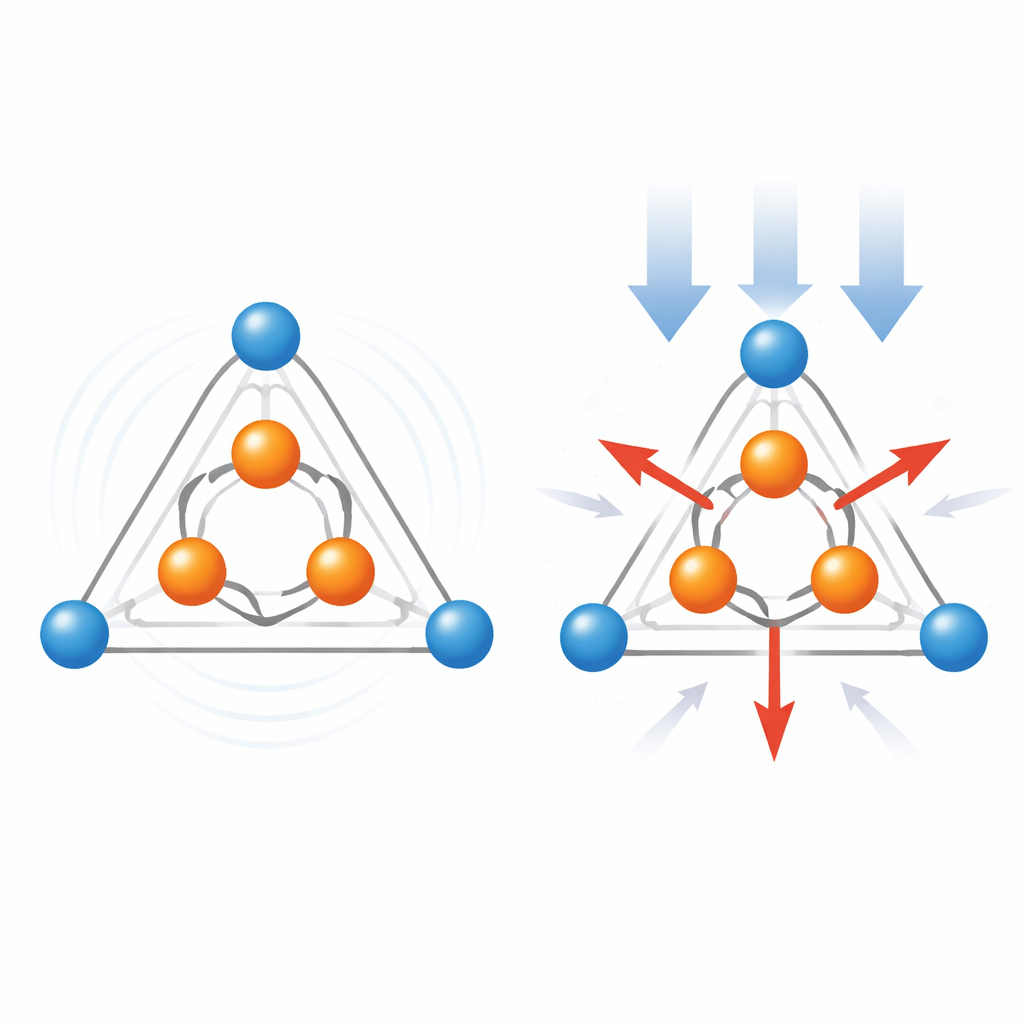
Measuring a Sudden Magnetic Switch
To find out how this delicate toroidal state behaves when a magnetic field is applied, the team first carried out conventional magnetization measurements on crystals and powders. As they increased the field, they saw that the molecule’s net magnetization remained very small up to about half a tesla and then rose sharply, signaling a switch from the almost field‑free toroidal ground state to an excited state where the three dysprosium moments align more like a conventional magnet. Subtle frequency‑dependent measurements of how the magnetization relaxes over time confirmed that more than one relaxation pathway is present and that the switch between states is tied to slow, temperature‑dependent dynamics typical of single‑molecule magnets.
Listening to the Nuclei with X‑rays
The central innovation of this work is the use of 161Dy synchrotron Mössbauer spectroscopy, a time‑resolved X‑ray method that is sensitive to the atomic nuclei sitting at the center of the dysprosium ions. By tracking how resonant X‑ray scattering decays over a few tens of nanoseconds, the authors could infer the internal magnetic field right at each nucleus. At zero applied field, the spectra showed a strong internal hyperfine field but no preferred overall direction, reflecting the random orientations of toroidal moments in the powder. Once the external field exceeded about 0.6 tesla, the spectra changed abruptly: the internal fields became partially aligned, revealing that the molecular moments had collectively turned into a more conventional magnetized state. This sharp change matched the kink seen in the bulk magnetization curves but was even clearer thanks to the ultrafast time window of the Mössbauer technique.
Pinning Down the Invisible Directions
Because the special behavior of this molecule depends critically on how each dysprosium ion is oriented in space, the team combined several single‑crystal techniques to map these directions. Cantilever torque magnetometry measured how the crystal twists in a magnetic field, showing that each dysprosium easy axis lies close to the plane of the triangle but tilted slightly out of it, and that their in‑plane projections follow a propeller‑like pattern consistent with a toroidal arrangement. Micro‑SQUID measurements—ultra‑sensitive magnetization curves on individual tiny crystals—revealed step‑like features and a hexagonal pattern when the field direction was rotated, again supporting this picture. Sophisticated quantum‑chemical calculations then reproduced these orientations in detail and showed that both the internal dipolar interactions between dysprosium ions and their coupling through the surrounding ligands stabilize the toroidal state, while even a “remote” chloride counterion has a measurable effect on the energy levels.
Why This Matters for Future Magnetic Bits
By showing that 161Dy Mössbauer spectroscopy can cleanly detect the field at which a toroidal, nearly non‑magnetic ground state flips into a magnetized state, this study adds a powerful tool to the growing toolbox for probing exotic molecular magnets. The work demonstrates that carefully designed metal clusters can host robust toroidal states whose handedness and switching fields might eventually be used to encode information, potentially offering new routes to dense, low‑interference data storage. It also highlights how seemingly minor ingredients, such as the placement of counterions, can subtly tune the magnetic structure, suggesting new chemical strategies for engineering next‑generation single‑molecule magnetic devices. 
Citation: Peng, Y., Braun, J., Scherthan, L. et al. Adding 161Dy-Mössbauer spectroscopy to a multitechnique investigation of magnetic transitions in a {CoIII3DyIII3} Single-Molecule Toroic. Nat Commun 17, 3864 (2026). https://doi.org/10.1038/s41467-026-71058-y
Keywords: single-molecule magnet, toroidal magnetism, dysprosium cluster, Mössbauer spectroscopy, molecular spintronics