Clear Sky Science · en
Flexible rubber with metal-like thermal conductivity achieved via hydrogen bonding engineering
Why cooler gadgets need softer materials
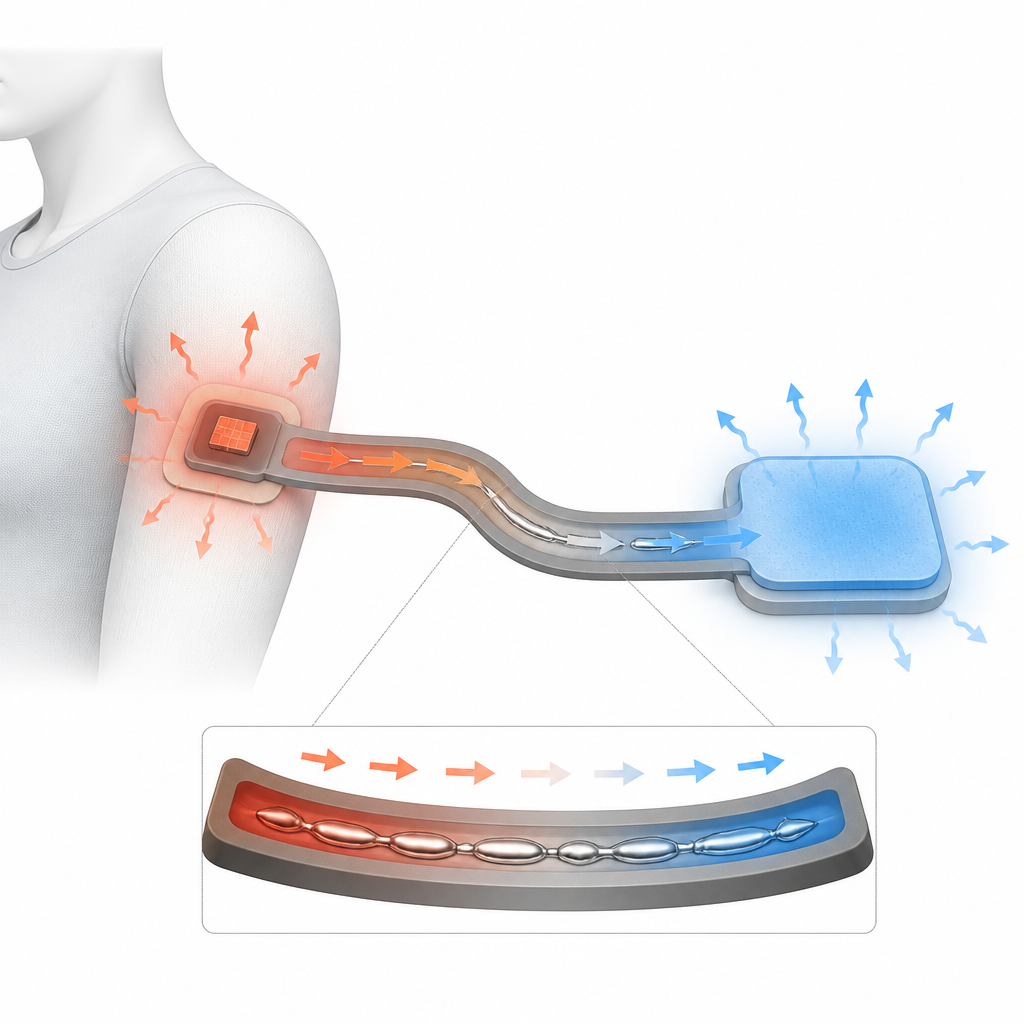
As we surround ourselves with smart watches, fitness bands, and soft robots, one stubborn problem keeps returning: heat. Electronics packed into tight spaces warm up quickly, yet the materials that feel comfortable against our skin usually trap heat like a blanket. This study introduces a new kind of rubbery material that moves heat almost as well as some metals while staying as stretchable as a rubber band, pointing to safer and more reliable wearable electronics.
Balancing bendiness and heat flow
Most flexible plastics and rubbers are excellent at bending but terrible at carrying heat away; their thermal conductivity is typically far below that of metals. Metals, by contrast, conduct heat extremely well but are heavy, rigid, and uncomfortable on the body. For years, engineers have tried to mix hard, heat-conducting particles into soft polymers to get the best of both worlds, but packing in enough particles to move heat usually makes the material stiff and fragile. The authors of this paper focus on breaking this trade-off so that a material can be both soft and an efficient heat pathway.
A liquid metal hidden inside rubber
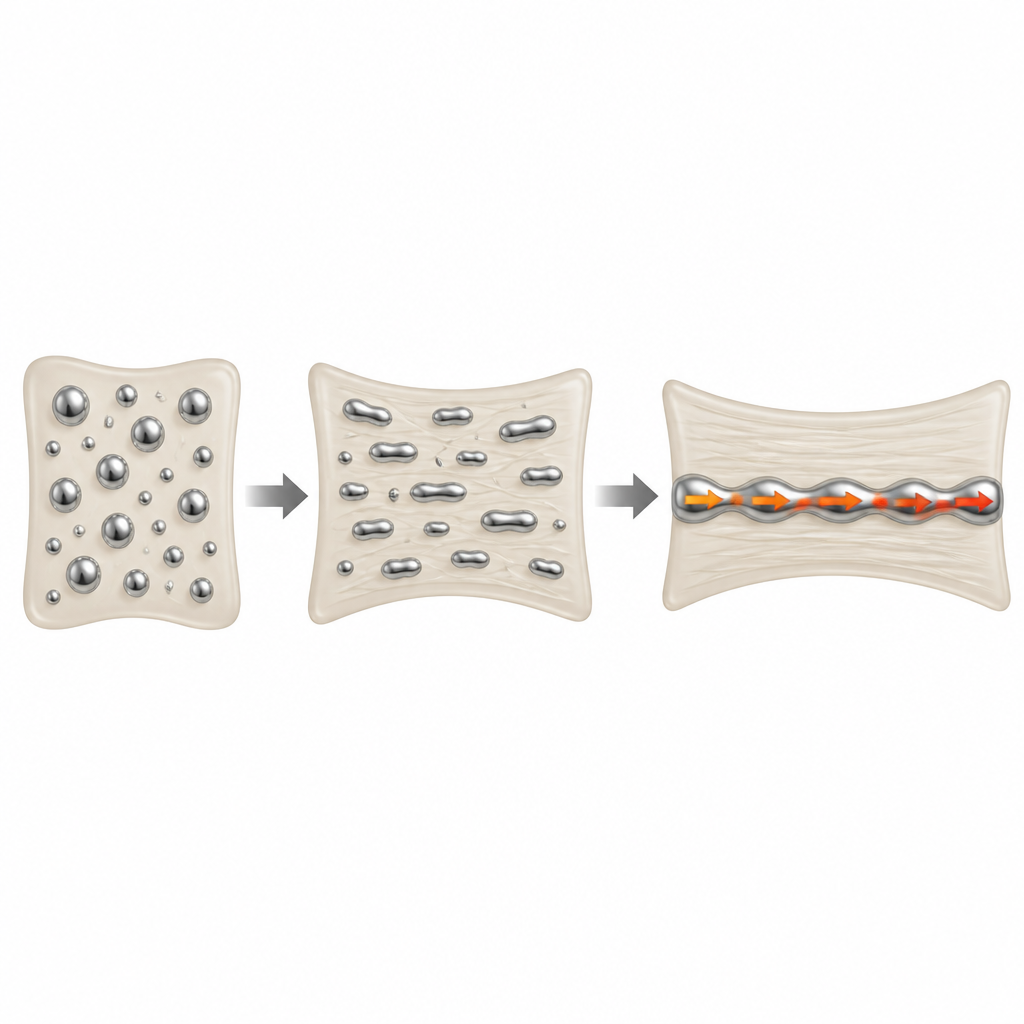
The researchers build their new material around a common flexible plastic called polyurethane and tiny droplets of a liquid metal alloy made from gallium and indium. Because this metal is liquid at room temperature, its droplets can stretch and reshape inside the rubber instead of cracking like solid particles. The challenge is that these droplets naturally behave like isolated islands that do not connect well enough to form continuous highways for heat. To fix this, the team modifies the surface of the droplets so they can interact strongly with the surrounding polymer, encouraging them to sit closer together and form near-continuous paths when the material is stretched.
Guiding heat with invisible molecular hooks
At the heart of the design is careful control of hydrogen bonds, a type of relatively weak attraction between molecules that acts like a reversible hook-and-loop fastener. The scientists tune the chemistry of the polyurethane so it contains a controlled number of sites that can form these bonds. They also graft small molecules bearing nitrogen-based groups onto the oxide skin of the liquid metal droplets. When mixed, the rubber chains and the droplet surfaces form dense networks of hydrogen bonds both within the rubber and at the rubber–metal boundary. Using techniques like infrared spectroscopy and X-ray diffraction, the team shows that these bonds line up and organize the polymer chains, creating more ordered pathways for heat to flow while also tightening the grip between the droplets and the matrix.
Stretching turns droplets into heat highways
When the material, called LiMPuC, is pulled, something remarkable happens on the microscopic level. The liquid metal droplets elongate and align along the direction of the pull, and the hydrogen bonds help keep them in close contact with the surrounding chains. This rearrangement transforms scattered droplets into pearl-like chains that nearly touch, forming efficient channels for heat flow along the stretch direction. Measurements using a custom test setup show that at a moderate metal content of 46 percent by volume, the thermal conductivity climbs to about 23.4 W m-1 K-1 at 400 percent strain, comparable to that of some metals yet achieved in a soft, rubberlike strip. Crucially, the material can still stretch more than seven times its original length and has a high toughness, meaning it can absorb substantial energy before breaking.
What this means for future devices
For everyday users, the key takeaway is that it may soon be possible to wear electronics that stay cool and comfortable even as they flex, twist, and stretch with body movement. By using hydrogen bonds as adjustable molecular hooks, the researchers create a rubber that automatically reorganizes its internal liquid metal network under strain, boosting heat removal when and where it is most needed. This strategy offers a general recipe for building flexible, high-performance thermal materials, with potential roles as skin-like heat spreaders or soft sensors in next-generation wearables and flexible circuits.
Citation: Liu, X., Wen, J., Xu, R. et al. Flexible rubber with metal-like thermal conductivity achieved via hydrogen bonding engineering. Nat Commun 17, 4480 (2026). https://doi.org/10.1038/s41467-026-71056-0
Keywords: liquid metal rubber, thermal conductivity, wearable electronics, flexible materials, heat management