Clear Sky Science · en
Multi-field coupling enhanced plasmonic Moδ+ active site to efficiently hydrolyze ammonia borane
Turning a Safe Powder into Clean Fuel
Hydrogen is often called a clean fuel, but storing and moving this light gas safely is a major challenge. This study explores how to unlock hydrogen from a solid, easy-to-handle chemical called ammonia borane using sunlight and a smartly engineered catalyst, pointing toward safer and more efficient ways to fuel a future hydrogen economy.
Why This Hydrogen Source Matters
Ammonia borane is a compact hydrogen carrier that can hold nearly one fifth of its weight as hydrogen while remaining stable and easy to transport in liquid solutions. To tap this stored gas, water is added and the material is broken down with the help of a catalyst. The problem is that many existing catalysts either rely on costly precious metals or waste much of the incoming light and electric charge, so the reaction proceeds slowly or inefficiently. The authors focus on building a better, low-cost catalyst that can overcome these roadblocks and keep working for long periods.
Building a Smarter Catalyst Surface
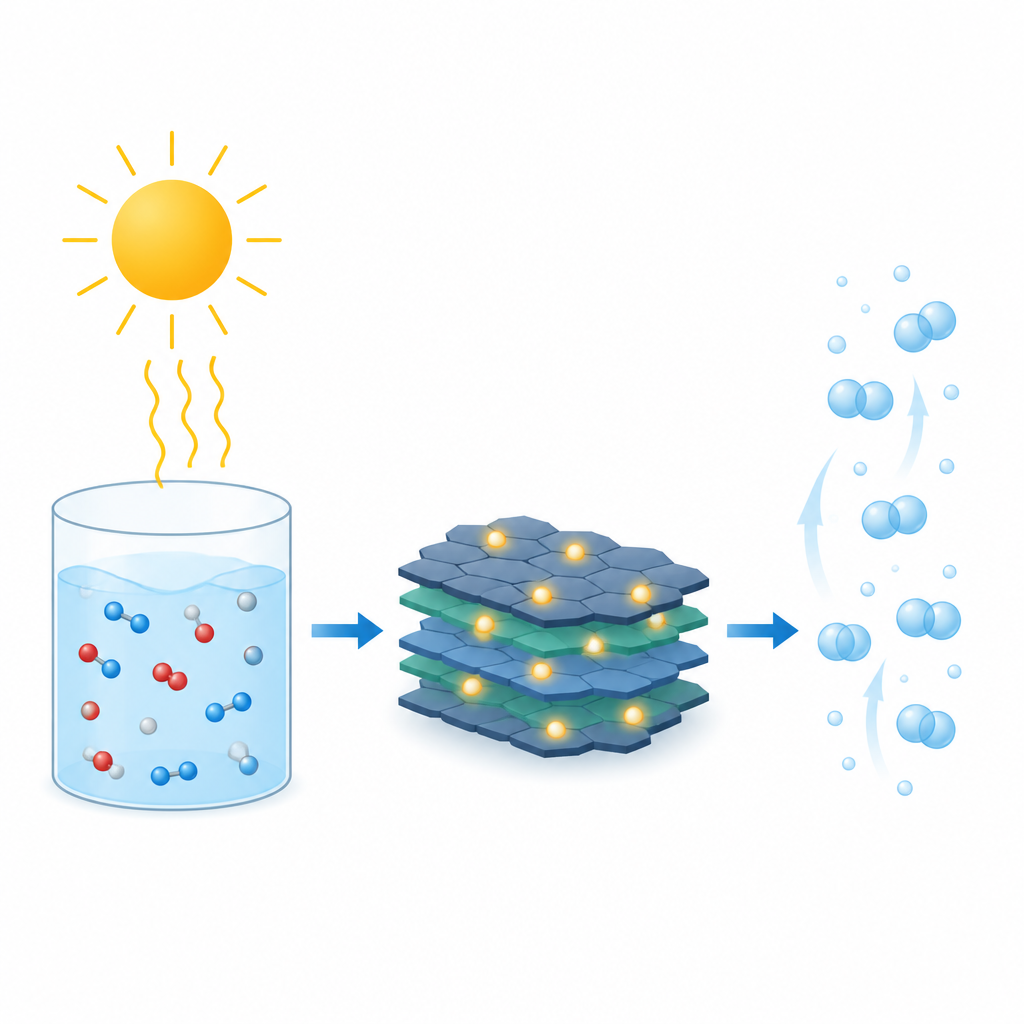
The team designs a catalyst based on molybdenum oxide, a semiconductor that can be heavily “doped” so it behaves partly like a metal and interacts strongly with light. On its surface, special molybdenum sites with an incomplete supply of electrons act like powerful hooks for ammonia borane. Using machine learning, the researchers screen which features of these metal sites most strongly influence how tightly they bind hydrogen-related species. This analysis highlights the importance of having many mobile charge carriers, so they choose a molybdenum oxide with missing oxygen atoms and then attach tiny flakes of a conductive compound called Ti3C2-OH to form a close-contact hybrid structure.
Combining Electric Fields and Light
By carefully joining these two materials, the researchers create what they call a multi-field coupling system. At the interface, differences in charge and the presence of oxygen vacancies and hydroxyl groups generate a built-in electric field that naturally pulls electrons and holes apart, steering extra electrons toward the active molybdenum sites. At the same time, both components behave like tiny antennas for light, especially in the near-infrared part of the spectrum. When illuminated, their electrons oscillate collectively and form intense local electric fields that produce “hot” electrons with extra energy. Experiments and simulations show that these fields are much stronger in the combined material than in either component alone, and that more energetic electrons linger near the reaction sites for longer times.
How Bonds Break and Hydrogen Forms
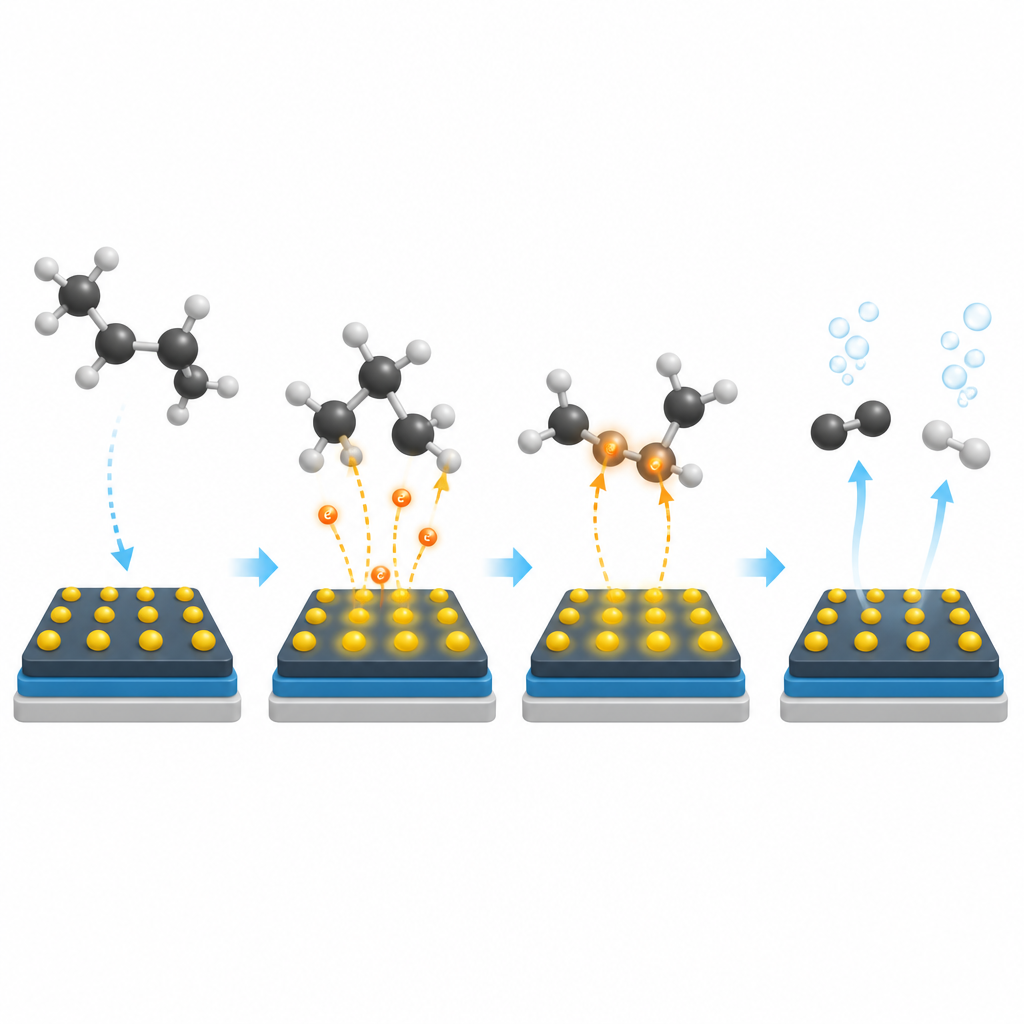
On the catalyst surface, ammonia borane first attaches to a molybdenum site: the molecule donates some of its electron density to the metal, and the metal in turn feeds electrons back into a weakened bond between boron and hydrogen. This two-way flow makes that bond easier to stretch and break. The built-in electric field further boosts electron density at the molybdenum sites, strengthening this feedback route into the antibonding region of the boron–hydrogen link. Local electric fields from the plasmon effect then add hot electrons that lower the energy barrier even more. Simulations and in-situ infrared measurements reveal that the boron–hydrogen bonds, not the water–hydrogen bonds, now become the slowest and most crucial step in the reaction, and these bonds are steadily weakened and broken as the reaction proceeds.
Performance and Stability in Action
Under simulated sunlight, the new catalyst releases hydrogen from ammonia borane far faster than either of its individual components or comparable multi-part systems. Even when the reactor is cooled to remove simple heating effects, the material maintains very high hydrogen production rates, and it continues to operate effectively for at least 100 hours without losing structure or activity. When temperature is allowed to rise, local heating from the light-absorbing plasmon effect provides an additional boost, showing that both electronic and thermal contributions are at work. Overall, the catalyst’s turnover frequency rivals or surpasses those of many systems based on expensive noble metals.
What This Means for Future Hydrogen Fuel
In everyday terms, this work shows how carefully shaping a catalyst at the atomic level and harnessing different types of electric fields can make it much easier to pull hydrogen out of a safe chemical storehouse. By combining a charge-separating interface with strong light-driven effects, the researchers create a surface that grabs ammonia borane, weakens its key bonds, and quickly releases hydrogen over many cycles. While more steps remain before such systems reach real-world devices, the study offers a clear strategy for designing future solar-driven materials that produce clean hydrogen efficiently without relying on scarce precious metals.
Citation: Li, P., Tu, N., Yang, Y. et al. Multi-field coupling enhanced plasmonic Moδ+ active site to efficiently hydrolyze ammonia borane. Nat Commun 17, 4576 (2026). https://doi.org/10.1038/s41467-026-71055-1
Keywords: hydrogen storage, ammonia borane, photocatalyst, plasmonic catalyst, solar hydrogen