Clear Sky Science · en
Bleb-based extravasation uses conserved morphodynamics but divergent calcium control
Cells on the move
When cells leave the bloodstream and invade tissues, the results can be life giving or life threatening. Our germ cells must exit tiny vessels to reach the future gonads and make eggs or sperm, while cancer cells use the same escape route to seed metastases. This study reveals that many of these travelers push their way out by briefly ballooning their surface, a motion called blebbing, and that they power this motion with internal bursts of calcium controlled in two very different ways.
How cells squeeze out of blood vessels
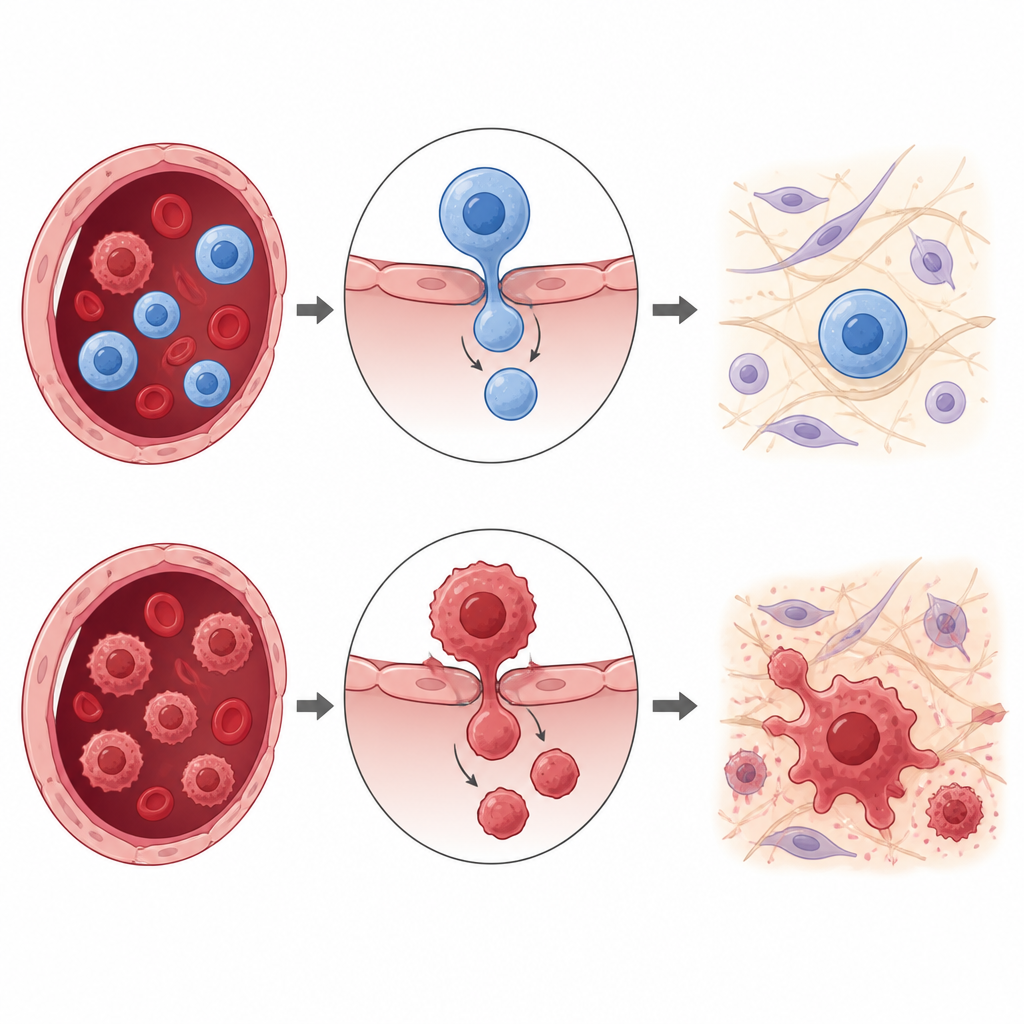
To understand this escape act, the researchers turned to bird embryos, whose early blood vessels are flat and transparent, making them ideal for high resolution movies of single cells on the move. They followed avian primordial germ cells, the ancestors of sperm and egg, as the cells first drifted in the blood, then crawled along the vessel wall, and finally squeezed through it into surrounding tissue. During the key exit step, instead of reaching out flat feet like many migrating cells, these germ cells repeatedly formed smooth, round bulges on their surface that grew, pushed outward, and then shrank. Similar bulges appeared when several human cancer cell types were transplanted into the same vessels, showing that normal and malignant cells share a common physical escape strategy.
Calcium pulses that inflate cellular balloons
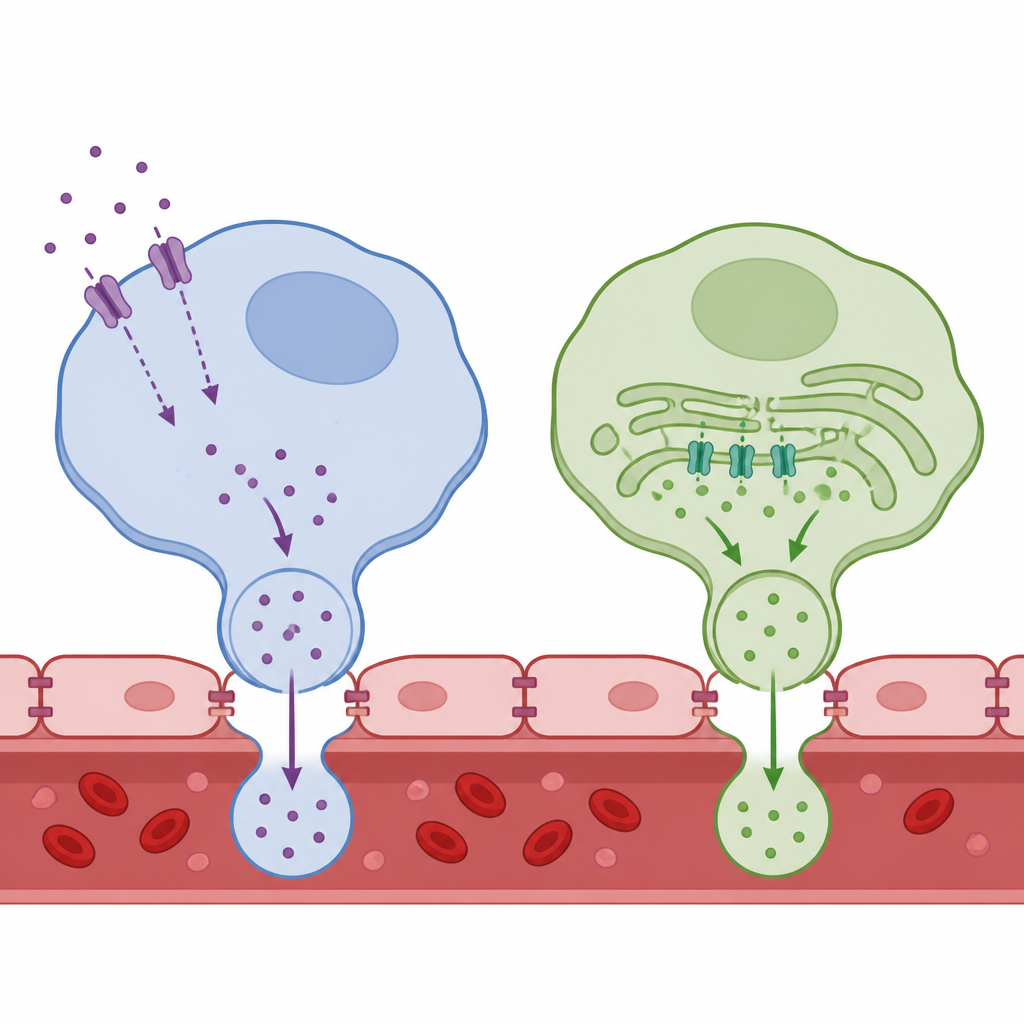
The bulges are not random. By tagging the cells’ skeleton and calcium levels with glowing markers, the team saw that each bleb began where the surface briefly detached from its supporting actin meshwork. At the same spot, calcium inside the cell spiked, the fluid interior softened, and cytoplasm rushed into the bulge. As the bleb collapsed, actin rebuilt the cortex. In germ cells, artificially raising calcium was enough to trigger repeated blebbing, while blocking calcium entry from outside the cell almost completely stopped it. The work showed that a specific route called store operated calcium entry, in which sensors in the endoplasmic reticulum open pores in the surface membrane, is both present and active in these germ cells, and is needed for them to crawl and migrate efficiently in lab tests.
Two paths to fuel the same motion
When the scientists studied cancer cells, they found a split in strategy. A fibrosarcoma line, HT 1080, behaved like germ cells: it relied on store operated entry from the space outside the cell to power bleb formation and vessel escape, and blocking the key pore protein Orai sharply reduced its ability to cross the vessel wall. But two epithelial cancer lines, PC 3 prostate cells and MDA MB 231 breast cells, kept right on blebbing when this pathway was shut down or when external calcium was soaked up. In these cells, fine tendrils of endoplasmic reticulum reached into the bulges and released calcium directly from internal stores through IP3 receptors. Drugs or genetic tools that disabled these receptors cut down blebbing and made it harder for the cancer cells to extravasate, even though the basic machinery for store operated entry was still present.
What this means for development and cancer
Despite their different calcium plumbing, all of the cell types studied rely on the same basic shape changes to exit blood vessels: rounded, pressure driven blebs that momentarily free the surface from its supporting scaffold. The authors argue that this shared behavior reflects an ancient, conserved escape program that can be powered by either external calcium entry or internal release, depending on the cell’s lineage and needs. Germ cells and some cancers favor a precise, surface based route, while other cancers tap into an older, more self contained release system. For readers, the key idea is that metastatic cells may borrow both developmental tricks and ancestral survival tools to invade new tissues, and that therapies will need to match the particular calcium supply route a tumor uses if they are to block its spread effectively.
Citation: Morita, M., Morimoto, M., Ikenouchi, J. et al. Bleb-based extravasation uses conserved morphodynamics but divergent calcium control. Nat Commun 17, 4422 (2026). https://doi.org/10.1038/s41467-026-71052-4
Keywords: cell migration, cancer metastasis, calcium signaling, membrane blebbing, extravasation