Clear Sky Science · en
Programmable multimodal actuation in cholesteric liquid crystal elastomer hollow fibers beyond mechanochromism
Colorful fibers that move on command
Imagine a material that not only changes color like a mood ring but also stretches, squeezes, and twists like an artificial muscle. This study introduces such fibers, which can shift their shape and color together when gently inflated, pointing toward new possibilities for soft robots, smart textiles, and visual sensors that communicate through motion and hue.
From smart liquids to living-like fibers
The fibers are made from a special class of materials called liquid crystal elastomers, which combine the orderly structure of liquid crystals with the rubbery flexibility of elastomers. In their cholesteric form, these materials naturally form a helical nanoscale pattern that reflects vivid colors, much like the iridescent sheen on beetle shells. Traditionally, these cholesteric elastomers are valued mainly because they change color when stretched. However, their helical structure averages out internal directionality, so they tend to deform like ordinary rubber, limiting how precisely their shape can be controlled. The authors set out to turn these “one-trick” color-changing materials into fully programmable actuators that can carry out specific motions while still providing bright structural color.
Building hollow fibers that remember direction
To achieve this, the team first developed a template method to make hollow fibers with uniform walls and strong reflected colors. A liquid mixture containing rod-like building blocks, a chiral additive to create the helix, and specialized crosslinkers was drawn into a cylindrical mold. As solvent slowly evaporated, the liquid crystals self-assembled into a periodic helical structure. Light-driven crosslinking then locked this structure into a solid yet flexible tube. Initially, the inner molecules pointed in many directions along the length, so the fiber behaved nearly the same in all in-plane directions. By adjusting the amount of chiral additive, the researchers could tune the fiber’s color from red to green to blue, confirming precise control over the internal pitch of the helix.
Teaching fibers to respond to air pressure
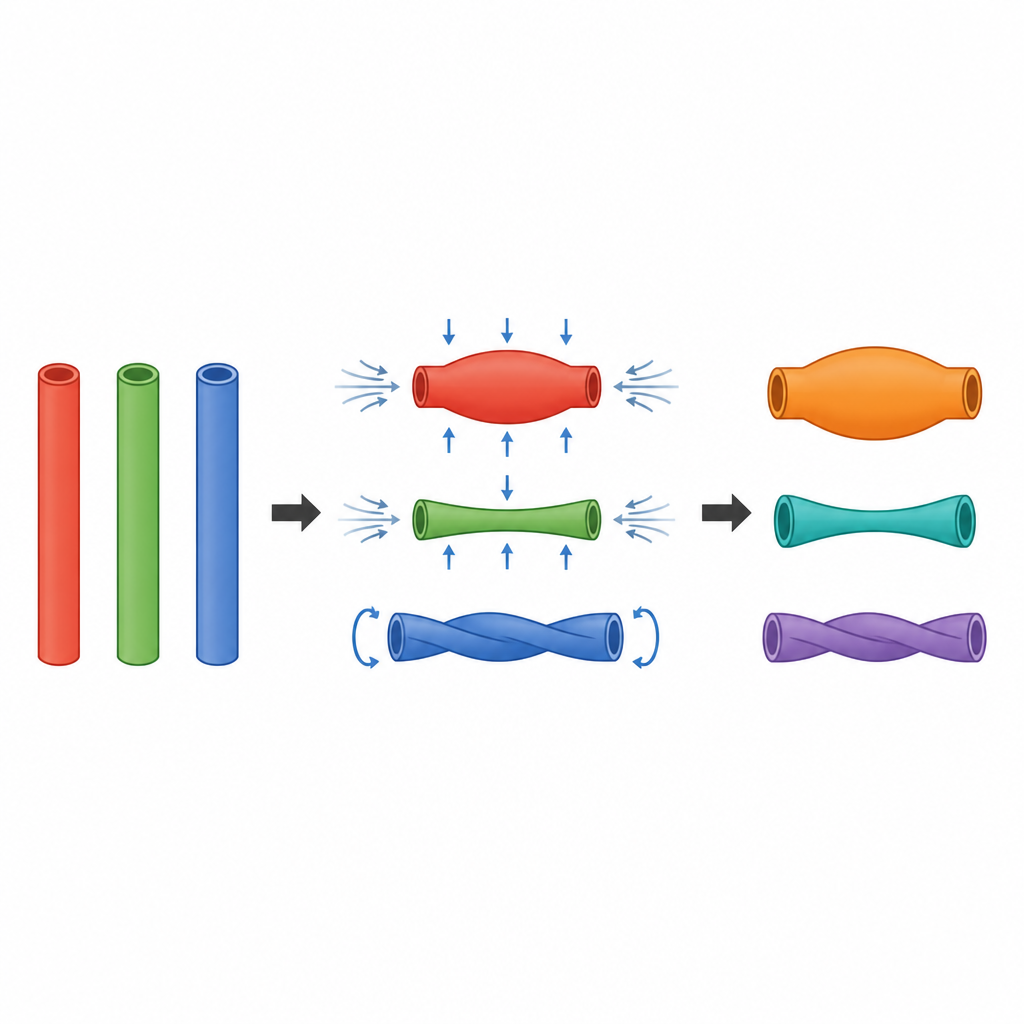
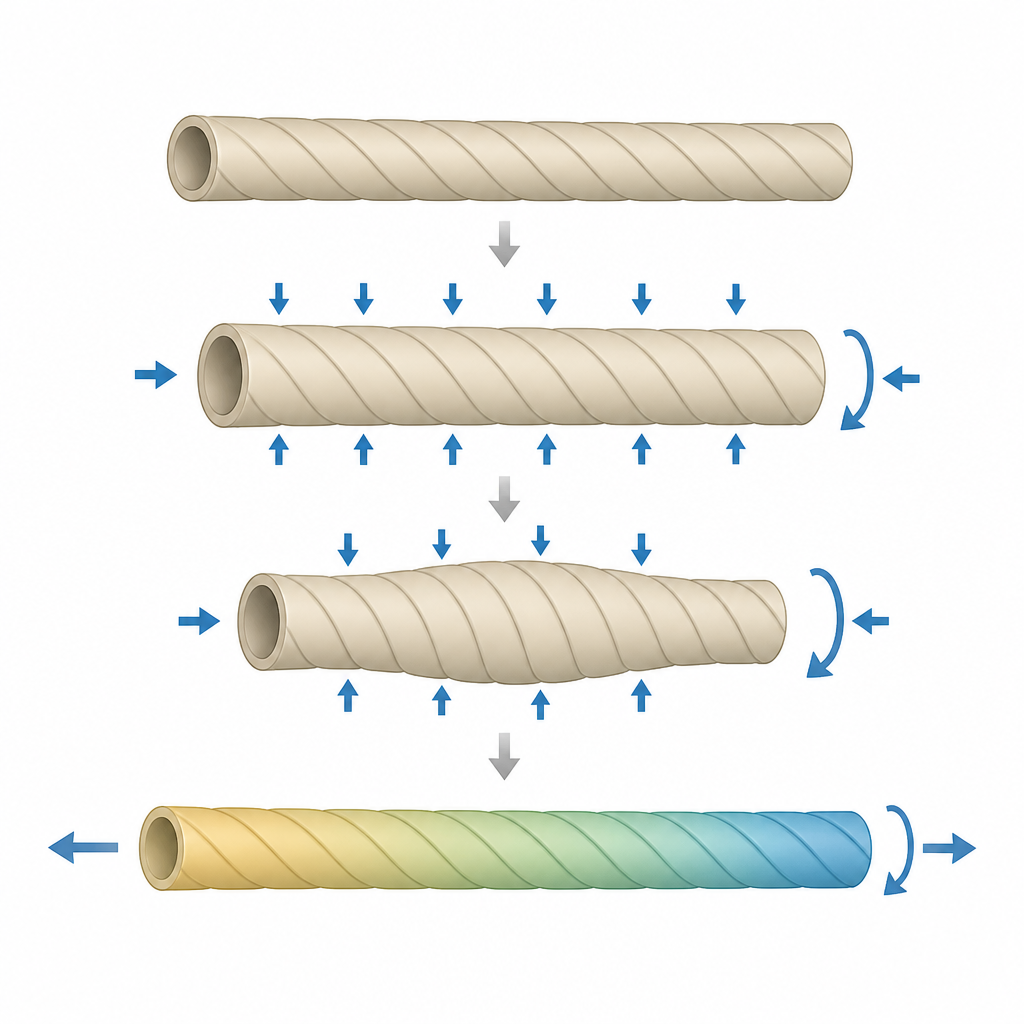
The key advance was to program the internal “grain” of the molecules after the fibers were made. The authors introduced dynamic boronic ester bonds, which can rearrange at moderate temperatures without destroying the overall network. By stretching, twisting, or inflating the fiber while gently heating it, they allowed these bonds to exchange and freeze in new global orientations. In this way they created fibers whose internal alignment ran mainly along the length, mainly around the circumference, or at a controlled slant forming a twisted pattern. When air was pumped into the hollow core, these different alignments led to strikingly different behaviors. Some fibers bulged outward while shortening, some elongated, and others twisted dramatically, all while their color smoothly shifted across the visible spectrum.
Hidden mechanics behind shape and color
To make sense of these complex motions, the researchers built a theoretical model that treats each fiber as a thin elastic membrane with a programmed internal direction field. Under inflation, the wall experiences more stress around its circumference than along its length. Depending on how the molecules were initially oriented, this imbalance can drive them to rotate within the solid, a process that costs very little energy and can trigger sudden, non-intuitive changes in shape. For example, fibers aligned along their length showed a “plateau-then-jump” response: they barely changed until a critical pressure, then abruptly contracted by about half while their diameter more than doubled. Twisted fibers showed even richer behavior, first twisting further in one direction, then partially untwisting and reversing as pressure increased. In every case, the same internal reorientation that reshaped the fiber also altered the spacing of the helical pattern, shifting the reflected color toward shorter, bluer wavelengths.
Why this matters for future soft machines
By combining programmable internal alignment, pneumatic actuation, and structural color, these hollow fibers act as both muscles and eyes in a single material. They can expand, contract, elongate, or twist in a pressure-dependent way, while simultaneously signaling their state through vivid color changes that span the visible range. The work shows that what was once mainly a color-changing coating can be turned into a versatile building block for soft robotics, adaptive camouflage, and smart fabrics, where shape and color responses can be designed together or even tuned separately for highly customized, responsive systems.
Citation: Ma, J., Biggins, J.S., Feng, F. et al. Programmable multimodal actuation in cholesteric liquid crystal elastomer hollow fibers beyond mechanochromism. Nat Commun 17, 4510 (2026). https://doi.org/10.1038/s41467-026-71050-6
Keywords: liquid crystal elastomer, cholesteric fiber, soft robotics, pneumatic actuator, mechanochromic materials