Clear Sky Science · en
Dnmt1 mediates epigenetic restriction of invasive traits in clonal crayfish
Why a single crayfish matters
Across ponds, canals and backyard aquariums, a small crustacean known as the marbled crayfish is quietly rewriting the rules of invasion biology. This all-female species reproduces by cloning itself, so its global population is almost genetically identical—yet it spreads rapidly and thrives in many environments. This paper explores how a molecular "dimmer switch" inside its cells helps tune behavior and body systems, shaping whether these animals stay put or boldly push into new habitats.
A clonal invader with surprising flexibility
The marbled crayfish has colonized lakes and rivers in more than twenty countries despite carrying almost no genetic variation. Traditional evolution cannot easily explain such success, so researchers turned to epigenetics—chemical tags on DNA that adjust how genes are used without changing the underlying code. The team focused on one key enzyme, Dnmt1, which maintains a common DNA mark called methylation inside genes. Earlier work hinted that marbled crayfish carry less of this marking than their non-invasive ancestors, suggesting a looser, more flexible form of biological control.
When the environment flips the internal switch
To see whether real-world conditions can nudge this molecular switch, the scientists exposed crayfish to sudden cold and to a drastic change in water quality. In both cases, levels of Dnmt1 in circulating blood cells dropped sharply, while related enzymes barely changed. This showed that environmental shocks can specifically dial down the methylation machinery. The researchers then mimicked this effect more directly: they injected double-stranded RNA designed to silence the Dnmt1 gene throughout the body, producing a stable, long-lasting reduction of the enzyme in many tissues.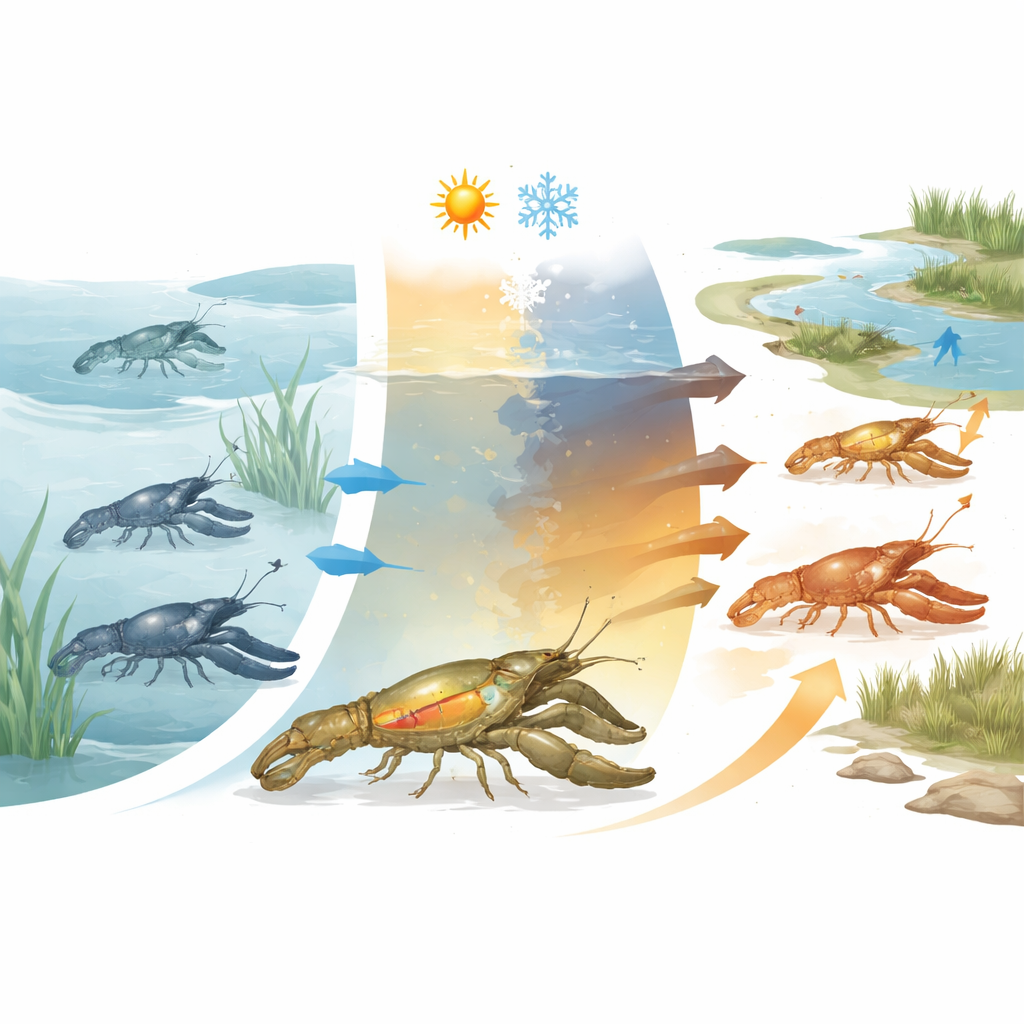
From molecular changes to bolder behavior
The next question was whether this invisible molecular shift alters how the animals act. In a plus-shaped maze with bright and dark arms, crayfish with reduced Dnmt1 spent less time sitting still, paused for shorter periods, and attempted to climb more often. They also ventured more into the light, a zone crayfish usually avoid. When all behavioral measures were analyzed together, the treated animals clearly separated from untreated controls, displaying a pattern of greater activity, boldness and exploration—traits that earlier studies have linked to successful spread of invasive crayfish.
Rewiring blood cells and brain support
Behavior sits atop a cascade of cellular events. Using imaging and single-cell RNA sequencing, the team mapped the different blood cell types that circulate in marbled crayfish. Normally, immature cells can either become powerful granular immune cells or transform into precursors that migrate to the brain and generate new neurons. After Dnmt1 was knocked down, the balance tipped: mature immune cells expanded, while neuron-producing precursors were sharply depleted. At the DNA level, whole-genome analysis showed a widespread loss of methylation within gene bodies, especially in genes involved in nerve function and immunity. These genes also changed their activity, and the physical packaging of DNA around protein spools (nucleosomes) became less regular, hinting that the chromatin landscape itself had been destabilized.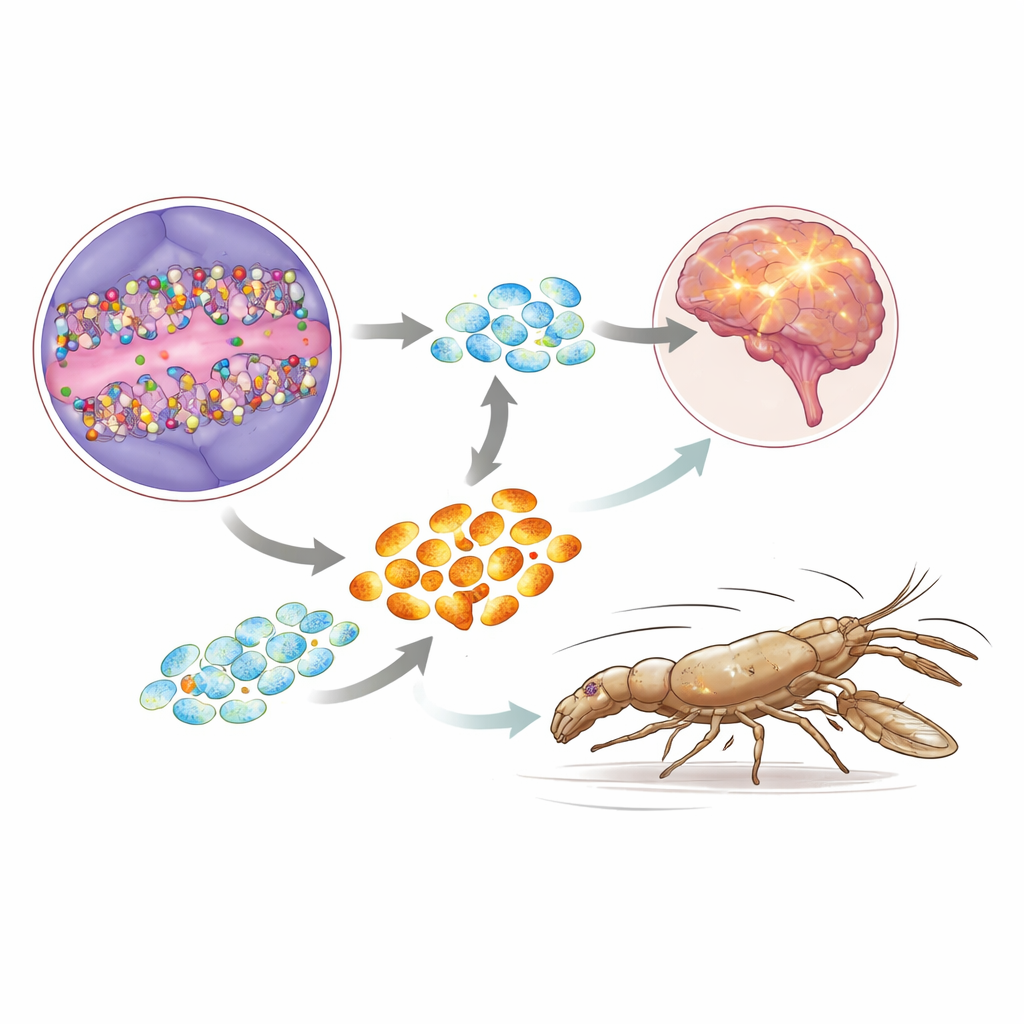
A new view of how invasiveness can emerge
Taken together, the findings suggest that Dnmt1 acts as a molecular brake that channels development and behavior into a narrower, more predictable range. When this brake is relaxed—either by environmental stress or experimental knockdown—DNA methylation within genes falls, nucleosomes become less orderly, blood cells choose different fates, and crayfish grow bolder and potentially better equipped to cope with new threats. For a clonal species, such epigenetic loosening may substitute for genetic diversity, giving rise to flexible, invasion-ready phenotypes without altering the DNA sequence itself.
What this means for ecosystems
For non-specialists, the key message is that the success of some invasive species may hinge less on new mutations and more on how existing genes are managed. In marbled crayfish, Dnmt1 helps keep behavior and cell types within bounds; turning it down makes individuals more adventurous and may strengthen aspects of their immune system, improving their odds in unfamiliar waters. By identifying this enzyme as a central hub that links environmental change to shifts in behavior and physiology, the study offers a concrete example of how epigenetic mechanisms can fuel biological invasions—and hints that tracking such molecular signatures could one day help forecast and manage emerging invaders.
Citation: Diaz-Larrosa, J.J., Carneiro, V., Hanna, K. et al. Dnmt1 mediates epigenetic restriction of invasive traits in clonal crayfish. Nat Commun 17, 2954 (2026). https://doi.org/10.1038/s41467-026-71049-z
Keywords: marbled crayfish, epigenetics, DNA methylation, biological invasions, animal behavior