Clear Sky Science · en
Formation of S- and Z-twist supramolecular micro-ropes by peptide stereoisomers
Why tiny molecular ropes matter
Ropes are among humanity’s oldest tools, from hauling stones to climbing mountains. Nature also relies on rope-like structures, such as collagen in skin, bone, and tendons, to give tissues strength. This study shows how chemists can build microscopic ropes from very short pieces of protein, and even choose whether these tiny ropes twist to the left or to the right. Understanding and controlling such twists could help create new materials for technology and medicine that are strong yet precisely structured at the molecular level.
From everyday ropes to molecular ropes
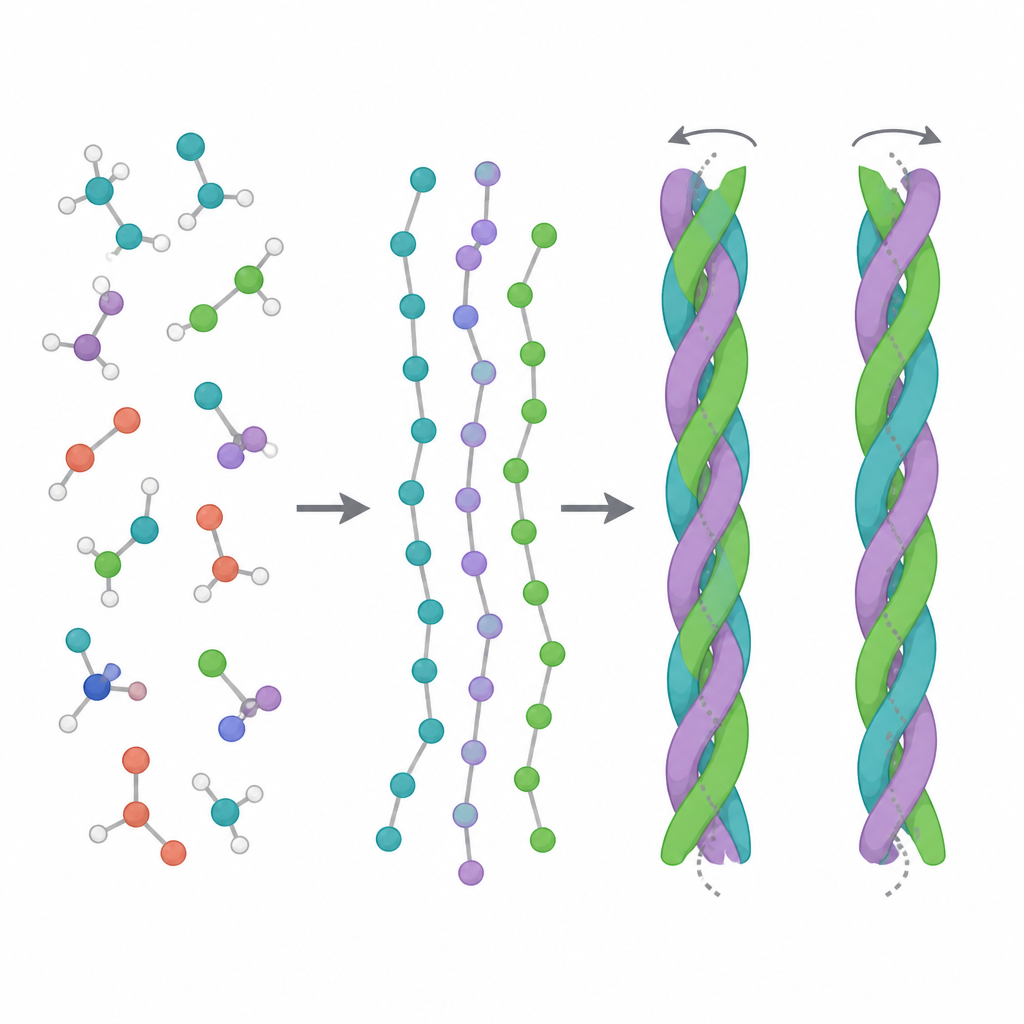
Traditional ropes are made by twisting fibers together, which makes them stronger than a single strand. In our bodies, collagen follows a similar idea: three chains wrap around each other into a stable triple helix that gives tissues mechanical support. However, natural collagen always twists in just one direction. The authors wanted to know whether they could recreate rope-like architectures using far smaller building blocks than collagen, and, crucially, whether they could tune the direction of twist much like engineers choose left- or right-handed industrial ropes.
Building ropes from tiny ring-shaped peptides
The team focused on minimalist molecules called cyclic dipeptides, made from only two amino acids: tryptophan and proline. They prepared several mirror-image versions of these ring-shaped units and dissolved them in hot water, then slowly cooled the solutions so that crystals could grow. Microscopy showed long, hexagonal rod-like crystals that grew in a preferred direction, hinting at an ordered internal structure. Spectroscopy and X-ray diffraction experiments revealed that inside these crystals, the small peptide rings lined up and linked together through hydrogen bonds and aromatic attractions, forming helical strands that then wrapped around each other into triple helices resembling molecular-scale ropes.
Choosing the twist with a single chemical handle
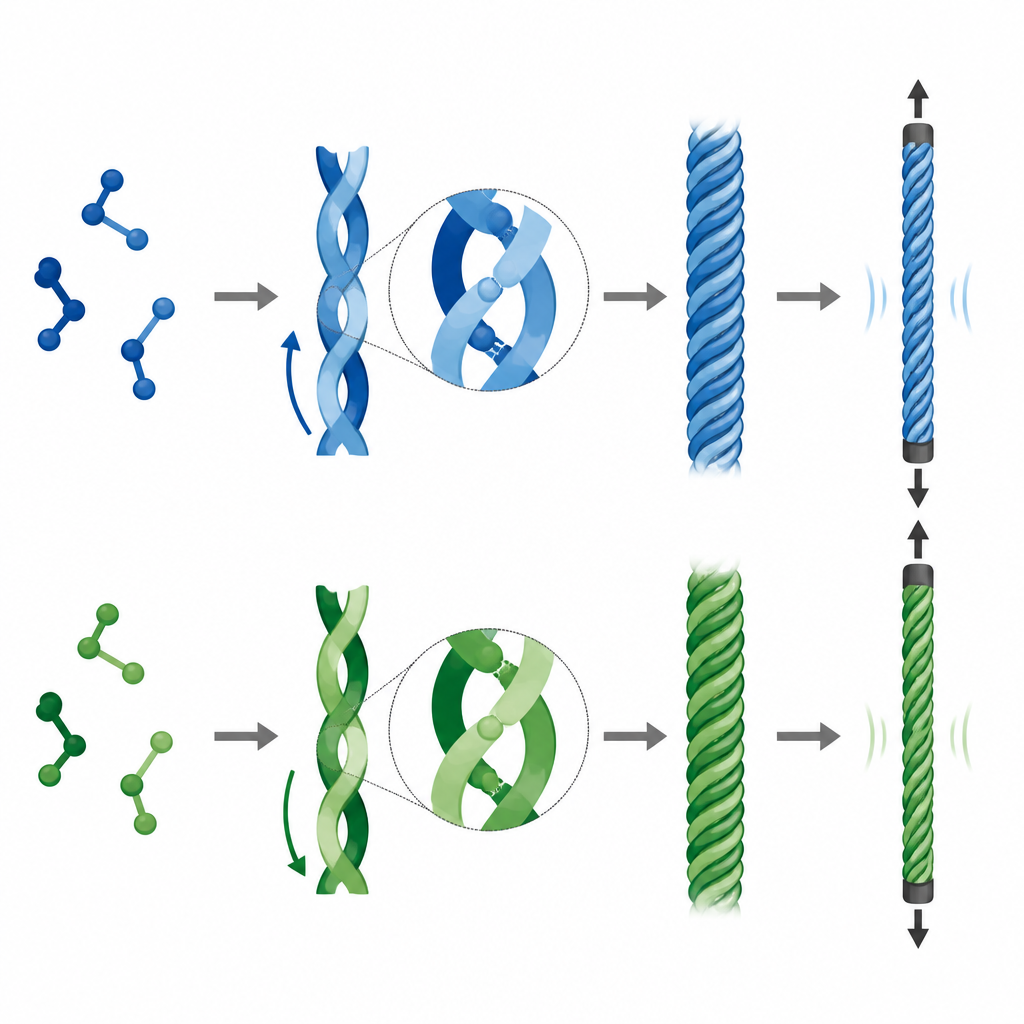
A striking discovery was that the overall twist of these peptide micro-ropes was dictated almost entirely by the handedness of a single tryptophan residue in each ring. When the tryptophan had the natural L-form, the triple helices adopted an S-type (left-like) twist; when the D-form was used, the architecture flipped to a Z-type (right-like) twist. Computer simulations showed how the orientation of key hydrogen bonds between tryptophan segments rotated along the length of the crystal, steering the entire bundle into one twist or the other. Additional water molecules sometimes slipped into the structure, forming extra hydrogen bonds that tightened and stabilized the helical ropes without changing their basic handedness.
Mixing building blocks and testing strength
To test how robust this control was, the researchers mixed different stereochemical variants and allowed them to crystallize together. When both left- and right-handed tryptophan units were present, the resulting crystals lost their triple-helix rope-like packing and instead formed layered arrangements, showing that mixed handedness disrupts the twisting pattern. In contrast, mixtures that kept tryptophan’s handedness consistent but varied proline still produced rope-like structures with the same overall twist. Mechanical tests on single crystals revealed that these peptide micro-ropes could bear significant tensile loads. In particular, water-containing S-twist ropes showed higher stiffness than their right-twisted or non-rope counterparts, highlighting how intertwined helices and dense hydrogen-bond networks combine to resist stretching.
What this means for future materials
By demonstrating that the global twist and strength of molecular ropes can be programmed through the handedness of just one amino acid, this work opens a path to designing new collagen-inspired materials from very simple building blocks. Such controllable, microscopic triple helices could be tailored for applications where chirality, or handedness, matters, such as sensing, selective molecular recognition, or advanced optical and biomedical devices. In essence, the study shows that by tweaking molecular “left” and “right,” scientists can tune not only the shape but also the mechanical performance of materials built from the bottom up.
Citation: Yuan, H., Yang, Z., Yuan, C. et al. Formation of S- and Z-twist supramolecular micro-ropes by peptide stereoisomers. Nat Commun 17, 4424 (2026). https://doi.org/10.1038/s41467-026-71043-5
Keywords: peptide self-assembly, supramolecular ropes, triple helix, chirality, biomimetic materials