Clear Sky Science · en
Nonaromatic polymer-deep eutectic solvent complexes with ultralong room-temperature and high-temperature phosphorescence
Glowing materials that keep shining
Imagine a soft plastic that keeps glowing long after you turn off a UV lamp, and keeps doing so even when it is hot. This study reports such materials made from simple, non-aromatic polymers and special liquid mixtures, offering new options for glowing paints, security inks, and sensors without relying on metals or complex aromatic molecules.
Why making long-lived glow is hard
Many organic materials can shine, but keeping that light on for a long time at room temperature is challenging. The type of glow explored here, called phosphorescence, relies on fragile excited states that are easily lost as heat, especially when molecules can wiggle or when the material gets warm. Earlier successes mostly used rigid, aromatic molecules and intricate crystal engineering to slow molecular motion, but these systems often struggle to combine long glow times with high brightness and to survive at high temperature.
Turning a soft gel into a tough long-glow solid
The researchers started from a simple water-rich gel made of polyacrylamide, a common non-aromatic polymer that only glows weakly. They then replaced the water inside the gel with a deep eutectic solvent, a thick liquid formed by mixing two small molecules, one of which contains bromine. After this solvent exchange, they “wet annealed” the material by gently heating it while the solvent was still present. This treatment produced a polymer–solvent complex in which only about one tenth of the weight is liquid, yet the structure becomes denser, tougher, and more transparent as annealing temperature rises.
How strong bonding and bromine lock in the light
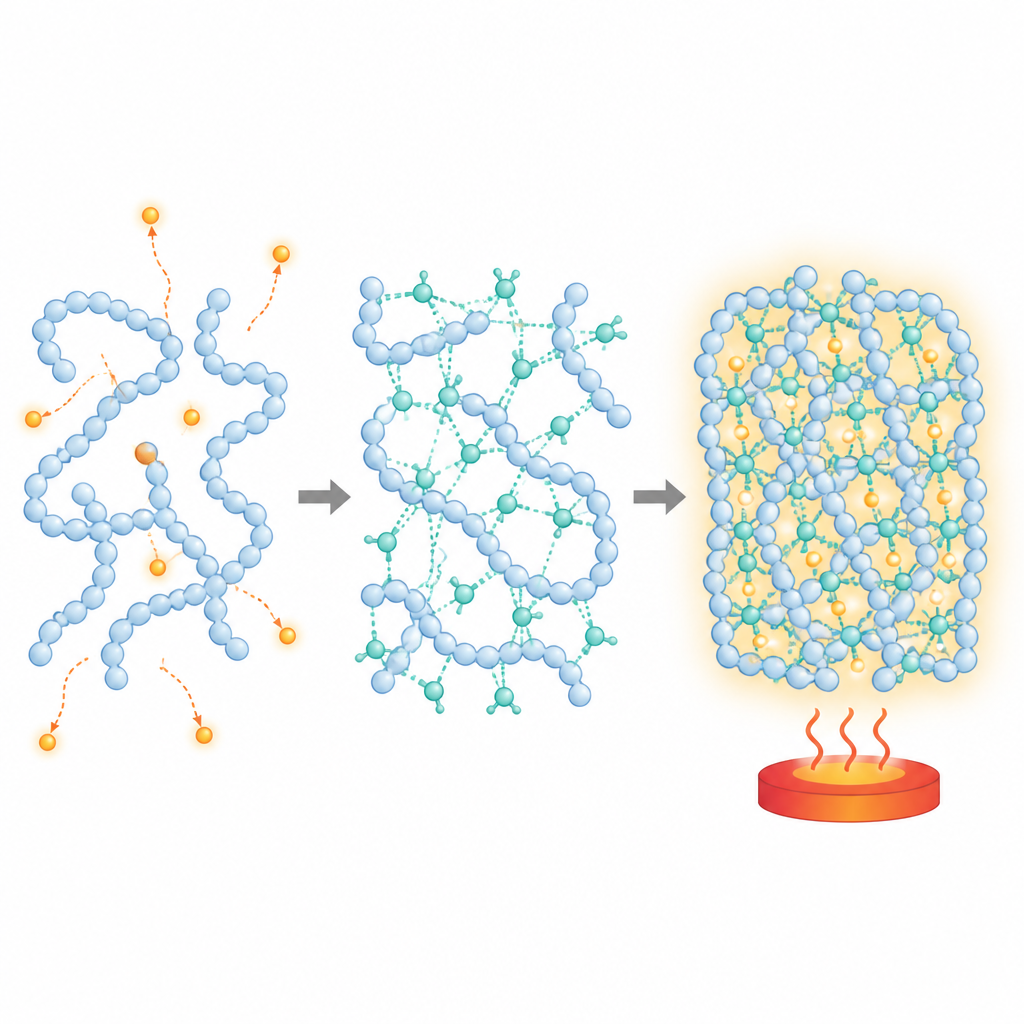
Inside these complexes, the polymer chains and the solvent components form strong hydrogen bonds, tightening the network and reducing how freely the chains can move. Microscopy, X-ray scattering, infrared spectroscopy, and low-field NMR all show that the material changes from a porous, loosely bound network to a more compact, layered structure with strongly bound solvent. At the molecular level, calculations indicate that the bromine in the solvent greatly boosts the probability that excited molecules switch into the long-lived state that produces phosphorescence, while the strong bonding keeps these states from decaying too quickly. As a result, the best sample shows visible afterglow for up to 9.5 seconds, a room-temperature lifetime above 600 milliseconds, and a relatively high fraction of absorbed energy re-emitted as light.
Glowing even when things get hot
Remarkably, the optimized complex continues to glow at elevated temperatures. At 120 °C, it still shows an afterglow that the eye can see, with a phosphorescence lifetime of about 0.37 seconds, a performance not previously reported for non-aromatic systems. Tests over many heating and cooling cycles reveal only small losses in glow time, and the material also keeps its behavior in certain organic solvents. X-ray and infrared measurements taken while heating show that the overall structure and key hydrogen bonds remain largely intact up to around 120 °C, only breaking down at higher temperatures where the glow finally disappears.
From secret messages to a general recipe
The team demonstrated that strips of complexes annealed at different temperatures can store hidden patterns that appear only briefly after UV light is removed or at certain temperatures. For example, a background pattern remains visible while a second message emerges for a few seconds and then vanishes, or can be erased permanently by heating, creating “burn after reading” security features. By swapping in other deep eutectic solvents and even other polymers, they showed that the same basic recipe can produce a family of non-aromatic glowing materials, with bromine-containing solvents giving the strongest and longest-lasting glow.
What this advance means
In simple terms, the study shows how to turn an ordinary, non-aromatic plastic gel into a tough solid that glows for a long time at both room and high temperatures by soaking it in a special solvent and gently heating it. The solvent and polymer grab onto each other, the bromine helps create long-lived excited states, and the rigid network protects these states from being quenched by heat. This offers a practical, metal-free platform for long-lasting glow-in-the-dark materials that can be tuned for uses such as anti-counterfeiting, information storage, and future optoelectronic devices. 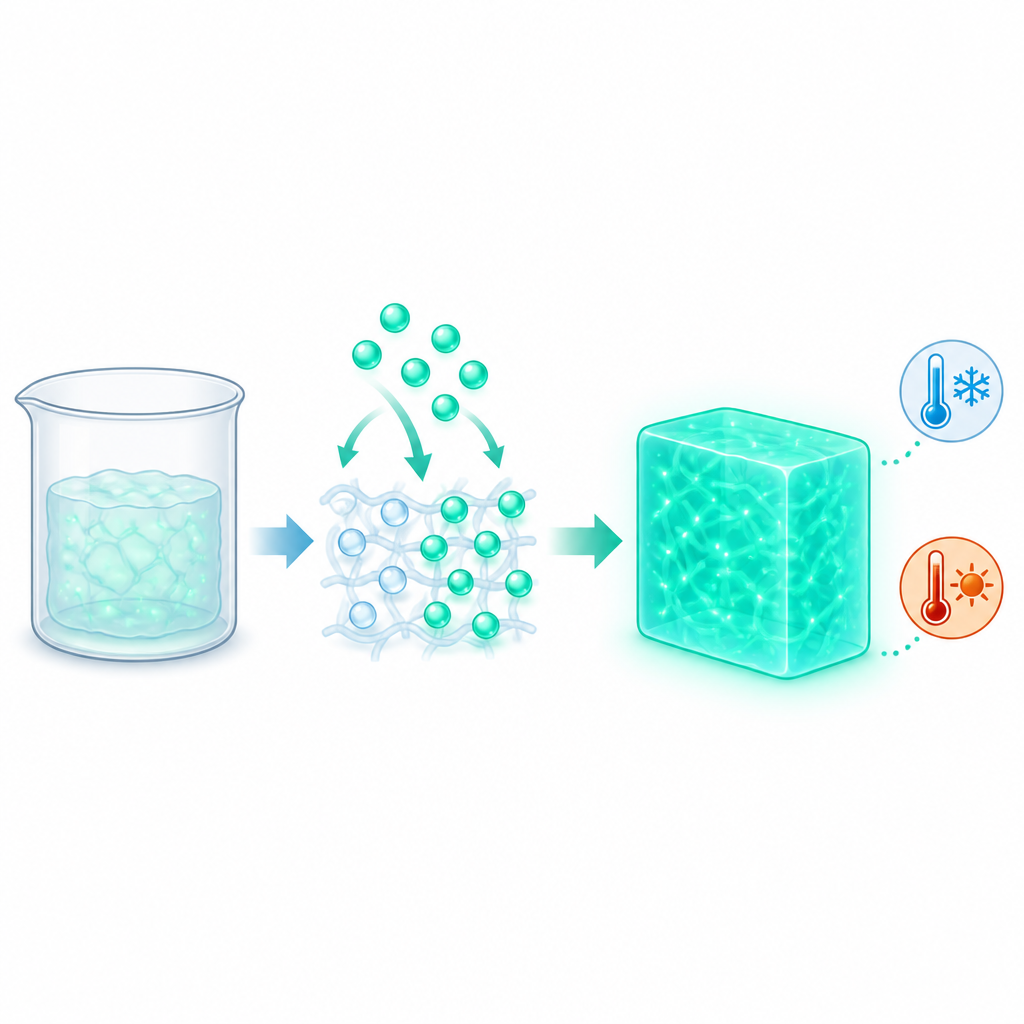
Citation: Zhong, X., Bai, Y., Qiao, G. et al. Nonaromatic polymer-deep eutectic solvent complexes with ultralong room-temperature and high-temperature phosphorescence. Nat Commun 17, 4399 (2026). https://doi.org/10.1038/s41467-026-71041-7
Keywords: phosphorescence, glow-in-the-dark materials, polymer gels, deep eutectic solvents, security printing