Clear Sky Science · en
Rhizobacteria opportunistically boost colonization and impair plant fitness by degrading plant-derived coumarins under iron deficiency
When Helpful Root Chemicals Backfire
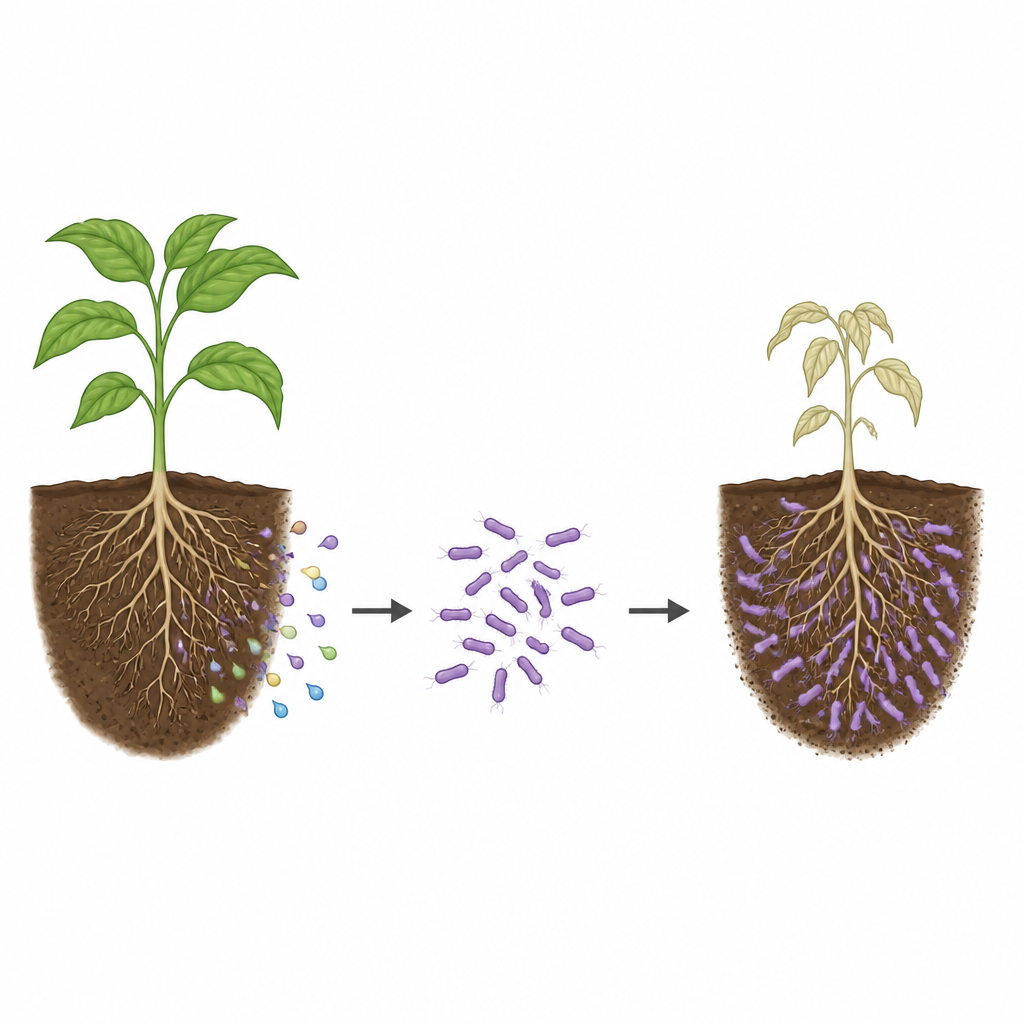
Plants constantly leak special chemicals from their roots to pull in nutrients and fend off germs. One group of these compounds, called coumarins, normally helps plants grab iron from the soil and shape a friendly community of microbes. This study uncovers a twist: a soil bacterium can turn those same helpful chemicals into a food source, crowding the root surface and leaving the plant stuck in long term iron shortage.
Roots, Iron Hunger, and Scent Trails in the Soil
Like people, plants need small amounts of iron to stay healthy. When iron is scarce, the model plant Arabidopsis boosts production of simple coumarins and releases them from its roots. These bright, fluorescent molecules pull iron closer and can also discourage some harmful microbes while favoring helpful ones. The researchers confirmed that Arabidopsis secretes much more of several coumarins, especially one called scopoletin, when grown under low iron. To the plant, this is a survival strategy: send out chemical signals that both unlock iron and help recruit a supportive root microbiome.
A Bacterium that Eats the Plant’s Lifeline
From the soil around plant roots, the team had previously isolated a Pseudomonas strain named NyZ480 that can grow using coumarin as its only carbon source. Here they show that NyZ480 also breaks down several other simple coumarins made by Arabidopsis. In lab tests, the bacterium rapidly removed these compounds from solution and, in some cases, used them to fuel its growth. Genetic and gene activity analyses revealed a suite of related enzymes, encoded by multiple copies of a gene family called xenA together with a shared downstream pathway, that together chop up the coumarin structure. Many of these enzymes act on more than one coumarin, giving the bacterium a flexible, overlapping toolkit for feeding on a whole family of plant chemicals and for detoxifying their antimicrobial effects.
How Coumarin Eating Bacteria Weaken Plants
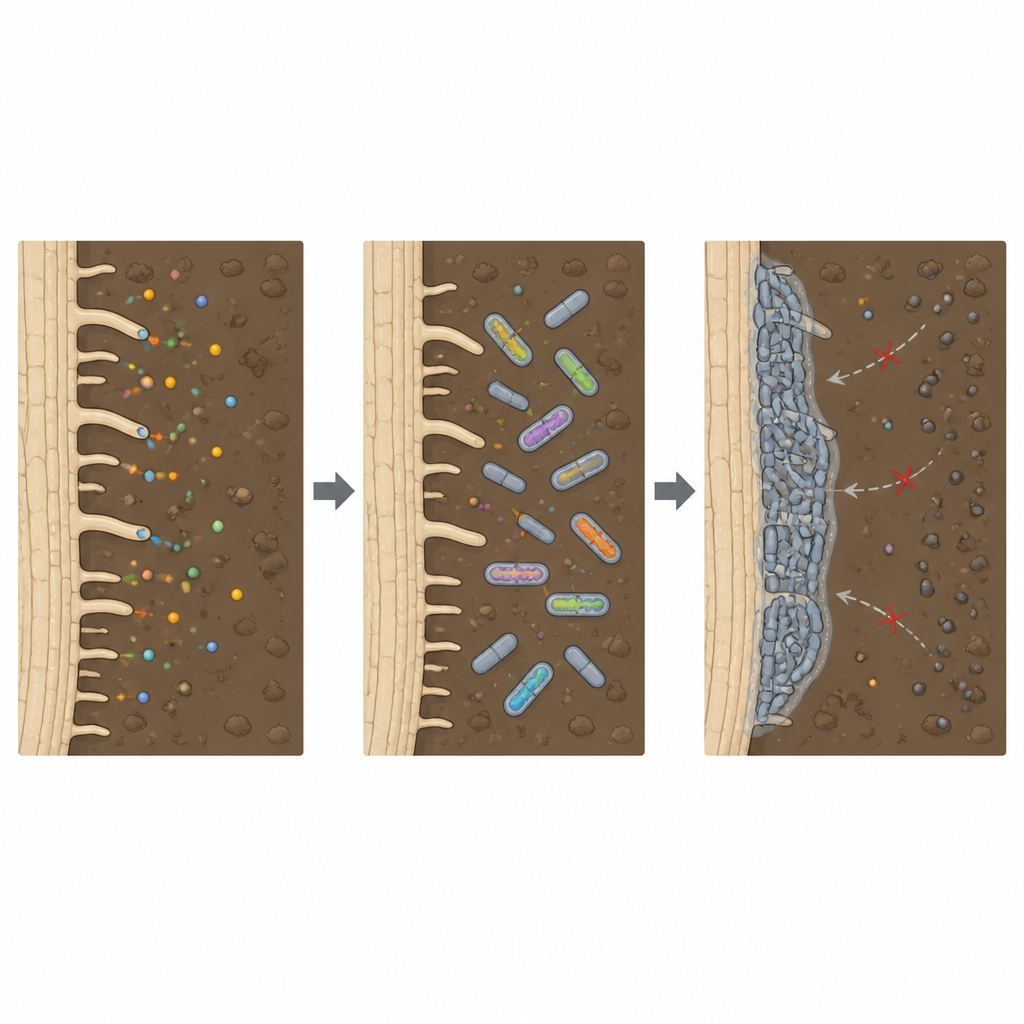
When Arabidopsis plants were grown in sterile conditions and then exposed to NyZ480, the outcome depended strongly on iron supply. Under normal iron, the bacterium colonized roots only modestly but still caused reduced root growth and lower fresh weight. Under low iron, however, plants pumped out coumarins and NyZ480 flourished along their roots, reaching much higher numbers. This heavy colonization went hand in hand with paler leaves, reduced chlorophyll, stunted roots, and a measurable drop in iron levels in the shoots. Plant gene activity profiles showed that roots under combined iron stress and NyZ480 attack switched on defense and stress response genes, as well as genes that make even more coumarins, suggesting a feedback loop: iron shortage triggers coumarin release, the bacterium consumes them, iron uptake falls further, and the plant reacts by trying to produce still more of the very compounds the microbe is exploiting.
Proving the Role of the Chemicals and the Bacterial Genes
To test whether this harmful partnership truly depends on coumarins and the bacterium’s ability to degrade them, the researchers used both mutant plants and mutant bacteria. Arabidopsis plants lacking a key coumarin making gene exuded almost none of the iron mobilizing coumarins and already grew poorly under low iron. On these mutants, NyZ480 could no longer build up large populations under iron shortage and did not further worsen growth or iron levels. Conversely, when the team removed the main coumarin breaking genes from NyZ480, the altered bacteria lost the ability to thrive on plant coumarins and colonized roots only weakly. Plants exposed to this mutant strain showed far milder growth defects and maintained higher iron levels, linking the worst damage directly to coumarin degradation by the wild type bacterium.
A Widespread Microbial Strategy with Hidden Costs
Looking across tens of thousands of bacterial genomes from many environments, the authors found that xenA like genes are extremely common and often present in multiple copies, especially in soil and plant associated bacteria. In contrast, the full set of genes needed to use coumarins as a growth substrate was rare and mainly confined to a few groups of Pseudomonas and related bacteria. This suggests that many microbes may simply detoxify coumarins to survive near roots, while a smaller subset can fully consume them and potentially impair plant iron nutrition. The work highlights an underappreciated risk: under stress, plants may unintentionally feed opportunistic microbes with the very compounds they release for self protection.
Why This Matters for Crops and Soils
For a non specialist reader, the main message is that the relationship between roots and soil microbes is not always friendly. Iron hungry plants use coumarins as chemical tools to gather nutrients and manage their microbial neighbors, but certain bacteria can hijack these tools for their own benefit. By breaking down and eating coumarins, such microbes can colonize roots more heavily and keep plants locked in iron deficiency, limiting growth. Understanding this chemical tug of war could help scientists design crop varieties or soil management strategies that keep the helpful sides of root chemistry while reducing chances for harmful microbial freeloaders.
Citation: Gu, Y., Pan, P., Yu, G. et al. Rhizobacteria opportunistically boost colonization and impair plant fitness by degrading plant-derived coumarins under iron deficiency. Nat Commun 17, 4398 (2026). https://doi.org/10.1038/s41467-026-71037-3
Keywords: plant microbiome, root exudates, iron deficiency, Pseudomonas, coumarins