Clear Sky Science · en
Acid-tolerant injectable bioadhesive for sutureless repair of large gastric perforation
Sealing Stomach Holes Without Stitches
When a hole suddenly opens in the wall of the stomach, it can spill acidic fluid into the abdomen and quickly become life threatening. Today, surgeons usually race to the operating room and sew the tear shut by hand, a delicate and time-consuming task. This study describes a new injectable gel that can be delivered through minimally invasive tools to plug large stomach holes quickly, hold up in harsh acid, and then slowly disappear as the body heals.
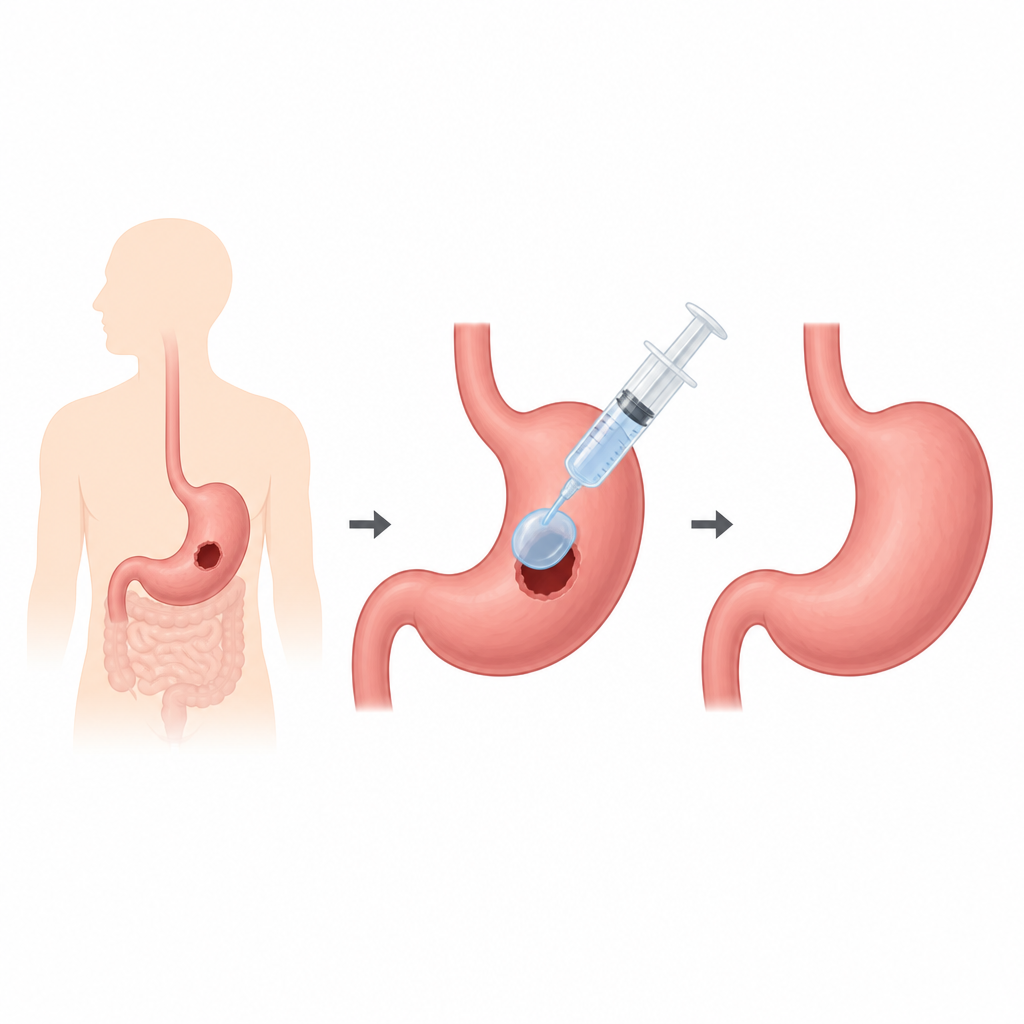
The Danger Inside a Leaking Stomach
Gastric perforation, a tear through the full thickness of the stomach wall, can lead to peritonitis, sepsis, and multiple organ failure. Traditional repair relies on sutures or staplers, which are hard to place on slippery, moving tissue and can themselves cause extra damage and scarring. Existing medical glues either become brittle, are too weak in strong acid, or swell and break down before the stomach has time to mend, especially when the hole is large. Doctors need a sealant that can be applied quickly in a wet environment, stay put under constant squeezing and churning, and yet not linger so long that it irritates nearby organs.
A Gel That Sets in Seconds
The researchers developed an injectable hydrogel made from medical-grade building blocks already used in other treatments. Two liquid components are mixed at the tip of a dual syringe and turn into a clear, flexible gel within about five seconds. As the mixture touches wet stomach tissue, it soaks up surface water and dries the contact area just enough for strong bonds to form with proteins in the tissue. This creates a tight, sutureless seal that conforms to irregular wound shapes. Because the gel itself remains slightly soft and stretchy, it can move with the stomach as it expands and contracts during digestion without cracking or peeling away.
Built To Withstand Acid and Motion
Many older gels are stitched together by chemical links that acid can easily cut, causing them to swell and fall apart. In this work, the team redesigned the internal structure so that the chains are joined by sturdier links and reinforced by dense hydrogen bonding. In tests with real human and pig stomach juices, the new gel hardly swelled and kept its strength and grip on tissue for weeks. Compared with several commercial glues, it held higher pressures before bursting, resisted being washed away by flowing liquid, and maintained adhesion even after soaking in simulated gastric fluid. Computer simulations at the molecular level showed that the new linking strategy creates a tighter network that blocks acid and enzymes from penetrating deeply into the material.
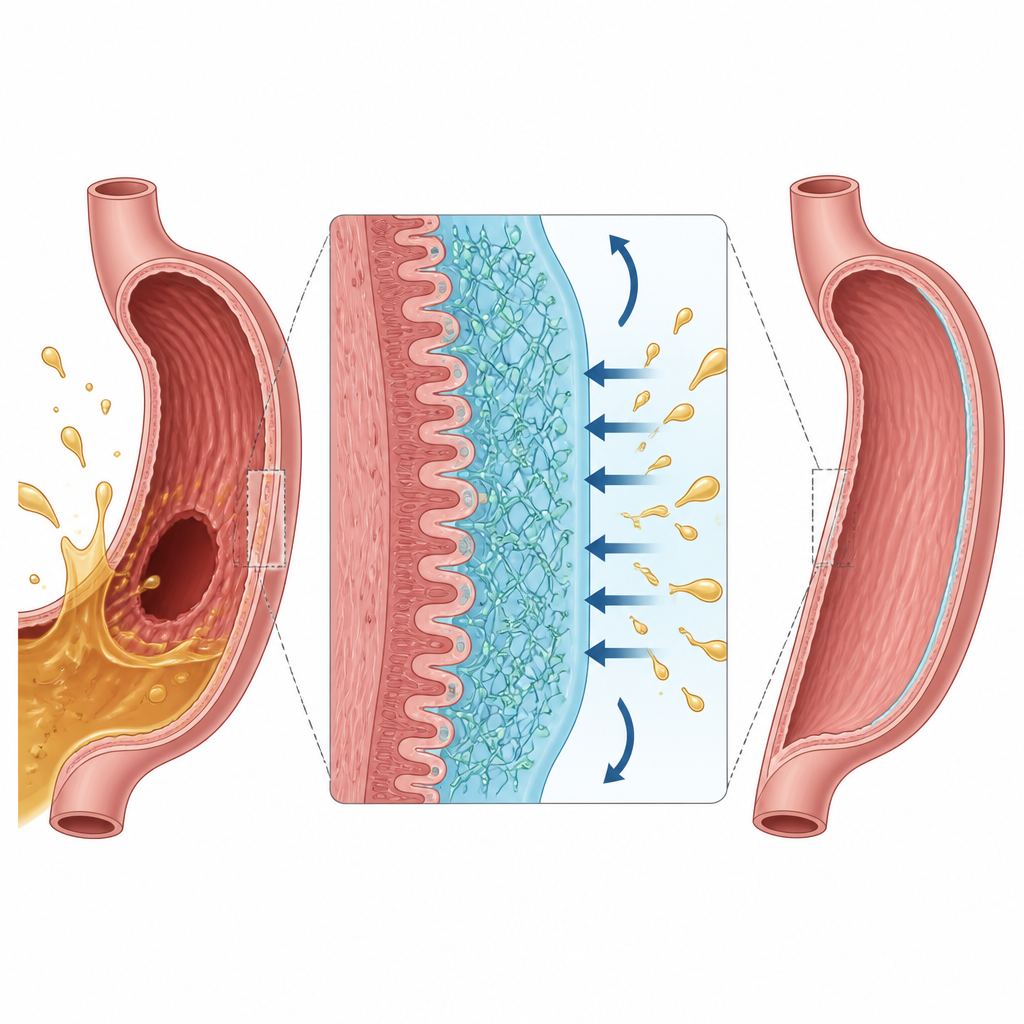
From Bench Tests to Living Stomachs
The gel was first challenged on isolated pig organs, where it sealed holes up to six centimeters long without leaking, even when the stomachs were filled with colored fluid at low pH and moved around. In rats, the material closed smaller gastric defects without stitches, produced less scarring and inflammation than sutures or a commercial sealant, and gradually degraded over several weeks. The team went further by studying gene activity and bacterial communities in the stomach and found that, unlike one commonly used glue, the new gel caused minimal disturbance to normal patterns. Finally, in live pigs with three-centimeter full-thickness perforations, surgeons delivered the gel laparoscopically and monitored healing with both laparoscopy and endoscopy. The treated animals recovered well, with strong closure, little internal scarring, and fewer abnormal adhesions between organs.
What This Could Mean for Patients
Overall, the study shows that an acid-tolerant injectable gel can rapidly seal large holes in the stomach without stitches, stand up to the harsh gastric environment while healing takes place, and then break down without poisoning cells or disturbing the gut’s natural balance. If translated to the clinic, such a material could simplify emergency repairs, shorten operations, and lower the risk of leaks and long-term complications for people with serious digestive injuries.
Citation: Wang, Z., Cao, B., Li, L. et al. Acid-tolerant injectable bioadhesive for sutureless repair of large gastric perforation. Nat Commun 17, 4364 (2026). https://doi.org/10.1038/s41467-026-71031-9
Keywords: gastric perforation, bioadhesive hydrogel, sutureless repair, stomach surgery, tissue sealant