Clear Sky Science · en
X-ray preactivated reversible persistent luminescence enables photodynamic immunotherapy of deep tumors
Light That Keeps Working After the Switch Is Off
Many powerful cancer treatments rely on light, but getting light deep inside the body without harming healthy tissue is hard. This study introduces tiny light-storing particles that can be charged once with X-rays outside the body, then travel to hidden tumors and switch their glow on only where and when it is needed. The approach could help doctors attack difficult cancers such as pancreatic tumors while also waking up the immune system to join the fight.
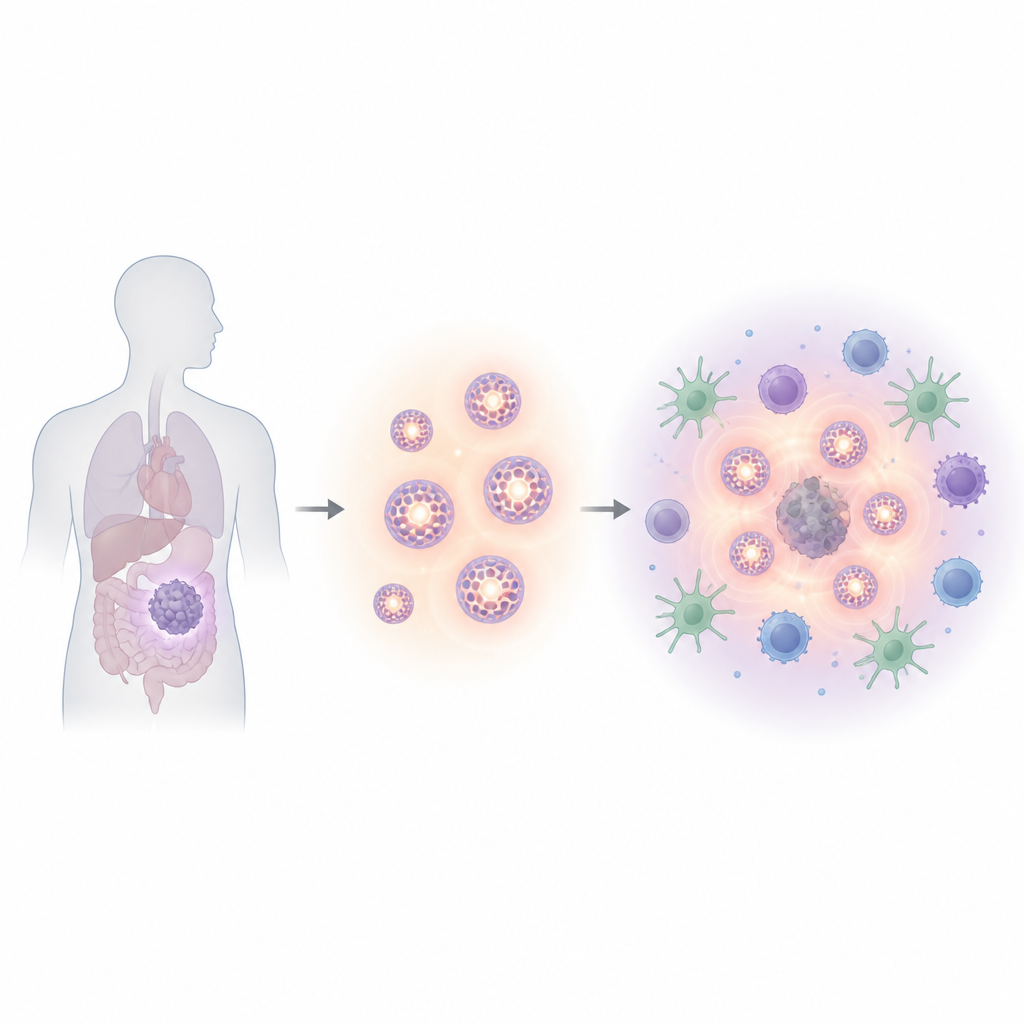
Why Deep Tumors Are So Hard to Treat
Photodynamic therapy uses light to activate a drug that kills cancer cells, but ordinary light does not penetrate far into organs. Shining strong beams from outside risks burning healthy tissue, and once light enters the body it quickly fades and spreads in all directions. Pancreatic ductal adenocarcinoma, a tumor that grows deep in the abdomen and is often called a cold tumor because it resists immune attack, is especially hard to reach with light-based treatments. Standard chemotherapy and radiation have limited impact, leaving a pressing need for more precise, less damaging options.
Tiny Beacons That Store and Release Light
The researchers built nanosized particles that can soak up energy from an X-ray pulse, store it, and then slowly release it as a gentle afterglow. These particles have a solid core that gives long-lasting light and a porous shell that can carry drugs. By adding a hormone-like targeting group that binds to receptors found on many pancreatic cancer cells, the team guided the particles toward tumors. They also attached a light-activated dye and packed in a separate drug called elimusertib, creating a single particle that can find the tumor, light up, and deliver treatment.
A Smart On Off Switch Inside the Tumor
A key feature of these particles is their response to acidity. Normal blood is close to neutral, but many tumors are slightly acidic. In the bloodstream, the particles cluster into larger bundles that keep their glow and the dye mostly muted, limiting unwanted light and reactive molecules in healthy organs. Once they enter the acidic tumor zone, the bundles fall apart into smaller pieces. This separation makes the stored light shine more strongly and frees the dye to generate toxic oxygen molecules that damage nearby cancer DNA. The change can be reversed, so the glow can be turned down again if the environment becomes less acidic, adding an extra layer of control. 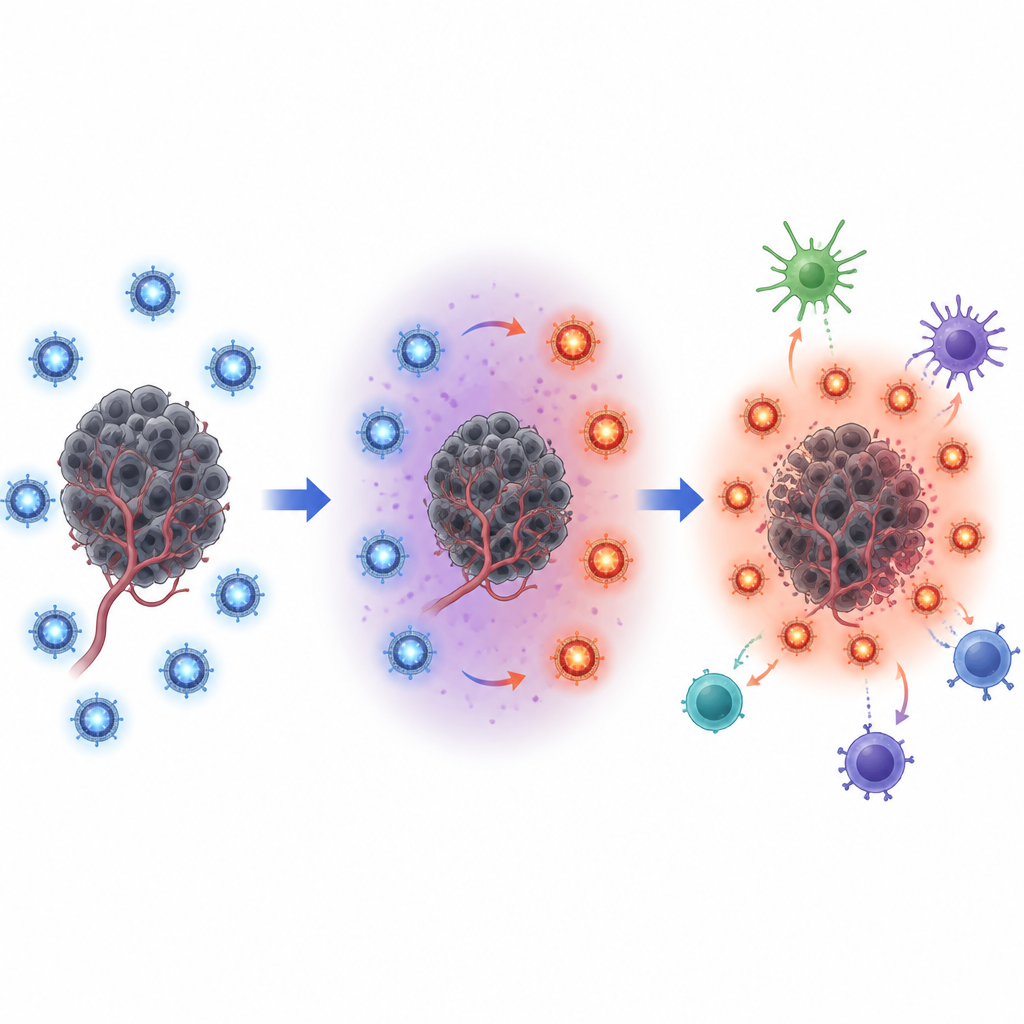
Turning DNA Damage Into an Immune Alarm
Elimusertib, the drug loaded into the particles, weakens a major DNA repair pathway that cancer cells use to survive damage. When the brightened particles near the tumor unleash bursts of reactive oxygen, they cut the DNA of cancer cells, and the weakened repair system cannot keep up. Fragments of DNA spill into the cell fluid, where a natural sensor called cGAS detects them and triggers an alarm pathway known as STING. In mice with pancreatic tumors, this combination drew in more killer T cells, reduced suppressive immune cells, shrank tumors, and extended survival, all without obvious harm to major organs.
What This Could Mean for Future Cancer Care
To a non-specialist, the takeaway is that the team has created a kind of rechargeable light capsule that can be switched on only inside tumors and paired with an immune-activating drug. In animals, a brief X-ray pulse before injection was enough to precharge the capsules, which then homed to deep tumors, lit them up for imaging, and helped both light and the immune system work together to kill cancer cells. While more testing is needed before use in people, the work suggests a way to treat hidden tumors with fewer side effects by combining precise light delivery with a built-in immune boost.
Citation: Topatana, W., Sun, Y., Xie, T. et al. X-ray preactivated reversible persistent luminescence enables photodynamic immunotherapy of deep tumors. Nat Commun 17, 4297 (2026). https://doi.org/10.1038/s41467-026-71028-4
Keywords: persistent luminescence, photodynamic therapy, nanoparticles, pancreatic cancer, cancer immunotherapy