Clear Sky Science · en
Bacterial cellulose as a promising biodegradable bioplastic for sustainability
Why new plastics matter to everyday life
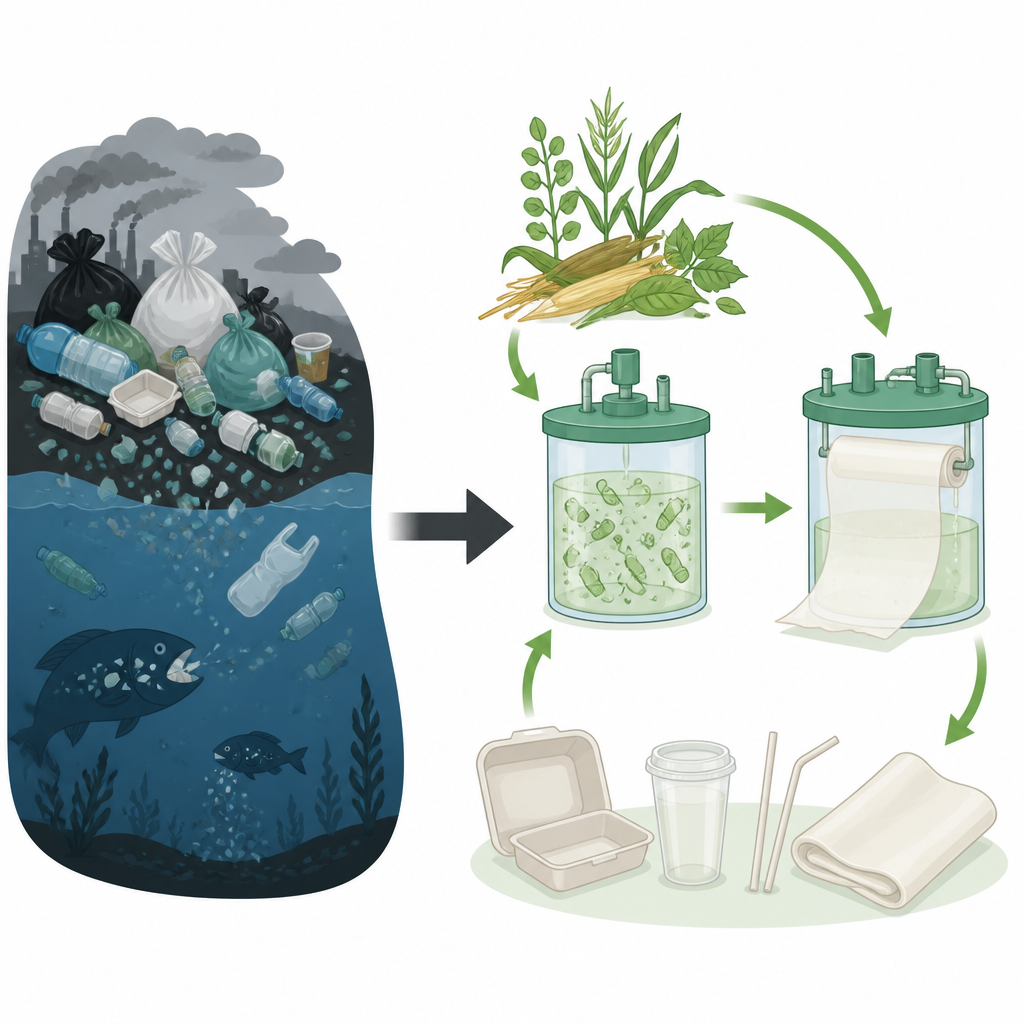
Plastic bags, bottles, and packaging make daily life easier, but they linger in landfills and oceans for decades, breaking into tiny fragments that enter our food, water, and air. This article explores a very different kind of plastic made by bacteria. Called bacterial cellulose, it behaves like a strong, flexible film yet can safely return to nature. Understanding how this material works, how it is made, and where it might replace today’s plastics sheds light on practical ways to cut waste and pollution without giving up modern conveniences.
From throwaway plastics to smart natural films
The authors begin by tracing how conventional plastics grew from a handful of early inventions into more than 8.3 billion tons produced so far, with most never recycled. These fossil-based materials depend on oil, release greenhouse gases, and leak into rivers and seas as trash and microplastics. In response, governments have introduced taxes, bans, and rules on single-use items, while industry has turned to biodegradable and bio-based plastics such as starch blends, polylactic acid, and plant cellulose. Each alternative has trade offs: some must be treated in special composting plants, others are weak, hard to purify, or still tied to petrochemical routes. Against this crowded background, bacterial cellulose stands out as a pure, microplastic-free material that can be grown rather than drilled.
How bacteria grow a natural plastic
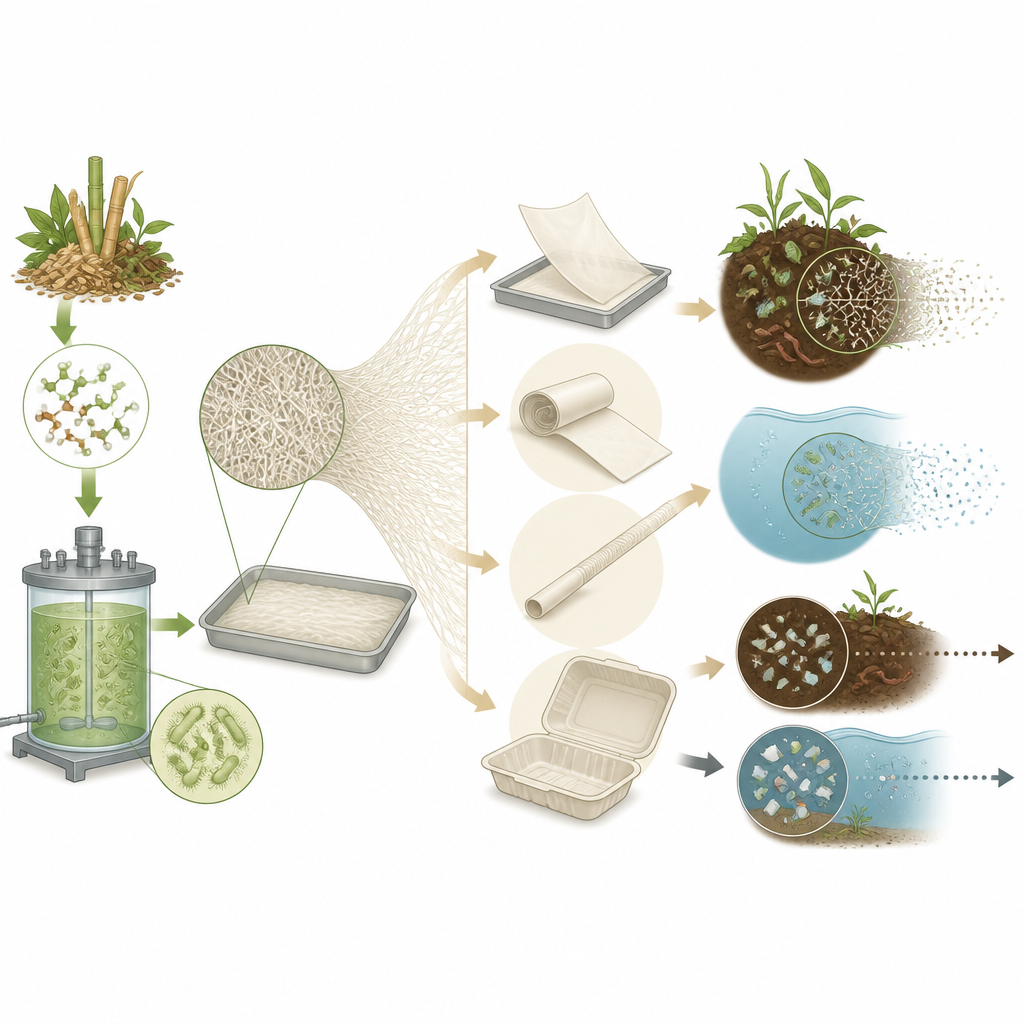
Bacterial cellulose is built by certain microbes that turn simple sugars into an ultra-fine web of cellulose fibers. These fibers form a moist sheet at the air–liquid surface in still tanks, or fluffy clumps in stirred tanks. Because the product is almost pure cellulose and contains no plant lignin or other debris, cleaning it is as simple as washing away the cells with mild alkali and water. The resulting hydrogel is about 99 percent water, yet the tiny fibers are highly organized and tightly bonded. This gives the dried films a stiffness and strength that can rival or surpass some synthetic plastic fibers, while remaining non-toxic and friendly to living tissues. In soil and compost, common microbes can break this cellulose down within weeks to months, avoiding long-lived fragments.
Tuning the material for real world uses
On its own, bacterial cellulose already holds water well and has impressive strength, but it can be tailored further. One set of approaches adds substances during growth, so particles or polymers become embedded in the fiber network as it forms. Another set changes the material after harvest, by coating, mixing, or chemically modifying the hydroxyl groups along the cellulose chains. By combining it with plastics like polyvinyl alcohol, natural polymers such as chitosan or collagen, carbon materials like graphene, or metal and metal oxide particles, researchers have created films and gels that conduct electricity, resist microbes, block light or gases, or act as sensors and catalysts. More advanced “living materials” even co-culture cellulose-producing bacteria with engineered yeast so that the growing sheet can sense signals or repair itself.
Everyday objects made from living factories
These tailored forms open the door to many familiar products. For disposable items, bacterial cellulose composites can act as cling film, food wraps, sausage casings, and straws that are strong in use yet break down naturally afterward. They can form biodegradable bags, cushioning foams, and even tableware such as spoons and cups. In electronics, cellulose combined with conductive fillers becomes flexible electrodes, supercapacitor yarns, battery components, and transparent films for displays. In medicine, its gentle interaction with the body and high moisture content support wound dressings, facial masks, tissue scaffolds, and artificial blood vessels. In fields and gardens, cellulose mulch films suppress weeds and keep soil moist, then decay without leaving plastic shards. Textile innovators are exploring it as a breathable, leather-like or fabric-like material that avoids shedding microfibers.
Weighing costs, climate impact, and future promise
The review also examines how bacterial cellulose compares with other bioplastics across its full life cycle. Making one kilogram currently emits less climate-warming gas than many commercial biodegradable plastics, though more than starch or plant cellulose, partly because today’s production is still small and process data come from labs rather than mature factories. A simple economic analysis suggests that its estimated price sits between cheap starch-based plastics and high-end biopolymers like polylactic acid and polyhydroxyalkanoates. Costs are strongly tied to the price of sugar feedstocks, fermentation time, and yield, so using agricultural leftovers and improving strains and processes could make it more competitive. The authors argue that if these hurdles are addressed and the material is integrated into existing plastic processing lines, bacterial cellulose could help shift many products toward a circular system where materials cycle safely instead of piling up as waste.
What this means for a cleaner plastic future
For non-specialists, the main message is that plastics do not have to be permanent pollutants. Bacterial cellulose shows that strong, useful films and molded items can be “grown” from renewable resources, used in familiar roles from takeout boxes to clothing, and then broken down by ordinary microbes instead of persisting as microplastics. While it is not yet the cheapest option and still faces scaling challenges, its mix of performance, safety, and true biodegradability suggests it could become an important part of how society keeps the benefits of plastics while easing their burden on the planet.
Citation: Yan, Y., Liu, L., Wang, F. et al. Bacterial cellulose as a promising biodegradable bioplastic for sustainability. Nat Commun 17, 4387 (2026). https://doi.org/10.1038/s41467-026-71025-7
Keywords: bacterial cellulose, bioplastics, biodegradable packaging, microplastic-free materials, circular economy