Clear Sky Science · en
DNA affects the phenotype of fuel-dependent coacervate droplets
How Simple DNA Can Steer Proto-Life
Life on Earth is built on the link between genes and traits: DNA encodes information, and that information shapes how organisms look and behave. This study explores an early, stripped-down version of that idea using tiny droplets that behave a bit like primitive cells. By slipping different short DNA strands into these fuel‑driven droplets, the researchers show that the DNA can make the droplets live longer or die faster, and even change their internal texture—hinting at how bare-bones chemical systems might one day evolve.
Droplets That Eat Fuel and Then Fade Away
Instead of full cells with membranes, the team works with "coacervate" droplets—soft blobs formed when positively and negatively charged molecules cluster together in water. Here, a long, negatively charged RNA strand mixes with a short, positively charged peptide. When a chemical fuel is added, it temporarily increases the peptide’s charge, making droplets appear, grow, fuse, and eventually shrink and vanish as the fuel is used up. These droplets need a steady supply of fuel to survive, much like living cells need food. But until now, they lacked anything like a genetic system: nothing inside them could be inherited or selected over time.
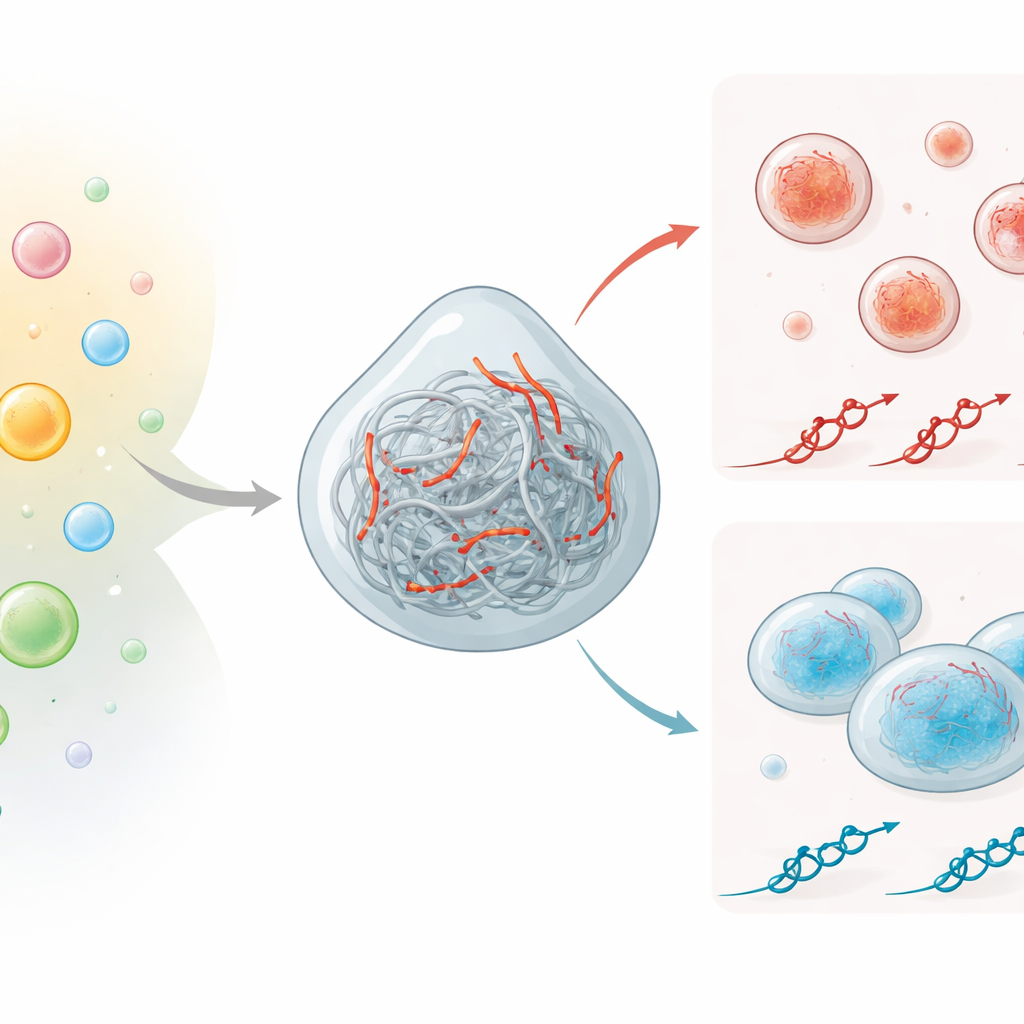
Giving Proto-Cells a Simple Genetic Code
To add a kind of “genotype,” the researchers introduced short, single‑stranded DNA pieces—each only 30 building blocks long—into the droplets. They started with mixed pools of DNA, some completely random and others biased toward one of the four letters of the genetic alphabet. Then they asked two questions: which DNA strands actually move into the droplets, and how do those strands change droplet behavior? By spinning down the samples and sequencing the DNA in the droplets versus the surrounding liquid, they found that strands rich in the letters A (adenine) or G (guanine), especially when these letters appear in long runs, are far more likely to be pulled into the droplets than other sequences.
Adenine Makes Droplets Fragile
Next, the team looked at what these preferred DNA types do once inside. Adenine‑rich sequences tended to weaken the droplets. In extreme form, a strand made of 30 adenines caused droplets to require more fuel to form, made them less resistant to salt, and shortened their overall lifetime. Microscopy and diffusion measurements suggest why: adenine pairs readily with the U bases in the RNA scaffold, creating short, rigid hybrid segments. This stiffness seems to disrupt the flexible, highly charged mesh that holds the droplets together. As a result, droplets fuse less, form bead‑like strings rather than smooth spheres, and fall apart sooner. The work also shows that the details matter: at least seven adenines in a row, especially near the ends of the DNA, are needed before the droplet’s behavior changes noticeably.
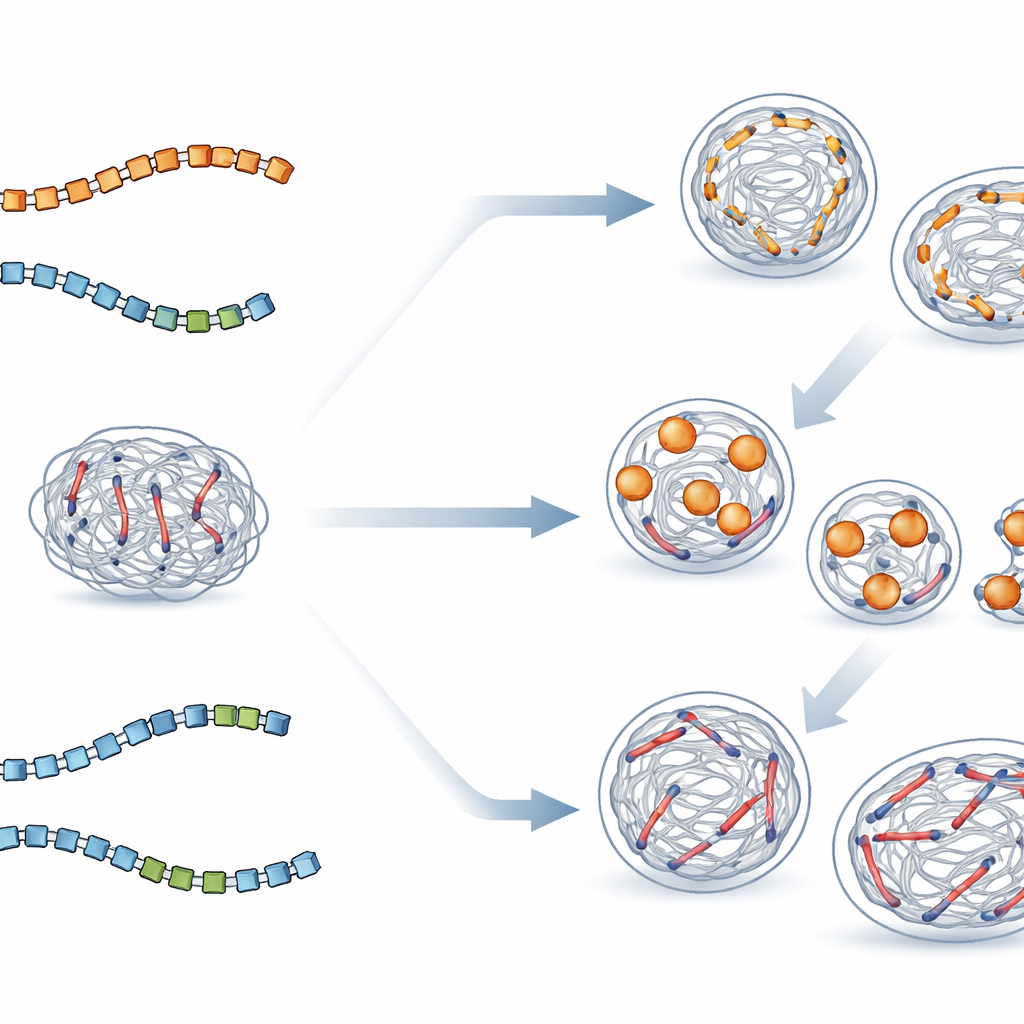
Guanine Traps Droplets in Long-Lived Networks
Guanine‑rich DNA has almost the opposite effect. When the researchers designed sequences with long guanine stretches at their ends, the droplets stopped dissolving even after the fuel was gone. These sequences strongly latch onto the peptide component, slowing its motion and creating dense internal networks. Droplets with such DNA become semi‑fused shells and tangled clusters that resist breaking apart and can be “revived” when new fuel is added. Mixed sequences containing both guanine and adenine combine these behaviors: they partly rigidify the RNA scaffold while also gripping the peptide, leading to delayed dissolution and strange, poorly fused shapes.
First Steps Toward Evolving Synthetic Life
By the end of the study, the researchers have drawn clear “design rules” connecting DNA sequence to droplet behavior: long runs of adenine make droplets fragile and short‑lived, while guanine‑rich segments at DNA ends can lock droplets into long‑lasting, kinetically trapped states. This is not yet true life—these DNA strands do not replicate on their own—but it shows that simple, programmable molecules can act as a rudimentary genetic code for synthetic cells. If similar DNA sequences were made capable of copying themselves, droplets carrying advantageous strands would be more likely to survive harsh conditions and persist through repeated fuel cycles. That scenario edges closer to a world where chemical droplets, guided by simple genotypes, could undergo Darwinian evolution.
Citation: Machatzke, C., Holtmannspötter, AL., Mutschler, H. et al. DNA affects the phenotype of fuel-dependent coacervate droplets. Nat Commun 17, 2953 (2026). https://doi.org/10.1038/s41467-026-71024-8
Keywords: synthetic cells, coacervate droplets, genotype phenotype, DNA sequences, origins of life