Clear Sky Science · en
Zinc isotope evidence for extensive carbonate recycling in the Arctic asthenosphere
Why deep Earth carbon matters
Much of Earth’s carbon is hidden deep below our feet, where it quietly shapes volcanic activity, earthquakes, and the long‑term climate. This study looks beneath the Arctic Ocean, at a remote stretch of mid‑ocean ridge called Gakkel Ridge, to ask a surprising question: why are its lavas so rich in carbon even though they are far from the usual deep‑Earth “hotspots” or active subduction zones? By following a subtle chemical fingerprint in zinc, the authors trace how ancient seafloor carbonates, once part of the ocean crust, now help fuel carbon‑rich volcanism in one of the most isolated corners of the planet.
A quiet ridge with an unexpected carbon load
Mid‑ocean ridges are long undersea mountain chains where new ocean crust forms as tectonic plates pull apart. Normally, ridges that lie far from hotspots and subduction zones are expected to tap relatively carbon‑poor mantle. Gakkel Ridge, the world’s slowest spreading ridge beneath the Arctic ice, breaks this rule. Previous work showed that lavas there contain about three times more carbon dioxide than typical “quiet” ridges, rivaling the carbon levels of ridges influenced by plumes rising from deep inside Earth. The new study sets out to explain this puzzle by examining the chemistry and isotopes of basalt samples dredged along an 1100‑kilometer section of the ridge.
Zinc as a tracer of hidden carbonates
The key clue lies in the isotopes of zinc, a metal present in both rocks and certain carbon‑bearing minerals. Surface carbonates, such as those that form in marine sediments, have distinctly “heavier” zinc isotope ratios than the average mantle. If these carbonates are dragged down at subduction zones and survive to great depths, they can later mix into the mantle beneath ridges and pass their zinc signal into rising magmas. The Gakkel basalts show zinc isotope values that are systematically heavier than those of typical mid‑ocean ridge basalts worldwide. Careful tests rule out other explanations, such as changes caused by crystal formation, melting degree, or mixing with carbonate‑free recycled crust. The simplest fit is that the mantle beneath Gakkel contains a small but important amount of recycled, magnesium‑rich carbonates.
Linking deep carbon to ancient Arctic subduction
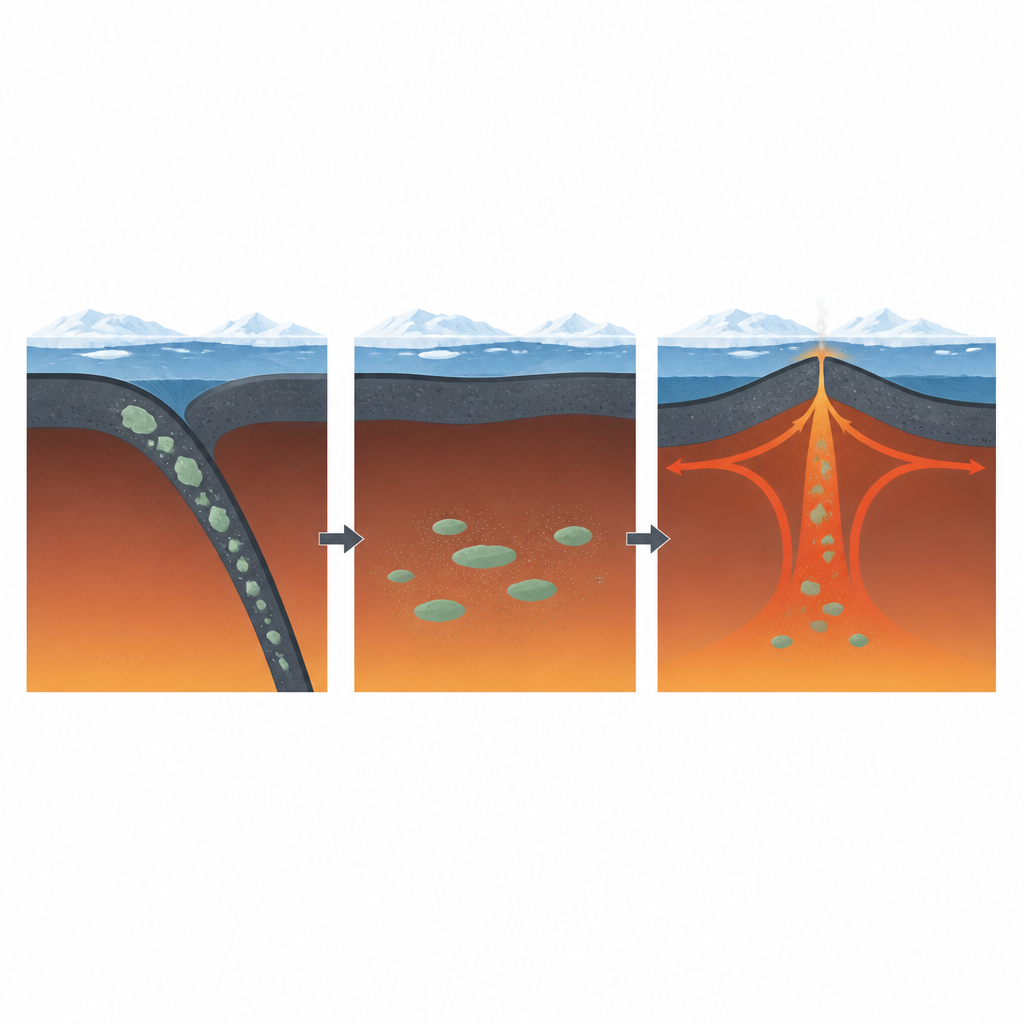
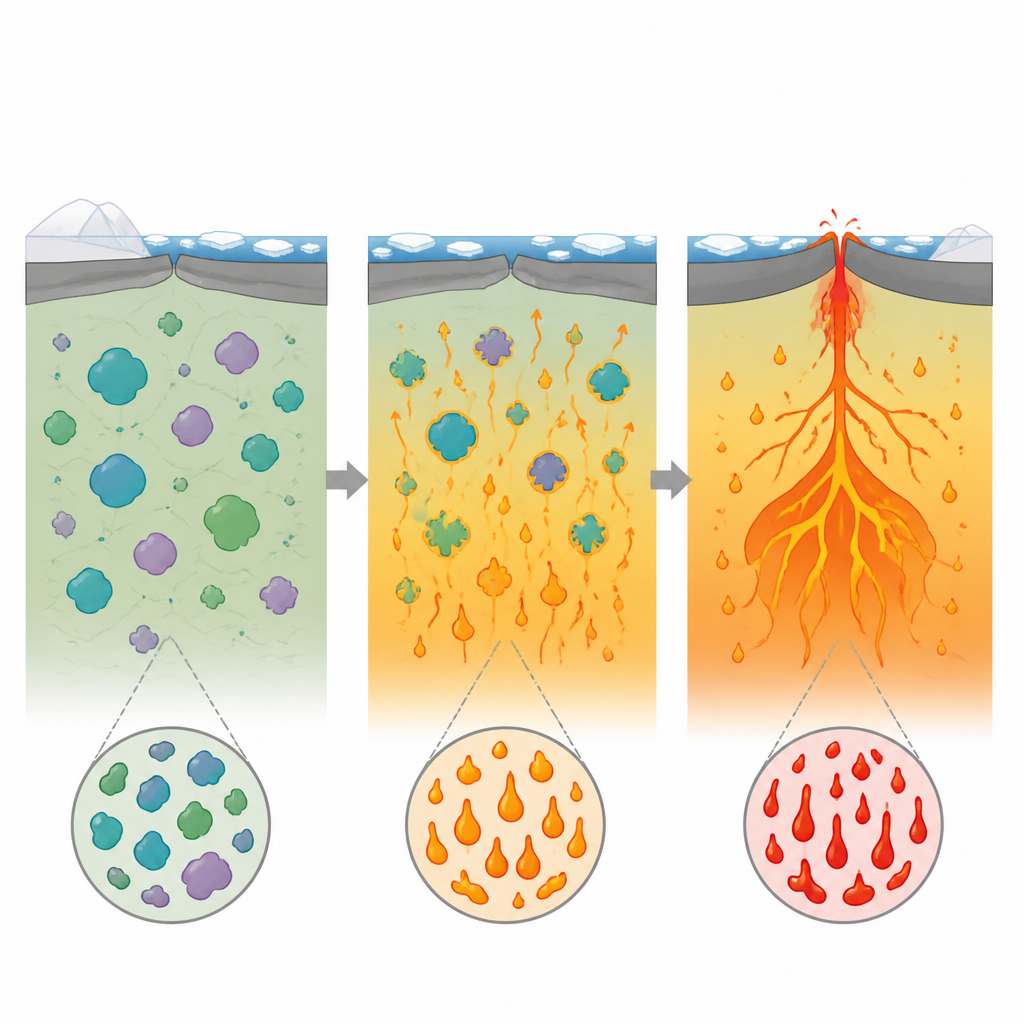
Geochemical models suggest that adding only about 1–4 percent recycled carbonate to otherwise typical depleted mantle can reproduce the zinc isotope, trace element, and strontium‑neodymium isotope patterns of the Gakkel lavas. Where did this carbonate come from? Plate reconstructions and seismic images point to an ancient ocean, the South Anuyi Ocean, that was subducted beneath the Arctic region in the Early Cretaceous, over 130 million years ago. Slabs from this vanished ocean now reside deep in the mantle, but some of the carbonates they carried appear to have been stranded in the overlying asthenosphere. As mantle rock slowly circulates, these carbonate‑rich patches can be swept into the upwelling beneath the Gakkel Ridge, enriching its magmas in both carbon and heavy zinc.
What this means for the upper mantle
The findings imply that the carbon content of the upper mantle is not controlled only by present‑day hotspots that inject deep carbon into ridges. Instead, the mantle also bears a long‑lived memory of ancient subduction, stored as scattered pockets of recycled carbonate that can persist for more than 130 million years. At Gakkel Ridge, this hidden inheritance likely promotes deeper and more carbon‑rich melting, which may help explain unusual features such as deep earthquakes and explosive submarine eruptions in the region. More broadly, similar processes may operate beneath other remote ridges and intraplate volcanoes, meaning that recycled seafloor carbonates are a major, and previously underappreciated, player in shaping the planet’s deep carbon cycle.
A simple take‑home message
In everyday terms, this study shows that some of the carbon locked in the Arctic seafloor volcanoes today began life as ocean‑floor carbonate sediments more than 100 million years ago. Those sediments were dragged deep into Earth by subduction, partly melted or dissolved, and then stored in the soft mantle layer beneath the Arctic. Only now are they being tapped by magma rising under Gakkel Ridge, boosting the carbon content of its lavas. By reading the zinc isotope “signature” in these rocks, scientists reveal how past plate movements continue to shape the modern deep carbon budget and, indirectly, the long‑term behavior of our planet.
Citation: Zhang, WQ., Ding, WW., Liu, CZ. et al. Zinc isotope evidence for extensive carbonate recycling in the Arctic asthenosphere. Nat Commun 17, 4340 (2026). https://doi.org/10.1038/s41467-026-71022-w
Keywords: deep carbon cycle, Gakkel Ridge, mantle carbonates, zinc isotopes, subduction recycling