Clear Sky Science · en
Origin of multiple skyrmion phases in EuAl4
Why tiny magnetic whirlpools matter
In many modern materials, magnetism does far more than simply point north. It can twist into miniature whirlpools of magnetization called skyrmions, which are promising building blocks for ultra‑efficient data storage and low‑power electronics. This paper asks a deceptively simple question: in a particular family of europium compounds, what really creates these tiny magnetic whirlpools, especially when the usual textbook mechanism is supposed to be absent? By tracking how the motion of electrons in the crystal is tied to its rich magnetic behavior, the authors propose a unified, engineerable route to generating and controlling multiple skyrmion phases.
From simple magnets to twisted spin patterns
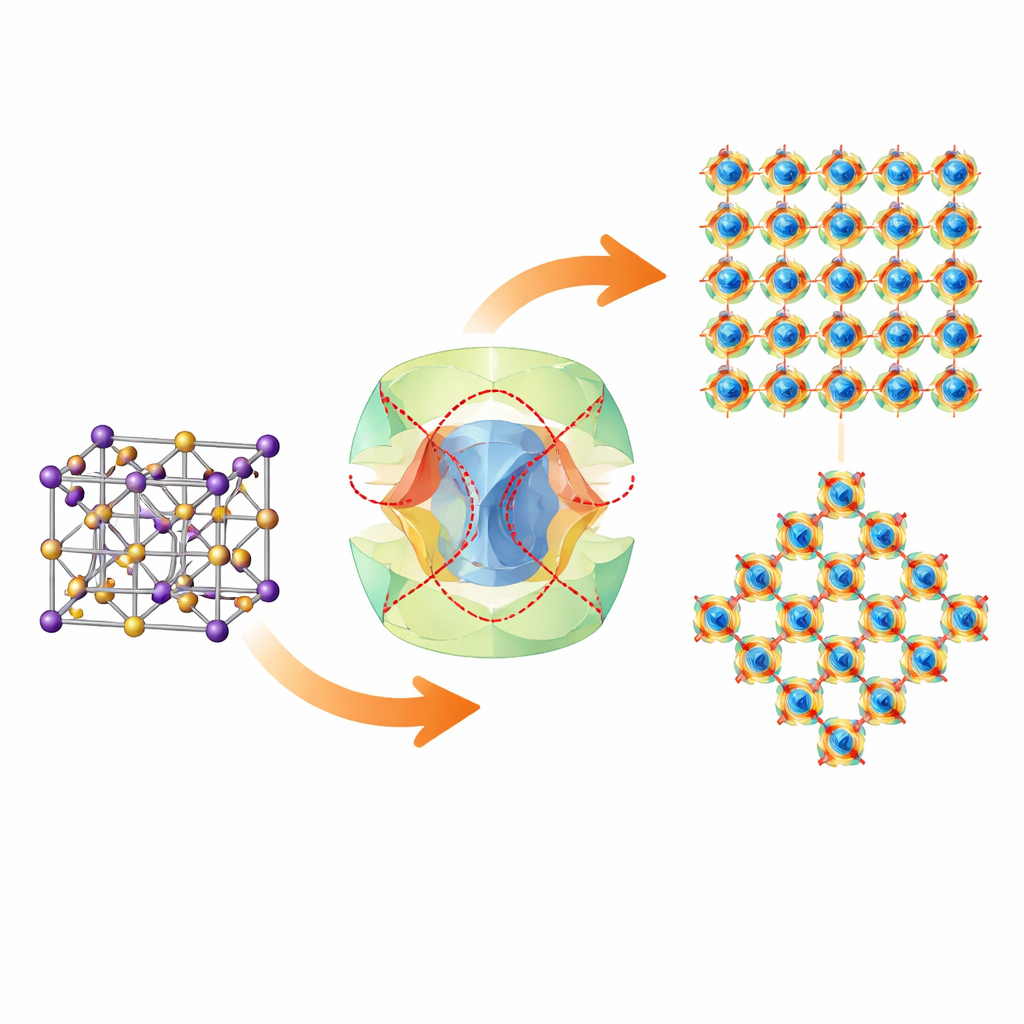
Skyrmions are swirling patterns of atomic magnets (spins) that carry a kind of built‑in topological robustness, making them hard to erase and attractive for information technologies. In most known materials, they are stabilized by an interaction that favors twisted spin alignments when the crystal lacks a center of symmetry. Yet in compounds like EuAl4, which are nearly centrosymmetric, skyrmions not only appear but are incredibly small—just a few billionths of a meter across. Even more puzzling, EuAl4 hosts several distinct skyrmion arrangements, including square and rhombus‑like lattices, along with other exotic magnetic states. These observations hint that a different, more itinerant mechanism—one rooted in how electrons roam through the crystal—might be at work.
Electrons, hidden surfaces, and a topological turning point
To uncover this mechanism, the researchers mapped the three‑dimensional electronic structure of Eu(Ga1−xAlx)4 using soft‑x‑ray angle‑resolved photoemission spectroscopy, a technique that can peer into the bulk of a material rather than just its surface. They systematically varied the ratio of gallium to aluminum and followed how the network of allowed electron states, known as the Fermi surface, evolved. A key discovery was a Lifshitz transition: as aluminum content increases, a new electron pocket (dubbed e1) appears around a particular point in momentum space. This pocket is absent in EuGa4 but present in EuAl4 and intermediate compositions, meaning the topology of the Fermi surface itself is reshaped by chemical substitution.
How nested electrons sculpt magnetic spirals
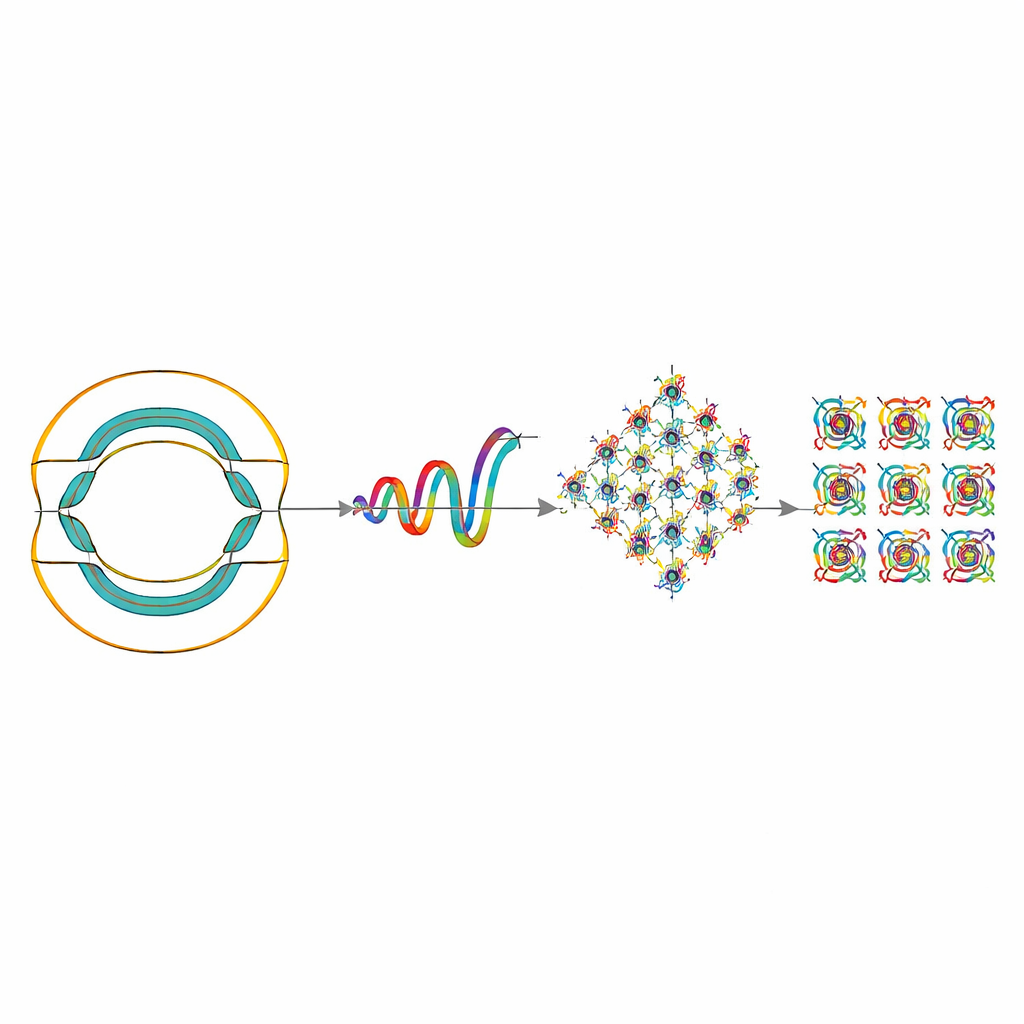
The appearance of this new electron pocket aligns strikingly with the onset of helical magnetism and skyrmion phases. The authors show that nearly parallel segments of different Fermi‑surface sheets can be connected by specific momentum transfers, called nesting vectors. Within the Ruderman–Kittel–Kasuya–Yosida (RKKY) framework, these nesting vectors dictate how conduction electrons mediate interactions between localized europium spins, setting the wavelength and direction of helical spin patterns. Quantitative comparison reveals that one particular nesting channel, linking the new e1 pocket to another pocket (e2), reproduces the experimentally measured helical wave vector in EuAl4. When similar nesting is considered along rotated directions, it also accounts for the wave vectors that build the square skyrmion lattice observed at higher magnetic fields.
Why more than one skyrmion lattice appears
The same Fermi‑surface geometry naturally supports several competing nesting vectors of almost equal strength. Superposing helices generated by different vectors produces multi‑wave spin textures, including the rhombic and square skyrmion lattices and other complex phases such as meron and vortex‑like patterns. Subtle distortions of the crystal lattice and a charge‑density wave that breaks inversion symmetry can tweak the relative strengths of these nesting channels, favoring one combination of helices over another without destroying the underlying electronic scaffolding. This explains why small changes in field, temperature, or composition can trigger sharp transitions between distinct skyrmion arrangements in EuAl4.
A new handle for designing magnetic whirlpools
In plain terms, the study shows that the rich zoo of skyrmion and related spin textures in EuAl4 is not primarily driven by the conventional twisting interaction, but instead by how the electrons “fit together” on their Fermi surface. When elemental substitution causes the electronic structure to pass through a topological turning point—the Lifshitz transition—a crucial electron pocket appears and activates several powerful nesting routes. These, in turn, orchestrate helical and multi‑wave spin patterns that manifest as multiple skyrmion phases. The work suggests that by deliberately engineering Fermi‑surface nesting, researchers may be able to design materials with tailor‑made skyrmion lattices and other topological spin textures, opening a pathway toward compact, energy‑efficient magnetic technologies.
Citation: Arai, Y., Nakayama, K., Honma, A. et al. Origin of multiple skyrmion phases in EuAl4. Nat Commun 17, 3162 (2026). https://doi.org/10.1038/s41467-026-71020-y
Keywords: magnetic skyrmions, EuAl4, Fermi surface nesting, RKKY interaction, topological magnetism