Clear Sky Science · en
Crystal symmetry-dependent Orbital Rashba Edelstein effect in epitaxial CuO thin film
Why this tiny crystal matters
Modern electronics increasingly rely on controlling not just electric charge but also tiny forms of motion inside electrons. This study shows how the internal geometry of a copper-oxide crystal can steer these hidden motions in a very directional way, offering a new design handle for future low-energy memory and logic devices that store information magnetically.
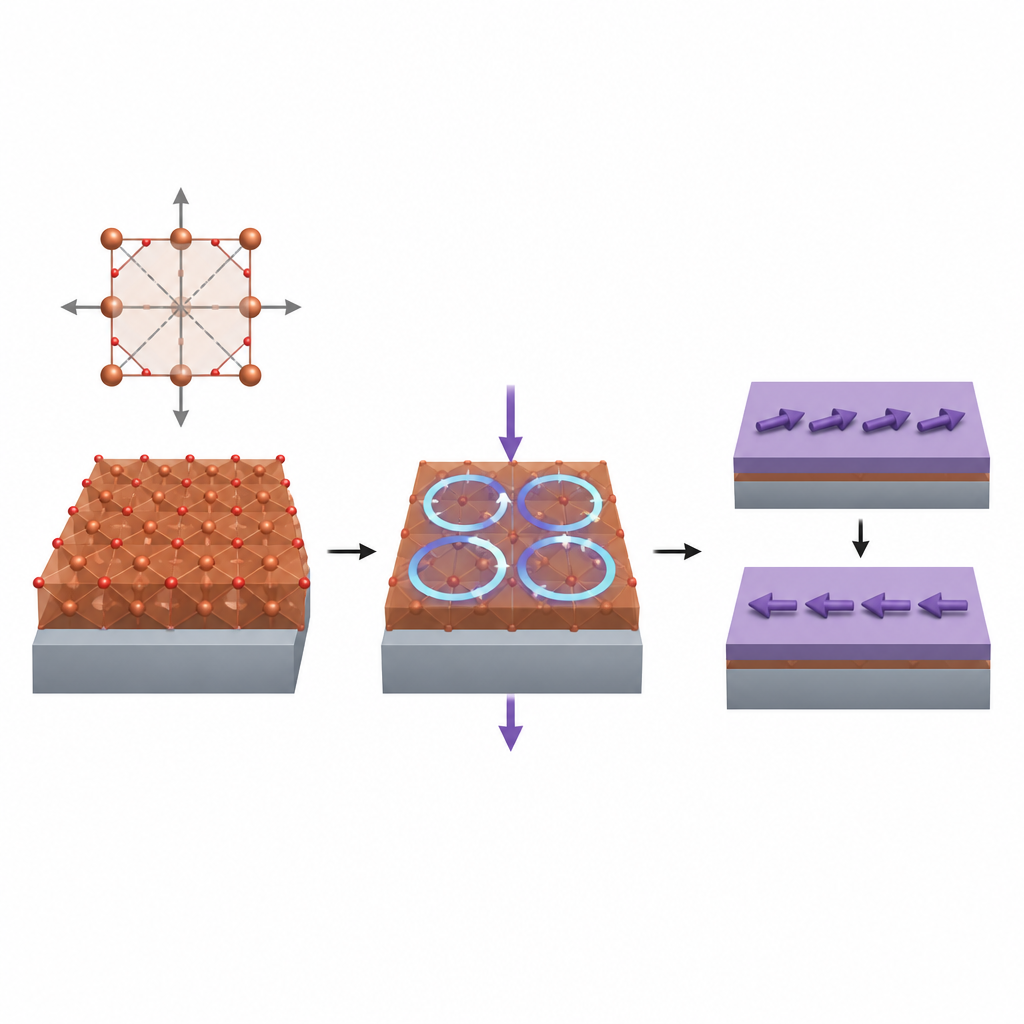
Hidden motion inside electrons
Besides carrying charge, electrons can carry two kinds of angular momentum: one linked to their spin, and another linked to how they orbit around atoms. Spin has long been used in spintronics, where spin currents can flip magnetic bits using effects tied to strong coupling between spin and motion. More recently, researchers have realized that orbital motion can also be harnessed, creating orbital currents that can in turn influence magnetism. Until now, most experiments on these orbital currents have used disordered or polycrystalline metals where the internal atomic order averages out, so any directional behavior has been difficult to see.
Building an orderly copper-oxide film
The authors created a highly ordered, ultra-thin film of copper oxide (CuO) grown on a magnesium oxide crystal. Although CuO naturally has a monoclinic structure without simple rotation symmetry, matching it carefully to the underlying substrate produced a film whose surface behaves as if it has four-fold rotational symmetry. Detailed X-ray and electron microscopy measurements confirmed that the film is epitaxial, well aligned with the substrate, and consists only of divalent copper in the CuO phase. This well-defined crystal environment is crucial, because it fixes the directions along which electrons can hop between atoms and therefore shapes how orbital motion develops when a current flows.
Turning current into directional torque
To test how this symmetry affects orbital currents, the team added a thin nickel layer on top of the CuO and patterned the stack into microscopic Hall bar devices. When an alternating current passes through the CuO/Ni interface, orbital accumulation builds up in CuO and is converted into a spin current in nickel, which produces a torque on the nickel magnetization. By carefully analyzing tiny voltage signals at twice the drive frequency, the researchers extracted the strength and sign of this torque as they rotated the direction of the current with respect to the crystal axes. They found that the torque efficiency not only varied with angle but actually reversed sign every 45 degrees, repeating with a clear four-fold pattern that mirrors the crystal symmetry of the CuO film.
Watching magnets flip in opposite ways
To make this behavior more tangible, the team built another structure where a platinum spacer and a cobalt–nickel multilayer provide a strong preference for magnetization pointing out of the plane. In these devices, short current pulses through the CuO-based stack could switch the perpendicular magnetization, as read out by a Hall voltage. When the current path was aligned along two different crystal directions separated by 45 degrees, the switching polarity flipped, meaning that a pulse that turned the magnet one way in one device turned it the opposite way in the other. The difference in the required current matched the angular dependence seen in the harmonic measurements, tying the macroscopic switching directly to the crystal-controlled orbital response.
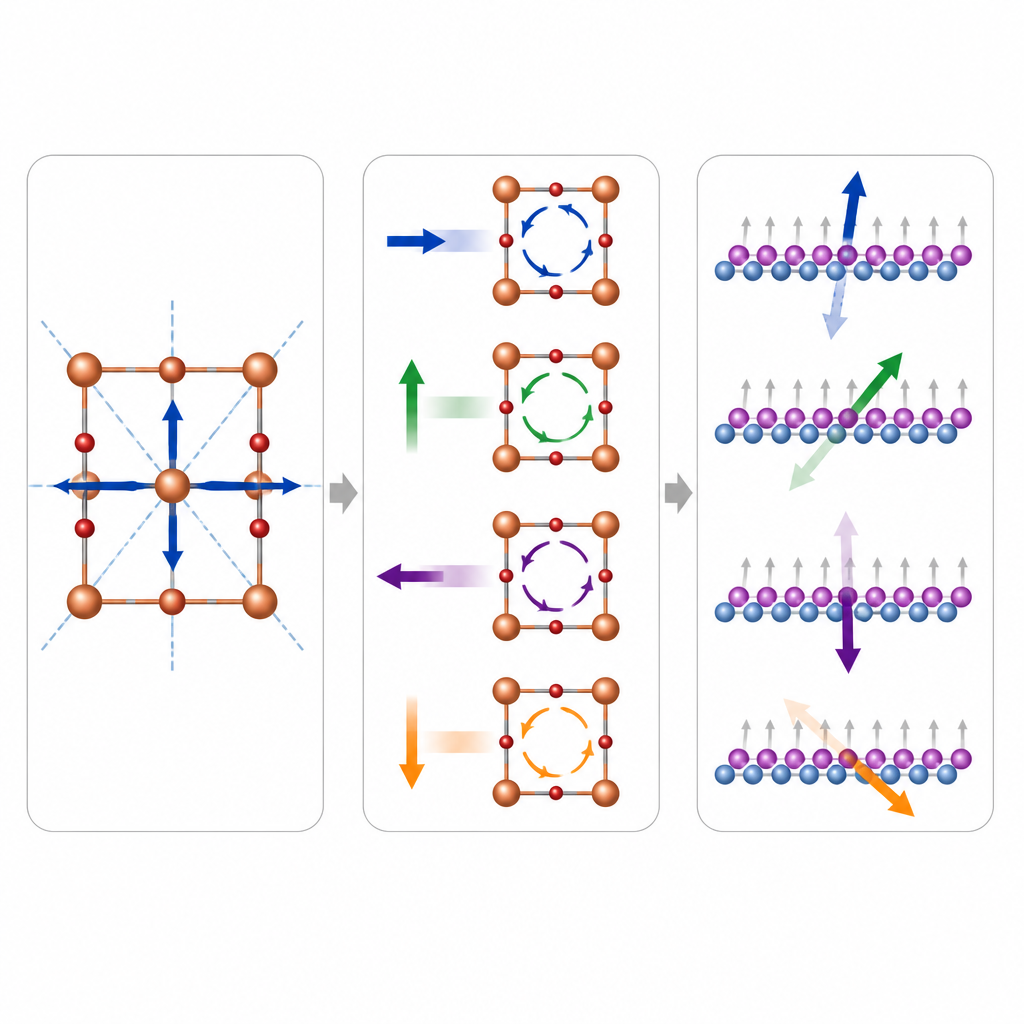
Theory behind the directional effect
First-principles calculations provided a microscopic picture of what is happening inside the CuO. The calculations show that both the orbital response and the usual spin-based Rashba response depend strongly on how the current direction lines up with the crystal. As the current direction rotates, the contributions from orbital and spin channels compete, so that in some directions the orbital part dominates and pushes the torque one way, while in directions rotated by 45 degrees the spin part wins and drives the torque the other way. This built-in angular tug-of-war naturally leads to the observed four-fold pattern and sign changes in the torque efficiency.
What this means for future devices
The work demonstrates that the internal symmetry of a crystal is not just a structural detail but an active control knob for how hidden orbital motion in electrons influences magnetism. By designing materials and interfaces with specific symmetries, engineers could tailor both the strength and direction of torques that switch magnetic bits, potentially enabling devices that operate without external magnetic fields and with lower power. In simple terms, the study shows that by carefully arranging atoms in a repeating pattern, one can program how electric currents twist tiny magnets, opening new possibilities for orbitronics, the emerging technology that uses orbital motion alongside spin to process information.
Citation: Xiao, R., Zhao, T., Baek, I. et al. Crystal symmetry-dependent Orbital Rashba Edelstein effect in epitaxial CuO thin film. Nat Commun 17, 4461 (2026). https://doi.org/10.1038/s41467-026-71018-6
Keywords: orbitronics, orbital angular momentum, spin torque, CuO thin films, crystal symmetry