Clear Sky Science · en
Non-contact laser polishing and reconstruction towards high-efficiency all-perovskite tandem solar cells
Making Solar Panels Work Better
Solar panels are getting cheaper and more common, but today’s standard designs waste a lot of the Sun’s energy as heat. One of the most promising ways to squeeze more electricity out of sunlight is to stack two solar cells on top of each other, each tuned to a different slice of the solar spectrum. This study shows how a new kind of “contact-free polishing” with laser light can fix a key weakness in such stacked perovskite solar cells and push their efficiency close to 30%, a level attractive for future rooftop, utility, and even portable power applications.
Why Stacked Perovskite Cells Struggle
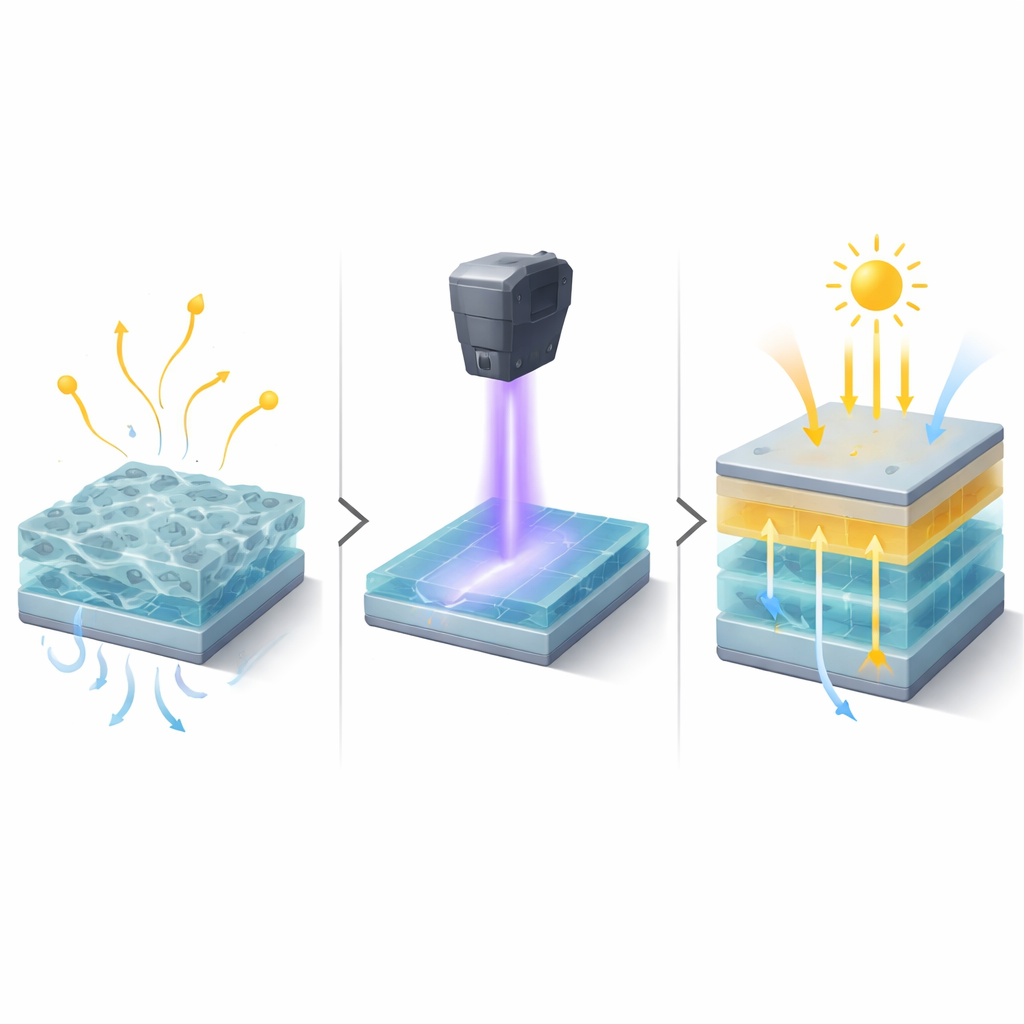
Perovskites are crystal-like materials that can absorb sunlight very efficiently and are easy to manufacture from solution. To beat the efficiency limits of single cells, researchers stack a wide-bandgap perovskite on top of a narrow-bandgap one, forming an all-perovskite tandem. The bottom, narrow-bandgap cell must collect the red and near‑infrared light that passes through the top cell, and its performance largely sets the tandem’s ceiling. Unfortunately, lead–tin narrow-bandgap films usually form with rough, defect‑rich surfaces. Tin tends to accumulate and oxidize near the top, iodine becomes deficient, and the bumpy surface makes poor contact with the electron-extracting layer. Together, these problems cause charge carriers to recombine before they can be harvested, wasting voltage and current.
Smoothing with Light Instead of Sandpaper
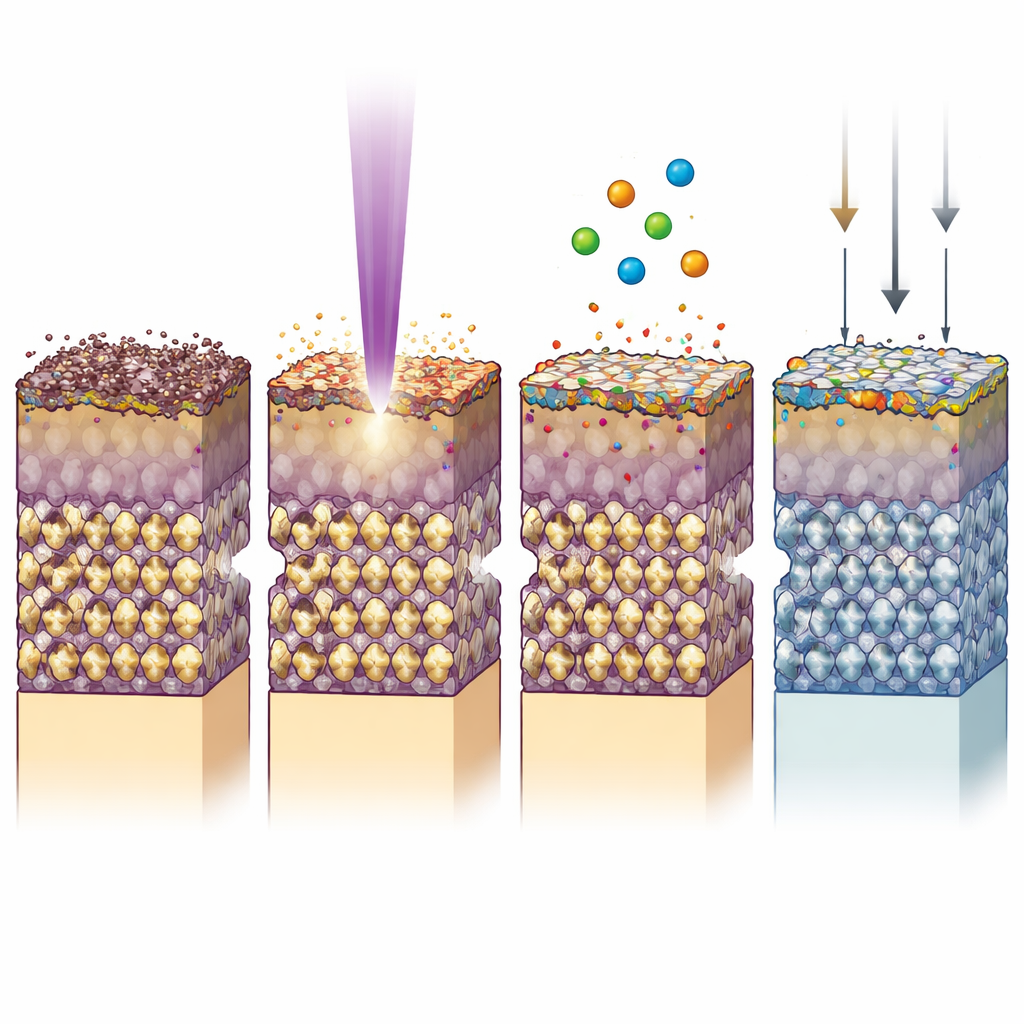
Conventional ways to clean up perovskite surfaces rely on liquid chemicals or physical contact, both of which can damage the delicate films and are hard to control over large areas. In this work, the authors developed a picosecond ultraviolet laser polishing method that never touches the film. Ultra-short laser pulses skim off only the defective top tens of nanometers, flattening the surface while minimizing heating of the underlying crystal. Microscopy shows that average roughness falls by about a factor of three, and chemical measurements reveal that the excess tin and missing iodine at the surface are largely removed. The polishing depth can be tuned with laser power and scan speed, and the team demonstrates sub‑nanometer precision and excellent repeatability across many batches.
Rebuilding a Healthier Surface Layer
Laser polishing does more than just shave off bumps; it leaves behind a perovskite surface with many empty “A‑sites” in the crystal framework—places where large organic or cesium ions normally sit. The researchers treat this freshly exposed surface with a solution containing guanidinium bromide, whose large guanidinium ions can form strong hydrogen bonds and tend to slow down ion motion. These ions selectively fill the vacant sites near the surface, reconstructing it into a guanidinium–cesium perovskite layer that is better ordered and less strained than before. X‑ray and electron microscopy show that distortions in the crystal lattice disappear and that the top few nanometers expand slightly, consistent with guanidinium’s larger size. Optical tests find brighter photoluminescence and longer carrier lifetimes, signaling fewer defects and more uniform film quality across large areas.
Turning Cleaner Surfaces into Higher Efficiency
When the team builds full devices, the benefits compound. Single narrow-bandgap cells made with the polished and reconstructed surfaces show higher voltage, current, and fill factor than untreated controls, while also exhibiting much less hysteresis—an indicator that mobile ions and unstable interfaces have been tamed. The best lead–tin cell reaches a power conversion efficiency of 24.07%, with an independently certified 23.47%, using a scalable process that does not rely on antisolvent quenching. Stacking this improved bottom cell under a wide‑bandgap top perovskite yields an all‑perovskite tandem with 29.80% efficiency and strong agreement between measured current and spectrally resolved response. Larger devices and mini‑modules fabricated with the same approach keep high efficiencies, and encapsulated tandems retain about 80% of their initial performance after roughly 650 hours of continuous operation.
What This Means for Future Solar Power
By using a non‑contact laser to precisely remove defective material and then rebuilding the top few nanometers with a more robust perovskite composition, this work tackles one of the main bottlenecks in advanced perovskite tandems: a rough, unstable interface that wastes charge. The result is smoother films, cleaner charge extraction, reduced ion migration, and record efficiencies for antisolvent‑free all‑perovskite tandems. Because the method is adjustable, rapid, and compatible with different bandgaps and device structures, it offers a broadly useful tool for pushing perovskite solar technology closer to its theoretical limits and toward real‑world deployment.
Citation: Ma, T., Luo, D., Ye, W. et al. Non-contact laser polishing and reconstruction towards high-efficiency all-perovskite tandem solar cells. Nat Commun 17, 4193 (2026). https://doi.org/10.1038/s41467-026-71017-7
Keywords: perovskite tandem solar cells, laser surface polishing, interface engineering, high efficiency photovoltaics, thin film solar technology