Clear Sky Science · en
Decoupling charge‒discharge electrolysis for hydrogen evolution and organic oxidation reactions
Turning Water and Waste into Useful Fuels
Producing clean hydrogen fuel often wastes energy and throws away useful chemicals. This study explores a smarter way to split water so that hydrogen is made more efficiently while common alcohol-like liquids, including those from plastic waste and biomass, are upgraded into valuable products. The work shows how a “charge and discharge” style device can both store electricity and manufacture chemicals, suggesting a future where hydrogen production, waste recycling, and energy storage happen in the same compact system. 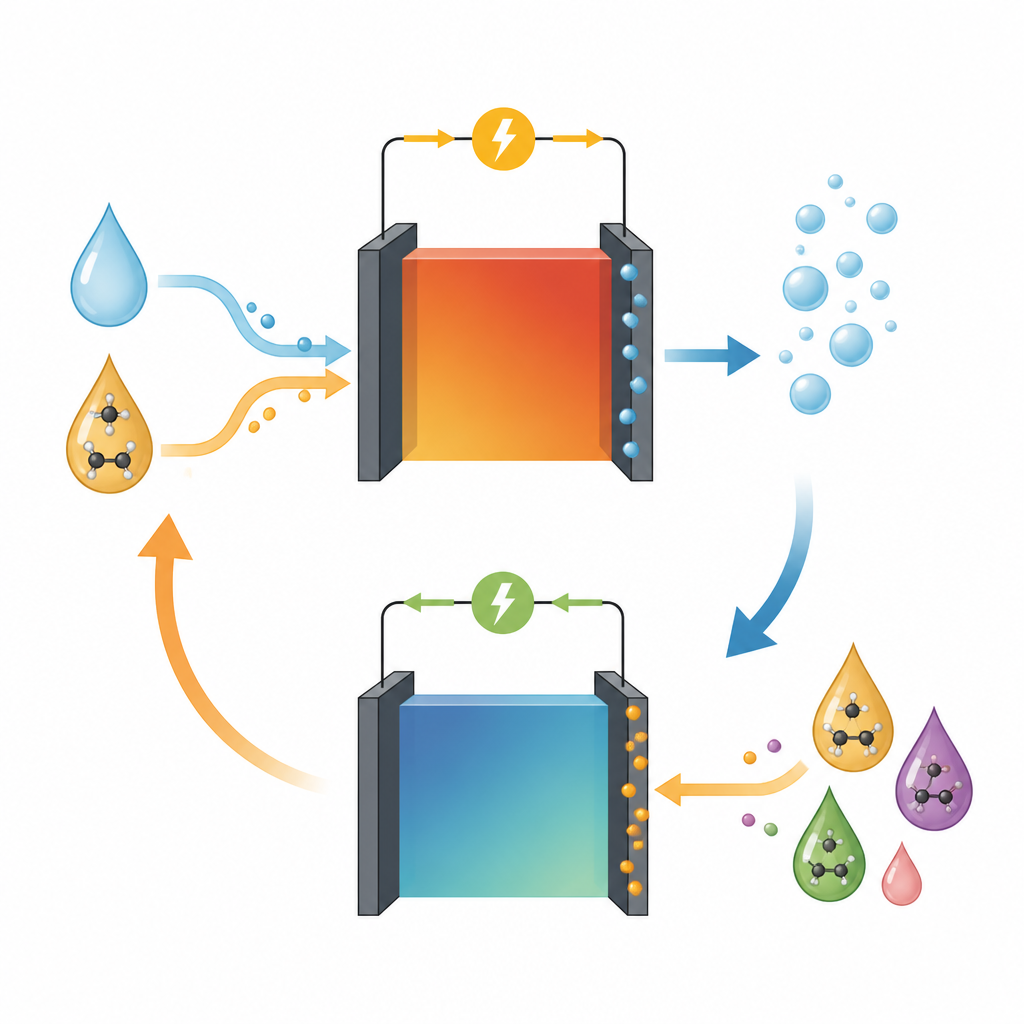
Why Traditional Water Splitting Falls Short
Conventional water splitting uses electricity to make hydrogen at one electrode and oxygen at the other. The oxygen side is slow and hungry for extra voltage, which raises power costs and mostly produces low-value oxygen gas. To avoid dangerous gas mixing, membranes are added, but these introduce resistance and can degrade over time. Replacing oxygen formation with the oxidation of organic molecules, such as small alcohols, can in theory save energy and yield valuable products, yet these organic reactions are themselves slow and tightly tied to the hydrogen-making side, so the overall process still suffers from a rate bottleneck and energy loss.
A Two-Step Path that Breaks the Bottleneck
The researchers solve this problem by decoupling the two sides of the reaction in time using a solid material that can reversibly store charge, called a redox reservoir. In their design, a nickel–cobalt hydroxide layer acts as this reservoir and sits between a hydrogen-producing electrode and a separate electrode where organics are upgraded. In the first step, the device is “charged”: water is reduced to hydrogen at a platinum electrode while the nickel–cobalt layer is oxidized, storing electrical energy in its changed chemical state. Because this oxidation is a simple one-electron step with fast reaction speed and no gas formation, it pairs very well with hydrogen evolution and allows high hydrogen output at lower cell voltages without a membrane.
Making Valuable Chemicals While Releasing Stored Energy
In the second step, the direction of current is switched and the stored energy in the oxidized nickel–cobalt layer is released. Now, that layer is reduced back to its original form while an organic molecule is oxidized at the other electrode. The team chose ethylene glycol, a common component of antifreeze and recycled plastics, and targeted its conversion to glycolic acid, a higher-value building block for biodegradable polymers. They built porous palladium nanosheet arrays that expose many active sites and help both hydroxide ions and ethylene glycol reach them quickly. In this discharge step, the cell generates electricity and converts ethylene glycol to glycolic acid with around 90 percent selectivity, even at high current, something that is hard to achieve in conventional, tightly coupled setups. 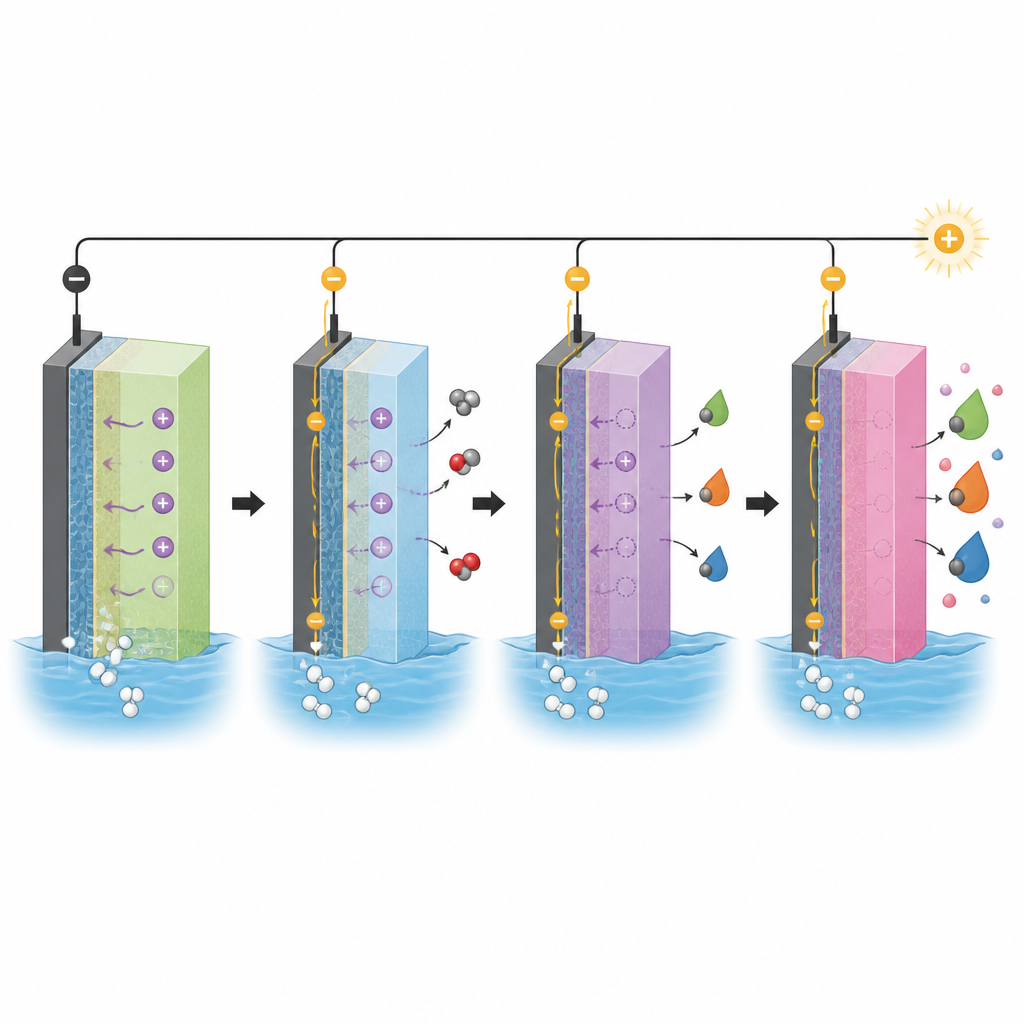
A Flexible Platform for Many Chemicals
Beyond ethylene glycol, the authors show that the same decoupled approach can work with several other small molecules, including glycerol, formaldehyde, and ascorbic acid, each yielding a different useful product while also producing power. They also swap in other reservoir materials such as manganese oxides and adapt the concept to both alkaline and acidic liquids. In another demonstration, they decouple an industrially important partial hydrogenation reaction, turning acetylene into ethylene more efficiently. By linking three cells in series and driving them with a small solar panel, they reach industrial-level hydrogen production rates while also making glycolic acid and collecting usable electrical energy, hinting at real-world viability.
What This Means for Clean Energy and Chemicals
To a lay observer, the device acts like a rechargeable battery that breathes water and simple organic liquids instead of metals alone. When electricity is cheap or abundant, it “charges” by producing hydrogen and storing energy in the solid reservoir. Later, it “discharges” by upgrading organic feedstocks into higher-value chemicals while giving some electricity back. The study concludes that this decoupled strategy can ease the built-in tension between fast reaction rates, stable catalysts, and selective product formation that plagues traditional electrolysis. As redox reservoir materials and cell designs improve, such systems could help integrate solar and wind power with chemical manufacturing, turning everyday waste streams into fuels and feedstocks with better use of every unit of electricity.
Citation: Huang, Y., Zhou, H., Wang, J. et al. Decoupling charge‒discharge electrolysis for hydrogen evolution and organic oxidation reactions. Nat Commun 17, 4502 (2026). https://doi.org/10.1038/s41467-026-71016-8
Keywords: hydrogen production, electrolysis, organic oxidation, energy storage, waste-to-chemicals