Clear Sky Science · en
Oriented diffusion tailors interfacial strain-polarization coupling for broadband electromagnetic absorption
Why invisible waves matter to everyday life
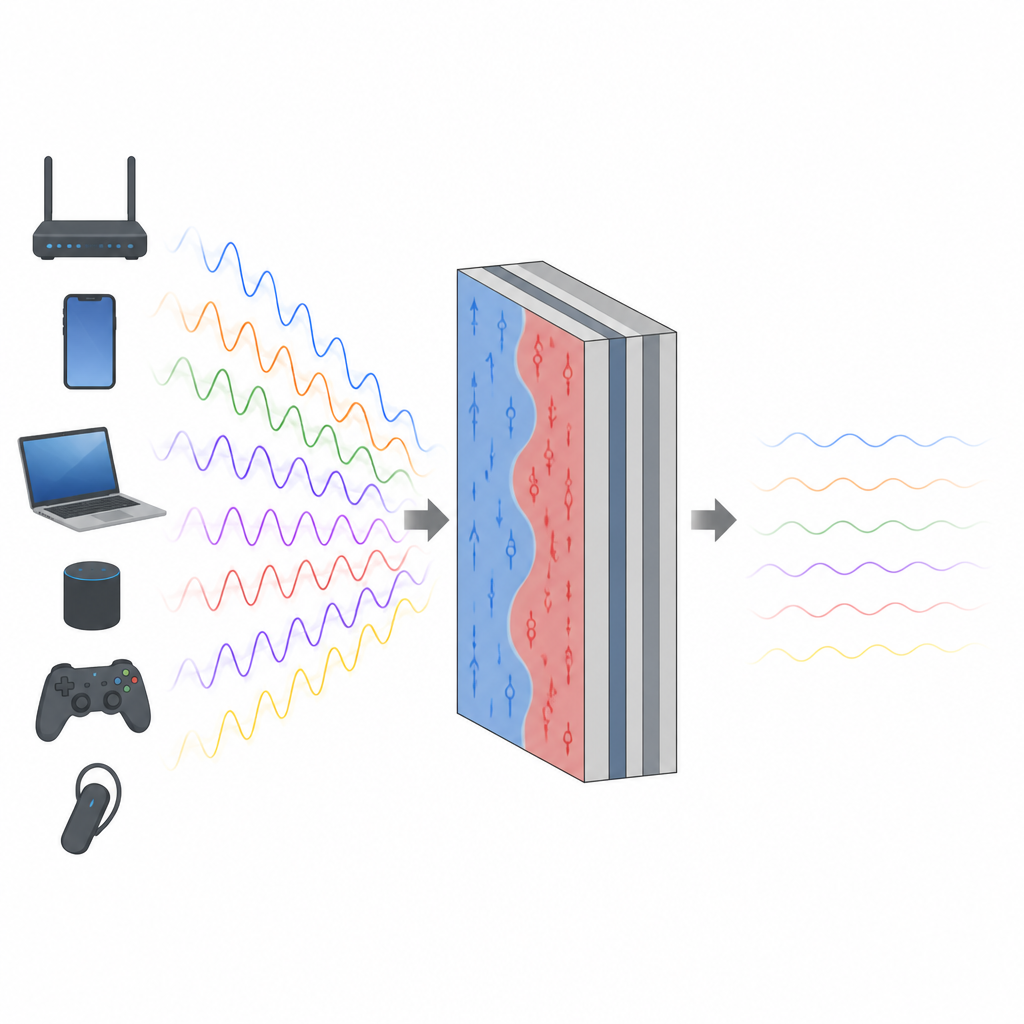
Our homes, offices, and cities are filled with invisible wireless signals from phones, WiFi routers, base stations, and radar systems. While these electromagnetic waves enable modern communication, most of the energy they carry goes unused and can contribute to electronic interference, security risks, and public concern. This study explores a new type of material that can quietly soak up a very wide range of these stray signals and turn them into harmless heat, offering a path toward cleaner and more reliable wireless environments.
Turning a problem at tiny scales into a useful tool
When different materials touch each other, their atoms do not line up perfectly. This mismatch creates tiny mechanical stresses, known as strain, along their shared boundary. In many devices this strain is treated as a nuisance, because it can disturb how electrons move. The authors of this paper instead ask whether that same strain, if carefully controlled, can be used as an extra “knob” to tune how a material interacts with electromagnetic waves. They focus on a pair of materials: zinc oxide, which responds strongly to electric fields, and an iron carbide that responds to magnetic fields, combining them into what is called a magnetoelectric composite.
Building a tiny layered sponge for wireless energy
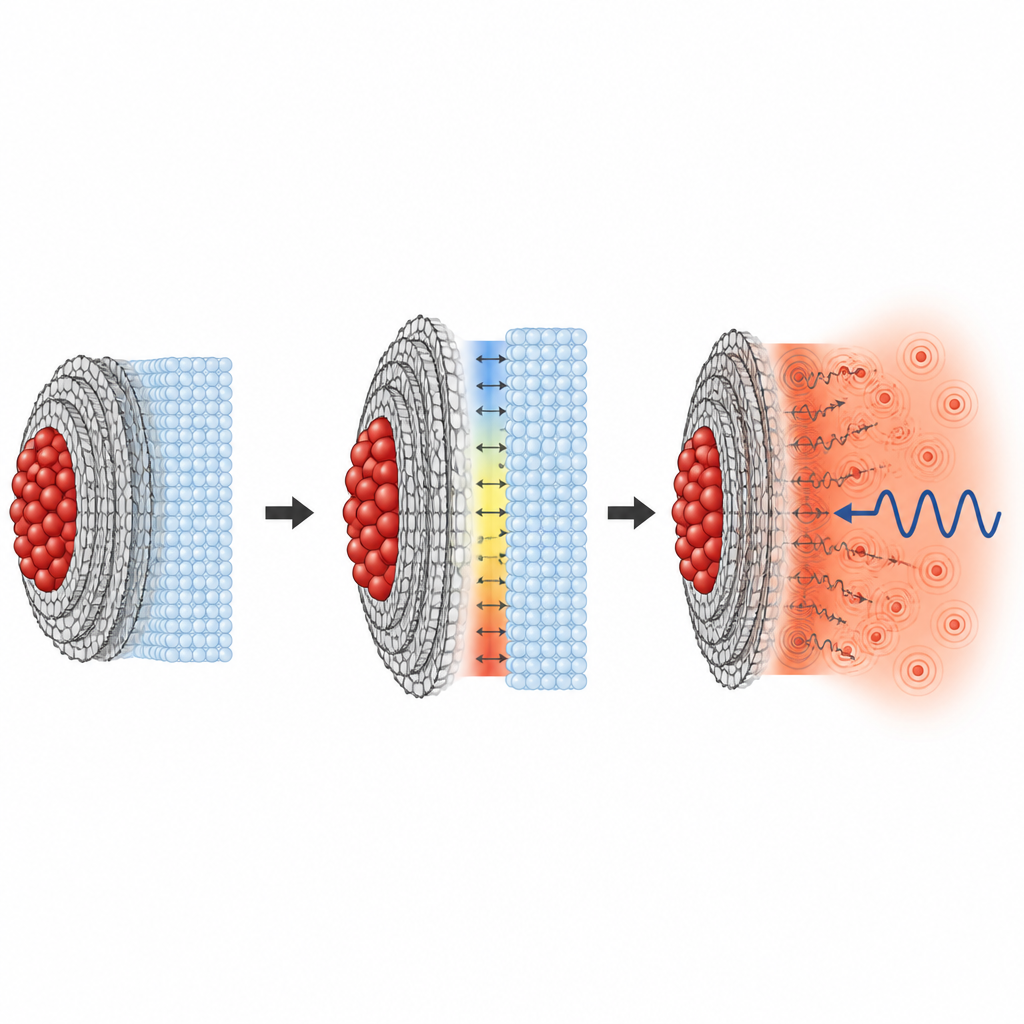
To realize this idea, the team builds miniature spheres with a carbon shell that holds both zinc oxide and iron carbide inside. By heating these structures under controlled conditions, they cause zinc oxide to slowly diffuse outward through the carbon shell. As it moves, zinc oxide and iron carbide first share a tight, compressed boundary, then pass through a stretched state, and finally separate. At the point where the interface is under gentle tension, the local electric fields at the atomic level are strongly reshaped. Electrons can move more easily across the boundary, and tiny electric dipoles form and relax rapidly, allowing the structure to absorb incoming electromagnetic energy and convert it into heat.
From atomic strain to broadband signal absorption
The researchers measure how these strained interfaces change the electrical behavior of the material across microwave frequencies used in wireless communication and radar. They find that when the interface is under tensile strain, the material shows a stronger and broader dielectric response: its internal charges can follow changing fields over a wide range of frequencies. Computer simulations and advanced electron microscopy reveal that strain alters the energy barriers for charge motion and creates many local regions where positive and negative charges are slightly separated. These act like countless tiny antennas and dampers inside the material, helping to slow down and dissipate passing waves.
Designing a silent shield for wireless noise
To test practical performance, the team mixes the optimized particles into a resin and shapes them into a patterned panel, known as a metamaterial. This panel is engineered so that its shape and internal structure cooperate: the magnetoelectric particles provide strong loss of electromagnetic energy, while the pyramid-like geometry helps incoming waves enter rather than bounce off. Experiments show that this metamaterial can effectively absorb signals across the entire 2 to 18 gigahertz range, which includes common wireless bands and radar frequencies. When placed in front of a 5G router, it cuts the measured radio signal strength by more than 95 percent and warms slightly as it converts the wave energy into heat.
What this means for future wireless spaces
In simple terms, this work shows that carefully “stretching” and “relaxing” the boundary between two tiny components inside a material can turn it into a powerful broadband sponge for electromagnetic waves. By steering how atoms sit and how electrons move at these internal interfaces, the researchers create a material that can tame a wide range of unwanted wireless signals without relying on bulky metal shields. Such strain-engineered magnetoelectric metamaterials could help protect sensitive electronics, reduce electromagnetic clutter in crowded cities, and support both civilian and defense technologies that depend on clean and secure communication channels.
Citation: Rao, L., Zhao, X., Wang, X. et al. Oriented diffusion tailors interfacial strain-polarization coupling for broadband electromagnetic absorption. Nat Commun 17, 4585 (2026). https://doi.org/10.1038/s41467-026-71015-9
Keywords: electromagnetic absorption, wireless interference, magnetoelectric materials, metamaterials, microwave shielding