Clear Sky Science · en
Molecular evolution and spatial transmission of severe fever with thrombocytopenia syndrome virus
Why this virus story matters
Severe fever with thrombocytopenia syndrome is a mouthful, but its impact is simple to grasp: this tick-borne disease can be deadly, it is spreading across East Asia, and there are no approved vaccines or specific treatments. The virus behind it, now called Bandavirus dabieense, is quietly evolving in people, livestock and ticks. This study pieces together nearly two decades of genetic and clinical data to reveal how the virus has changed, how it travels across the landscape, and which versions are most dangerous to patients.
Where the virus comes from and where it goes
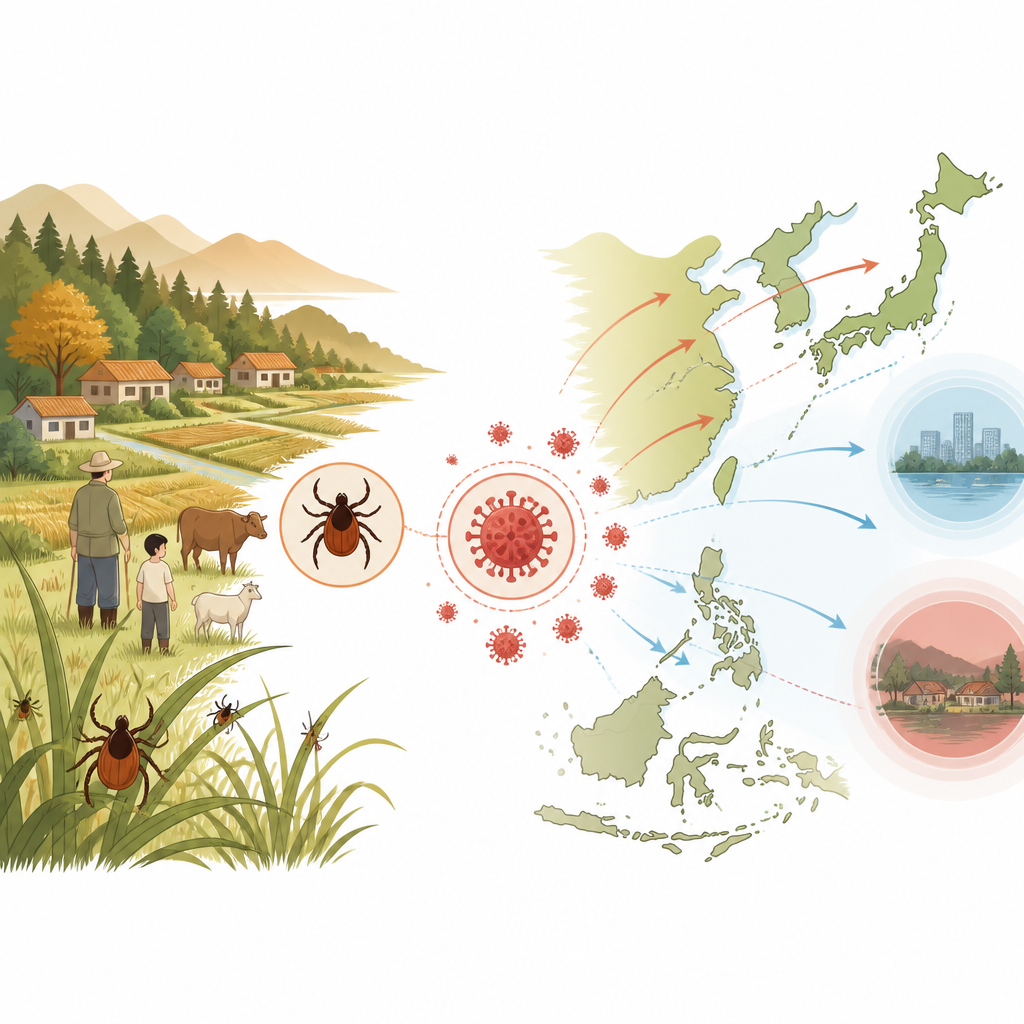
By analyzing 1942 complete virus genomes collected between 2005 and 2023 in China, South Korea, Japan and Thailand, the researchers reconstructed the family tree of the virus. They found two main branches: a Chinese lineage with ten genetic types and a Japanese–Korean lineage with three. Countries show distinct patterns. In Japan, one type dominates and remains stable. South Korea shows a mixed pattern with two main types. China has the most complex picture, with many types circulating at once and clear regional differences. Mountainous inland areas such as the Dabie Mountains host a rich mix of types, while many coastal provinces are dominated by a single type.
How the virus shuffles its genetic deck
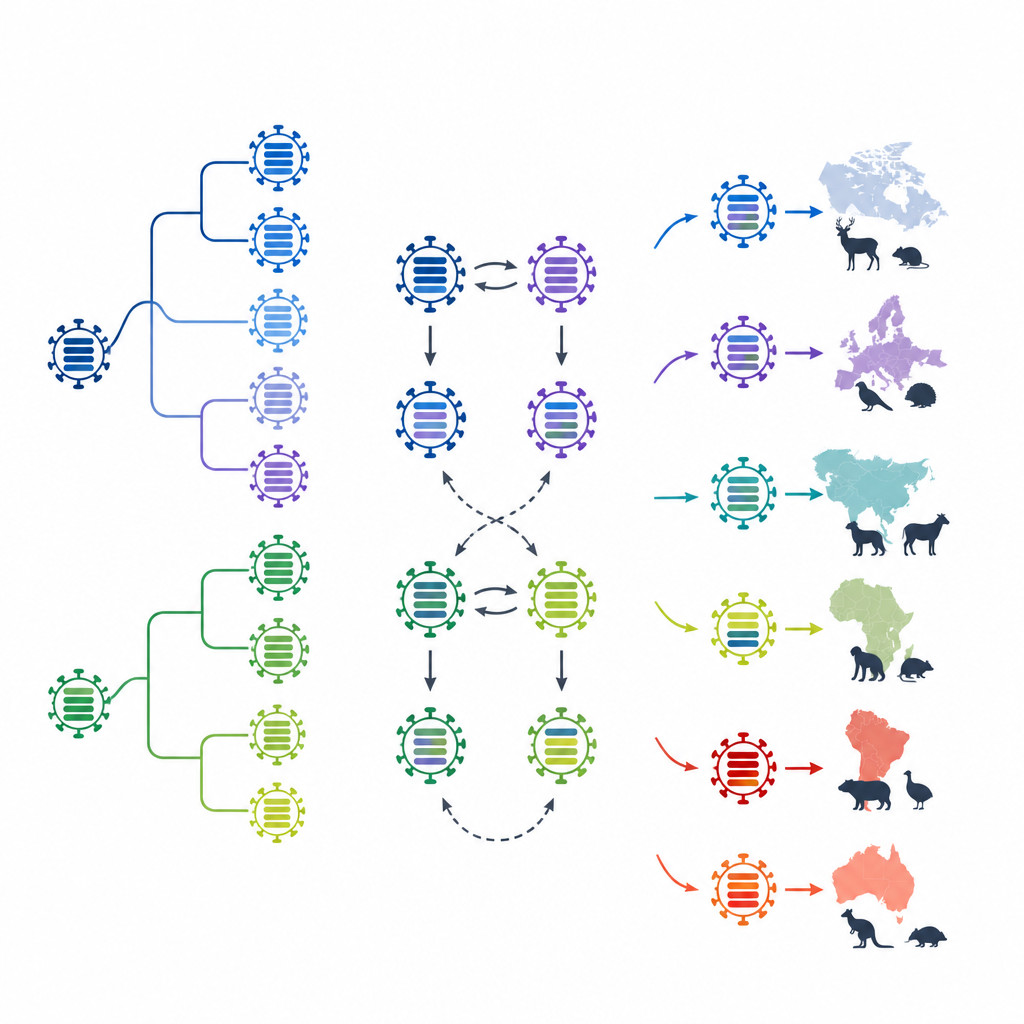
The virus genome is split into three pieces, and when two strains infect the same host cell, they can swap these pieces. This swapping, known as reassortment, creates new combinations. The team detected 212 such events spread across China, South Korea, Japan and Thailand, with the middle genome segment swapping most often. They also found 69 recombination events, where parts of a genome piece are stitched together from different parents. These events were concentrated in a few Chinese provinces, especially Henan, Hubei and Zhejiang, turning them into hotbeds of new variants. One region, Hubei, stood out for hosting many mixed and reshaped strains, suggesting intense local evolutionary activity.
Land paths, sea paths and the role of climate
Using time-stamped genomes and geographic data, the authors traced the virus back to the border between Jiangsu and Anhui provinces in China, with an origin likely in the 17th century. From there, the Chinese lineage spread mainly over land into East and Northeast China and into the Dabie Mountain region, helped by human movement and expanding tick habitat. The Japanese–Korean lineage followed sea-linked routes, with South Korea acting as a bridge between Japan and China’s Zhejiang coast. Climate-driven shifts in the range of the main tick species, which can reproduce without mating and spread quickly, appear to have helped the virus move northward and into new regions.
Which viral types hit patients hardest
For just over a thousand cases, the researchers had both virus sequences and patient outcomes. This allowed them to match specific genetic types with survival or death. Among the five common types studied in detail, one type called genotype IV had the highest death rate and was strongly linked to severe brain and nerve problems. Detailed mapping of mutations showed clusters of changes that tended to occur together in this genotype, especially in viral proteins involved in copying the genome and entering cells. Several positions in these proteins showed signs of strong evolutionary pressure, hinting that they help the virus adapt in ways that worsen disease.
What this means for public health
Overall, the study shows that this tick-borne virus is not static: it is diversifying in mountain hotspots, stabilizing in some coastal areas, and traveling along both land and sea corridors. Some of its genetic branches, particularly genotype IV and its linked mutation networks, appear more deadly for patients. For a lay audience, the takeaway is that careful tracking of where different viral types circulate and how they change can guide surveillance, focus tick control in key regions, and help scientists design vaccines and treatments that target the most dangerous versions of the virus.
Citation: Leng, Y., Mu, HZ., Cui, N. et al. Molecular evolution and spatial transmission of severe fever with thrombocytopenia syndrome virus. Nat Commun 17, 4499 (2026). https://doi.org/10.1038/s41467-026-71008-8
Keywords: tick-borne virus, severe fever with thrombocytopenia syndrome, viral evolution, East Asia transmission, genotype IV virulence