Clear Sky Science · en
Engineering high environmental robustness in solar evaporation to bridge the lab-to-field performance gap
Turning Sunlight into Safe Drinking Water
Access to clean water is a growing concern for many communities, especially in hot, dry regions far from large treatment plants. This study explores how to use simple sunlight-driven devices to turn salty or dirty water into fresh water, and, crucially, how to make sure they work just as well outdoors as they do in the lab. By understanding why performance drops in real weather and how to prevent those losses, the work points toward more reliable off-grid drinking water systems. 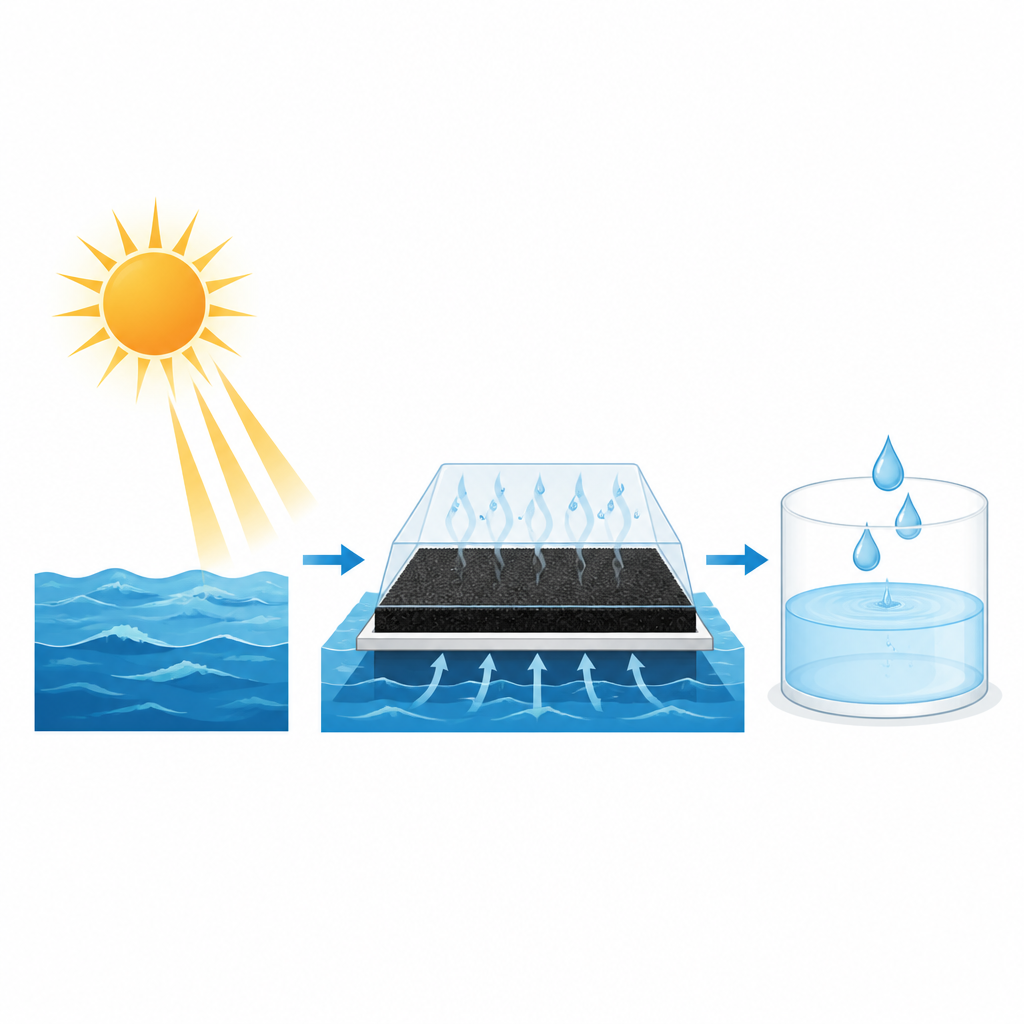
Why Lab Success Often Fails Outdoors
In recent years, engineers have created compact solar stills that boil water using sunlight and then condense the vapor into drinkable liquid. A clever “multistage” design passes heat from one level to the next, so the same sunlight drives several evaporation–condensation cycles, greatly boosting output. In the lab, these stacked systems can produce several kilograms of fresh water per square meter each hour, enough to approach or even beat the theoretical limit of a single-stage still. Yet when the very same designs are placed outdoors, their water production often drops by a quarter to more than half, even under similar sunlight, revealing a serious gap between lab tests and real-world performance.
Measuring Real-World Toughness
To make sense of this gap, the authors introduce a simple yardstick called the Environmental Robustness Index, or ERI. It compares how much water a device makes outside, under local weather, to how much it makes under standard lab conditions. An ERI close to 1 means the device barely notices the change in environment; a low ERI means it is fragile. By building a detailed heat and mass transfer model, the team shows that two main culprits sap performance outdoors: moving air that strips heat from the hot surface and “sky cooling,” where the device radiates heat directly into cold outer space through a transparent band in the atmosphere. Together, these effects can dump more heat into the sky and wind than the sun supplies, leaving too little energy to drive evaporation.
Locking in Heat with a Clear Protective Layer
Guided by their model, the researchers propose a “spectrally selective air lock,” a clear protective layer that acts like a one-way gate for energy. It lets in visible sunlight but blocks the infrared radiation that carries heat away, and it traps a thin, mostly still layer of air to choke off convective losses. They first demonstrate this idea with a fine-pored silicone aerogel that is highly transparent to sunlight yet nearly opaque to thermal radiation and an excellent insulator. To show the concept does not depend on exotic materials, they also build versions using everyday plastic or glass sheets combined with a carefully sized air gap that is thick enough to insulate but thin enough to prevent circulating air currents. All of these coverings sharply reduce unwanted heat loss from the top surface. 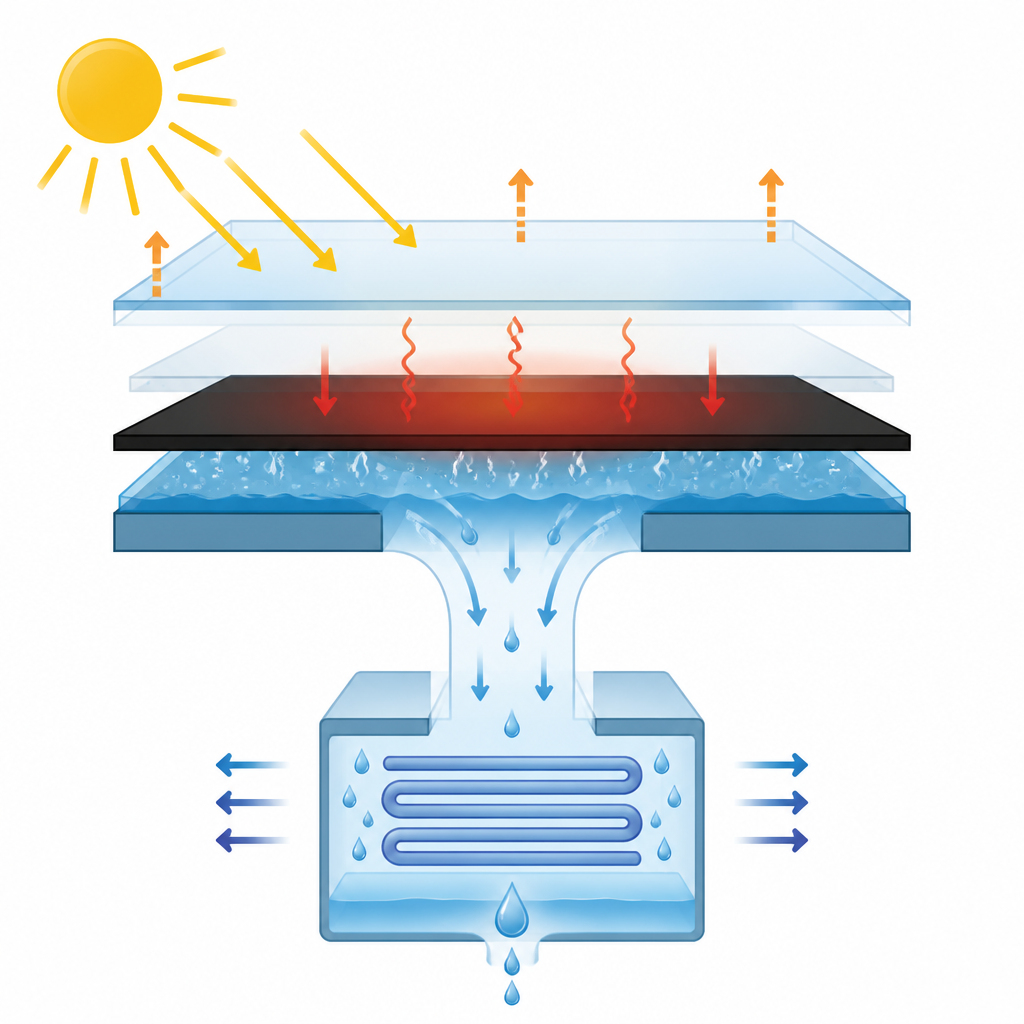
From Simulations to Real Sun and Wind
Computer simulations predict that uncovered devices lose most of their heat to wind and sky cooling, causing their ERI to sink well below 1. With the air lock in place, over 80 percent of incoming solar energy remains available for evaporation, and ERI stays high even in strong wind or clear, dry air. Laboratory tests with a six-stage module confirm these trends: without a cover, water output collapses as wind speed rises and at low sunlight levels. With aerogel or glass–air coverings, production remains strong until sunlight falls below a practical activation threshold. Outdoor trials using real seawater then put the concept to the test. Over a week of changing weather, the aerogel-covered unit consistently produced about twice as much fresh water per day as an uncovered twin. Its ERI reached 0.98 under mild conditions and even climbed above 1.6 during hot summer days, meaning it performed better outside than under standard lab conditions by tapping extra warmth from the air.
What This Means for Future Water Systems
By clearly defining environmental robustness and demonstrating a practical way to achieve it, this study shows that solar-powered distillers can deliver reliable, low-cost water in the real world, not just under perfect lab lighting. The key message is that reporting lab productivity alone is not enough; every new design should also report how well that performance carries over outdoors through its ERI. Simple, transparent air lock covers made from aerogel, glass, or plastic can shield solar evaporators from wind and sky cooling, close the lab-to-field gap, and in hot climates even turn harsh conditions into an advantage. Together, these insights help move solar evaporation from promising prototypes toward trustworthy tools for off-grid drinking water and related solar-thermal uses.
Citation: Wang, Ct., Lin, C., Xu, K. et al. Engineering high environmental robustness in solar evaporation to bridge the lab-to-field performance gap. Nat Commun 17, 4437 (2026). https://doi.org/10.1038/s41467-026-71004-y
Keywords: solar desalination, solar evaporation, clean water, thermal insulation, aerogel cover