Clear Sky Science · en
π-π Stacking origin of irreversible dispersibility of graphene oxide
Why dried graphene ink behaves so strangely
Graphene oxide is often used as an easy-to-handle ink for making advanced materials, from filters to electronics. It spreads as single, paper-thin flakes in water, but once you dry it into a solid, it stubbornly refuses to return to that well-behaved state, even under strong stirring or ultrasound. This study uncovers the hidden reason behind that one-way change and shows how to turn it to our advantage for making soft, conductive gels for brain and nerve probes.
From smooth liquid to stubborn solid
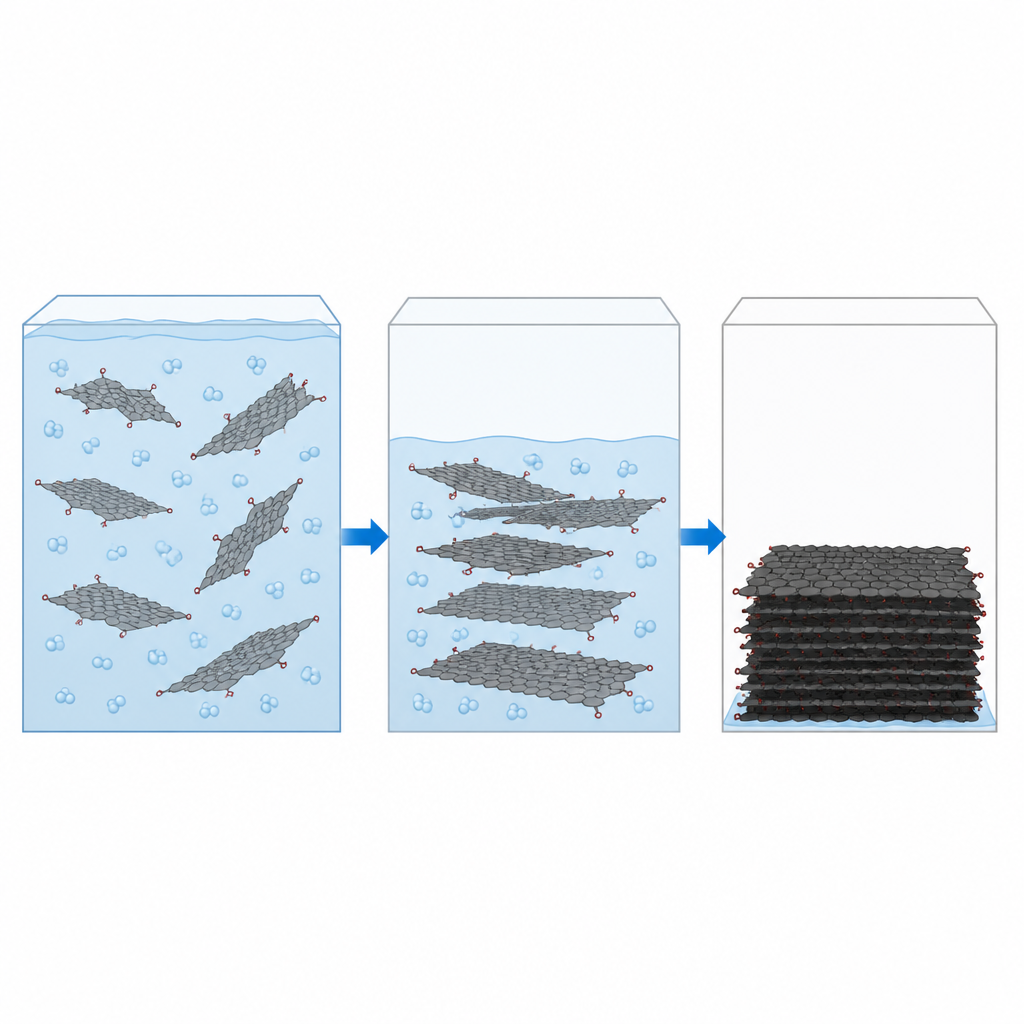
Fresh graphene oxide disperses in water as individual sheets only one atom thick, giving industry a convenient starting point for coatings, films and composites. Yet, once those sheets are dried into a solid, trying to redisperse them mostly produces clumps instead of single layers. The team systematically dried graphene oxide using common methods, from gentle air drying to vacuum heating, and then measured how much of the material could be brought back to single sheets. They found that poor redispersion was a general feature of dried graphene oxide, not tied to any special chemical treatment, hinting that a structural change in how the sheets pack together was responsible.
Sheets that lock together face to face
To trace when and how this lock-in occurs, the researchers followed the drying process in real time. As water slowly left the dispersion, the sheets moved closer together. Beyond a certain concentration, non-redispersible clumps began to appear, meaning the sheets had crossed a distance threshold where they started to interact strongly. X-ray measurements revealed that, at this point, some layers reached a spacing comparable to that in graphite, a form of carbon where flat layers sit snugly atop one another. Electron microscopy showed twisted stacks several sheets thick, and light-emission tests revealed a strong quenching effect typical of flat aromatic regions pressing against each other. Together, these clues point to “face to face” attraction between the flat carbon regions on neighboring sheets as the main cause of the irreversible stacking.
A patchwork surface that drives sticking
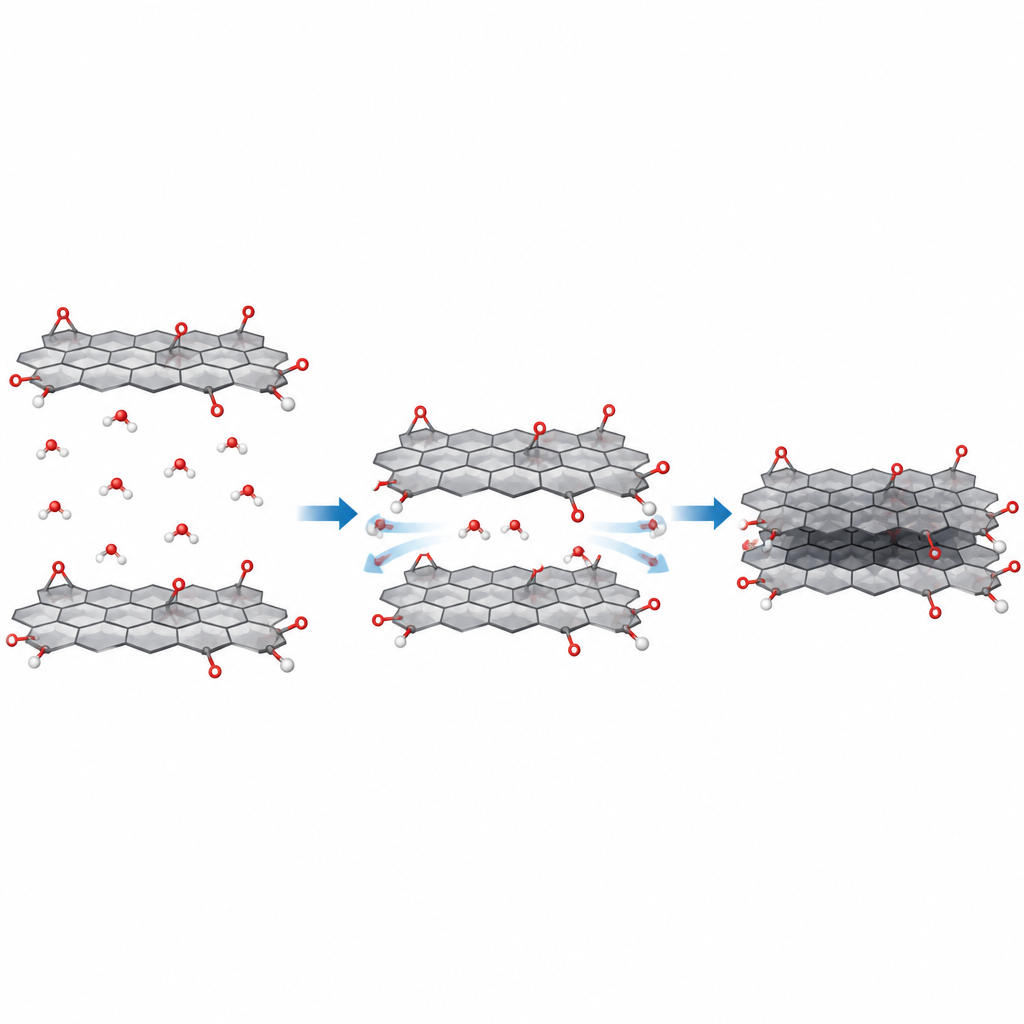
Graphene oxide is not uniform: each sheet is a patchwork of flat carbon islands and more oxidized, water-loving zones. The authors quantified this mosaic by measuring how much of each sheet is made of flat carbon areas and found that solids richer in these regions were harder to redisperse. Computer simulations of two sheets facing one another backed this picture. As the distance shrank, water was squeezed out from between flat carbon regions, allowing them to nestle together closely, while water preferred to stay between the more oxidized patches. Energetically, the system is rewarded when these flat regions pair up and expel water, leading to tight stacks that no longer peel apart into single layers under mild treatment.
Teaching graphene oxide to let go again
Armed with this mechanism, the researchers devised two ways to make dried graphene oxide redisperse. One route adds special surfactant molecules that insert themselves between sheets and shield the flat regions from locking together, so that nearly all of the material returns to single layers after drying. The other route increases the oxidation level of the sheets, shrinking and breaking up the flat carbon islands so they can no longer contact each other over large areas. In highly oxidized samples, dried powders could be fully redispersed without leaving behind stubborn clumps. These approaches allowed the team to repeatedly cast and recycle graphene oxide films with mechanical strength and conductivity similar to films made from fresh dispersions.
Turning sticky stacks into useful soft electronics
The same attractions that cause problems for redispersion can be harnessed to build useful structures. When a dried graphene oxide film is soaked in water, it swells into a gel that holds together through the very face to face contacts that once caused clumping. By carefully choosing the order of steps, the authors used this gel state to make long, flexible graphene-based hydrogels. First they fixed the network using ions, then chemically reduced the sheets to restore high electrical conductivity while preserving a porous structure. The resulting soft, conductive films could be produced continuously over meter scales and patterned into fine features, and they performed well as implantable electrodes for recording brain activity and stimulating nerves in animals.
What this means for future carbon materials
For non-specialists, the main takeaway is that graphene oxide behaves like a one-way ink because its flat carbon patches snap together tightly when water is removed, and ordinary processing cannot easily undo that contact. By understanding and controlling this hidden sticking force, scientists can design powders that redisperse on demand, or gels that stay robust and conductive inside the body. The work offers a practical roadmap for handling graphene oxide in factories and labs, and a broader way to think about how flat carbon-based materials assemble, stick, and function in advanced technologies.
Citation: Gao, Y., Wang, Y., Liao, Y. et al. π-π Stacking origin of irreversible dispersibility of graphene oxide. Nat Commun 17, 4529 (2026). https://doi.org/10.1038/s41467-026-71003-z
Keywords: graphene oxide, pi stacking, nanomaterials, hydrogels, neural probes