Clear Sky Science · en
Zipper-inspired molecular polarity strategy enabling robust adhesive hydroplastics as sustainable plastic substitutes
Turning Trees into Smart Everyday Materials
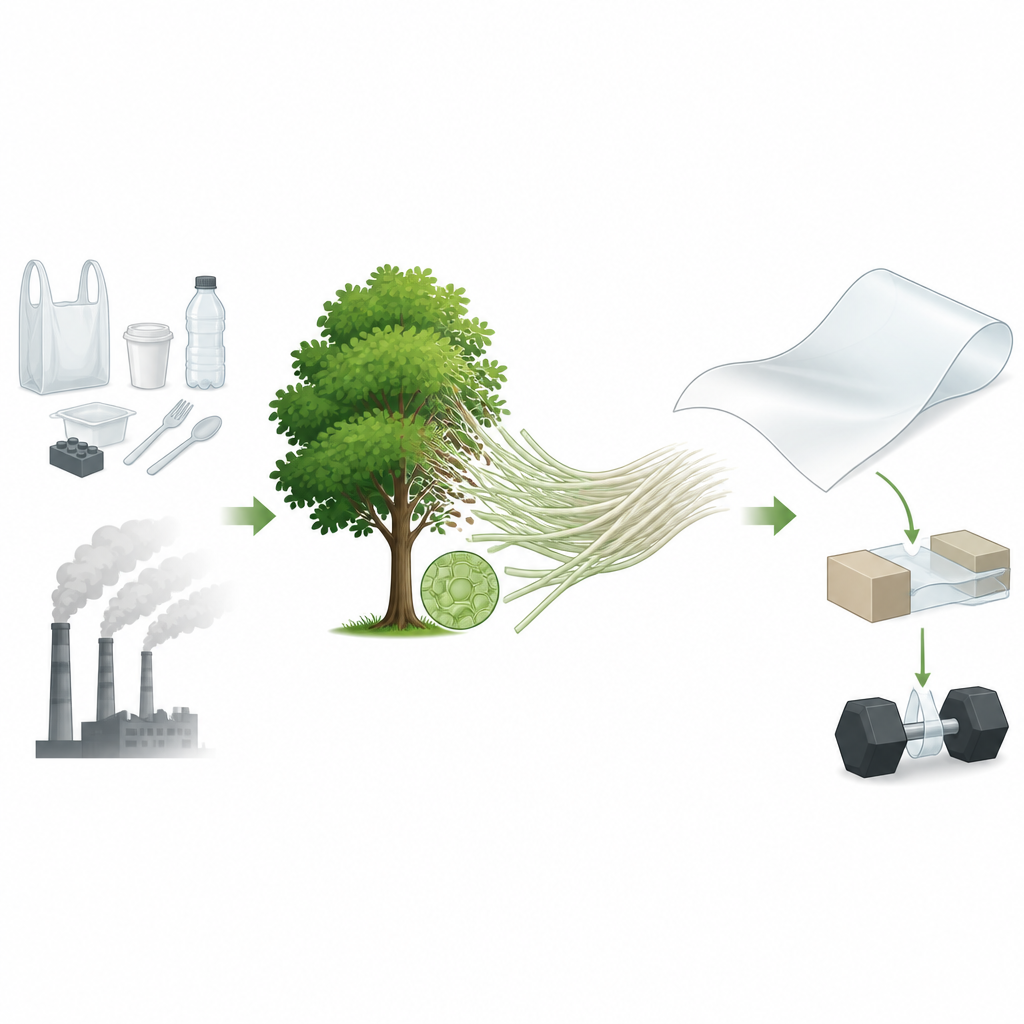
Plastic waste and rising energy use affect everyone, from the food we buy to the air we breathe. This study explores a way to turn cellulose, a natural substance found in trees and plants, into a strong, reusable, and biodegradable material that could replace many petroleum-based plastics. Even more surprising, the researchers show how ordinary water can be used not just to soften this material for shaping, but also to make it stronger and stickier again, much like zipping and unzipping a zipper.
Why We Need Better Plastics
Traditional plastics are made from oil, are produced in enormous quantities, and are rarely recycled. They linger in landfills and oceans for decades. Cellulose, by contrast, is produced by plants at levels thousands of times higher than global plastic production, and it naturally breaks down in the environment. However, plastics made from cellulose have long struggled to match the strength, flexibility, and easy processing of common plastics like polyethylene and polypropylene. Existing cellulose “hydroplastics” use water to soften the material, but they tend to swell, weaken, or lose shape under repeated wetting and drying, limiting their real-world use.
A Zipper-Like Trick with Water
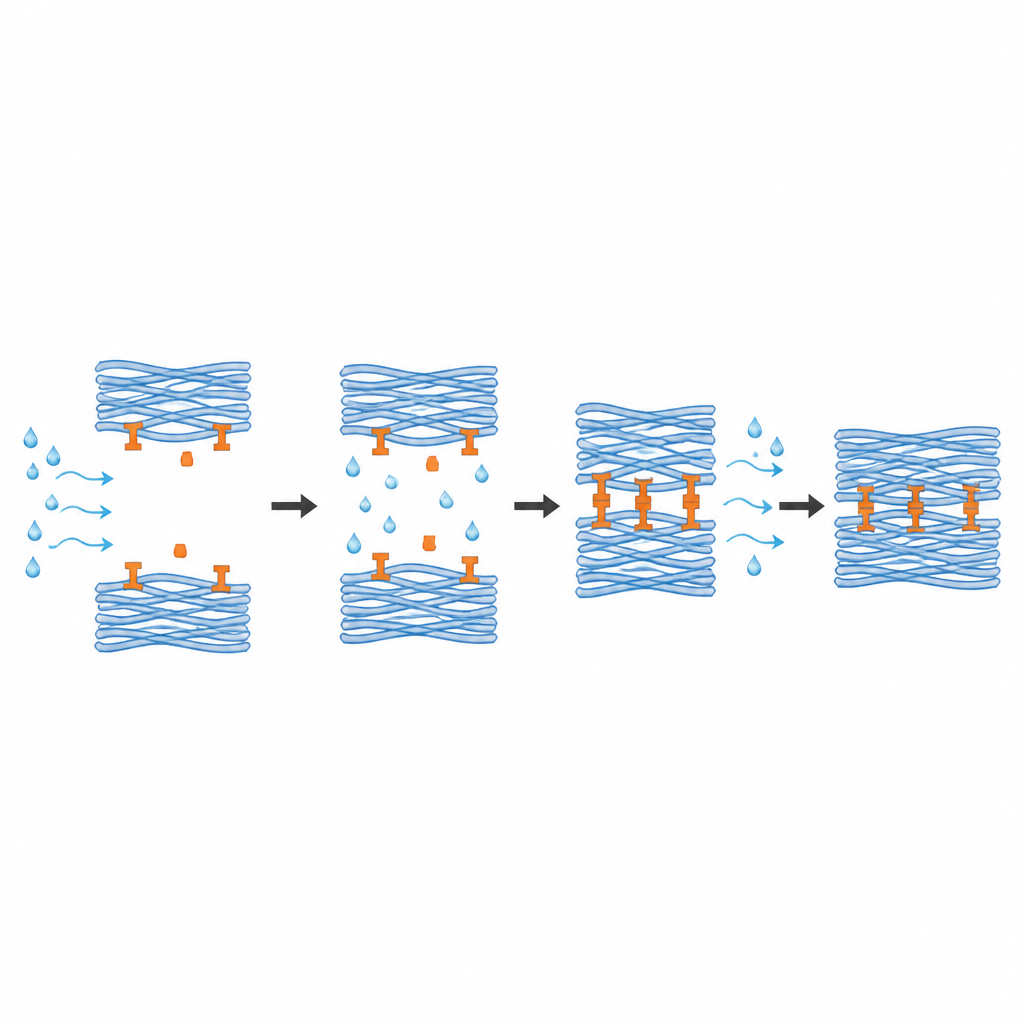
The researchers tackled this problem with a “zipper-inspired” design at the molecular level. They start with cellulose and graft onto it a small natural molecule called thioctic acid. This molecule brings two key features: very polar groups that are strongly attracted to water, and reversible sulfur–sulfur links that can reconnect like tiny latches. Together, they create a gradient of polarity within the material, so different parts of the network prefer water to different degrees. When water is added, it slips into the most attractive sites first, loosening some connections and letting the molecular chains move. When water leaves, capillary forces pull the chains closer, and the sulfur links re-form, locking the network into a denser, stronger state.
How Water Both Softens and Reinforces
Using a suite of techniques and computer simulations, the team followed how water interacts with the new cellulose network. They found that water first clusters around the carboxyl groups introduced by thioctic acid, then around cellulose’s own hydroxyl groups. This selective hydration acts like a controlled competition for bonding sites, temporarily breaking old connections and allowing the chains to rearrange. As the material dries, water evaporation generates tiny pulling forces that draw the chains together, while sulfur–sulfur bonds form between locally enriched thioctic acid segments. X-ray measurements show that this process increases the ordered, crystalline regions and orients the chains more uniformly, which explains why the material grows stronger after cycles of wetting and drying rather than falling apart.
Strength, Shape-Shifting, and Strong Stickiness
Because of this zipper-like action, the resulting hydroplastic films are clear, flexible, and remarkably robust. Their tensile strength starts higher than many other cellulose plastics and climbs to about 203 megapascals after several hydration–dehydration cycles, rivaling or surpassing common petroleum plastics. The films can be softened with water, quickly bent or molded into new shapes, and then fixed again as they dry in only a few minutes. They also maintain good strength when wet or in humid air. A particularly striking feature is their water-activated adhesion: two pieces of the material lightly moistened at the interface can bond strongly enough to lift heavy objects, and this bonding can be repeated many times because the same polar and sulfur sites are reused.
From Packaging to Soft Robots and Back to Soil
Beyond lab tests, the authors demonstrate how these hydroplastics could work in everyday life. The films can be solution-cast over large areas, acting as transparent, antibacterial, and gas-barrier packaging that can self-seal with only a splash of water instead of heat or glue. They can repair cracks in other plastics, serve as flexible parts in soft robotic setups where water-driven swelling causes motion, and be shaped into thicker hooks, handles, and small household items. Importantly, soil tests show that these cellulose-based materials break down much more readily than common plastics like polyethylene and polypropylene, suggesting they would not contribute to long-term microplastic pollution.
A Simple Idea with Big Potential
In plain terms, this work shows how to turn water from a simple softener into a tool that both reshapes and reinforces a plant-based plastic. By engineering a zipper-like molecular pattern using thioctic acid and cellulose, the researchers create a material that becomes moldable when wet and tougher and adhesive when dry. This dual behavior, combined with transparency, repairability, and biodegradability, points toward a practical route for replacing many single-use and structural plastics with a more sustainable, plant-derived alternative.
Citation: Chen, G., Huang, C., Dong, Y. et al. Zipper-inspired molecular polarity strategy enabling robust adhesive hydroplastics as sustainable plastic substitutes. Nat Commun 17, 4393 (2026). https://doi.org/10.1038/s41467-026-70998-9
Keywords: cellulose plastics, biodegradable materials, water-responsive polymers, sustainable packaging, adhesive hydroplastics