Clear Sky Science · en
Linking photoelectron circular dichroism to the asymmetric total photoemission yield measured in aerosol nanoparticles of tyrosine
Why light and tiny particles can tell left from right
Many molecules in our bodies come in two mirror-image forms, much like left and right hands. These “left” and “right” versions can behave very differently in drugs, food flavors, and even atmospheric particles, but telling them apart is often slow and technically demanding. This study reveals a way to read out molecular handedness from clouds of microscopic particles made of the amino acid tyrosine, using light and a simple measurement of how many electrons are kicked out, potentially turning a subtle quantum effect into a practical analytical tool.
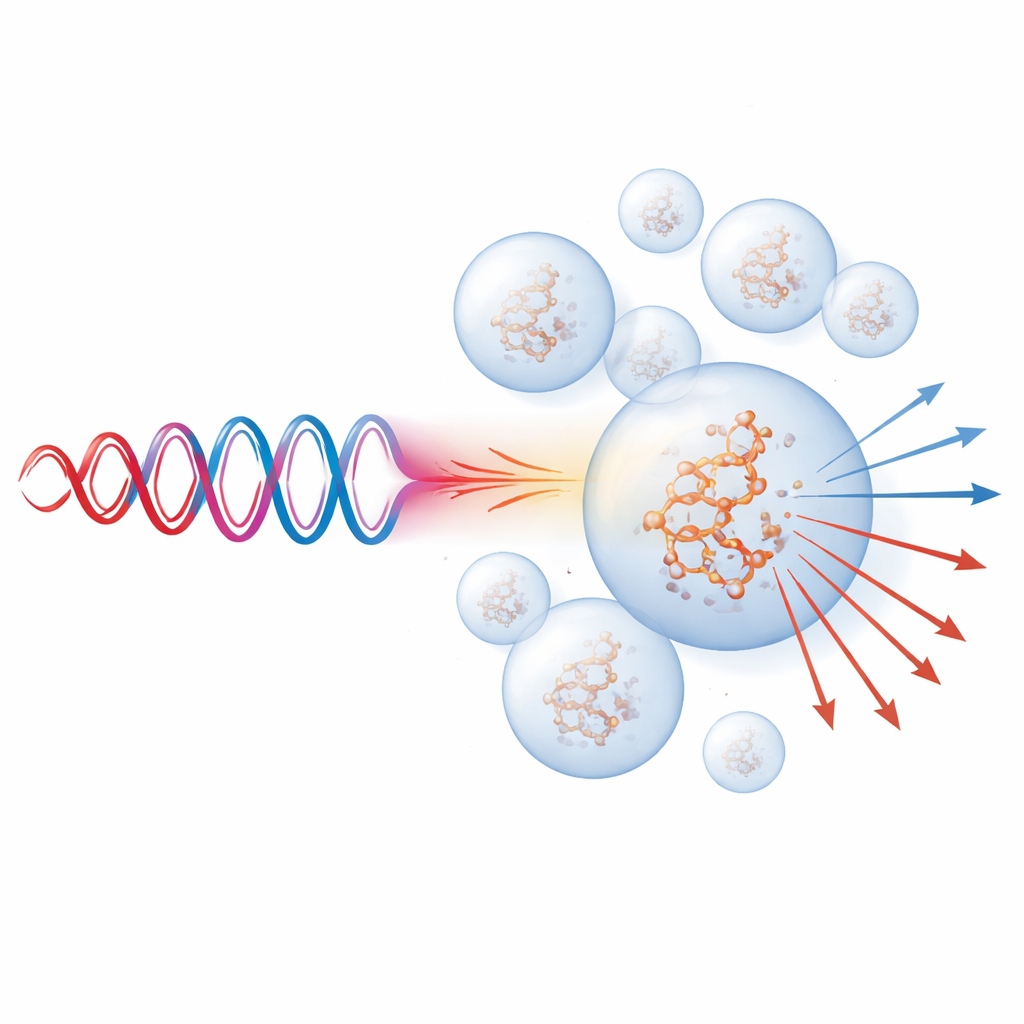
How handed molecules talk to swirling light
When circularly polarized light—light whose electric field rotates like a corkscrew—hits a handed (chiral) molecule, the electron it ejects prefers to fly slightly more forward or backward along the direction of the light beam. This directional bias, known as photoelectron circular dichroism, is unusually strong compared with traditional chiral optical effects and arises purely from how the electron scatters in the chiral molecular landscape. Because the forward–backward imbalance can reach several percent or more, it has long been seen as a promising way to distinguish left- and right-handed molecules, but in practice it usually demands high-vacuum chambers and sophisticated electron imaging detectors, limiting its use outside specialized laboratories.
What changes when molecules clump into tiny particles
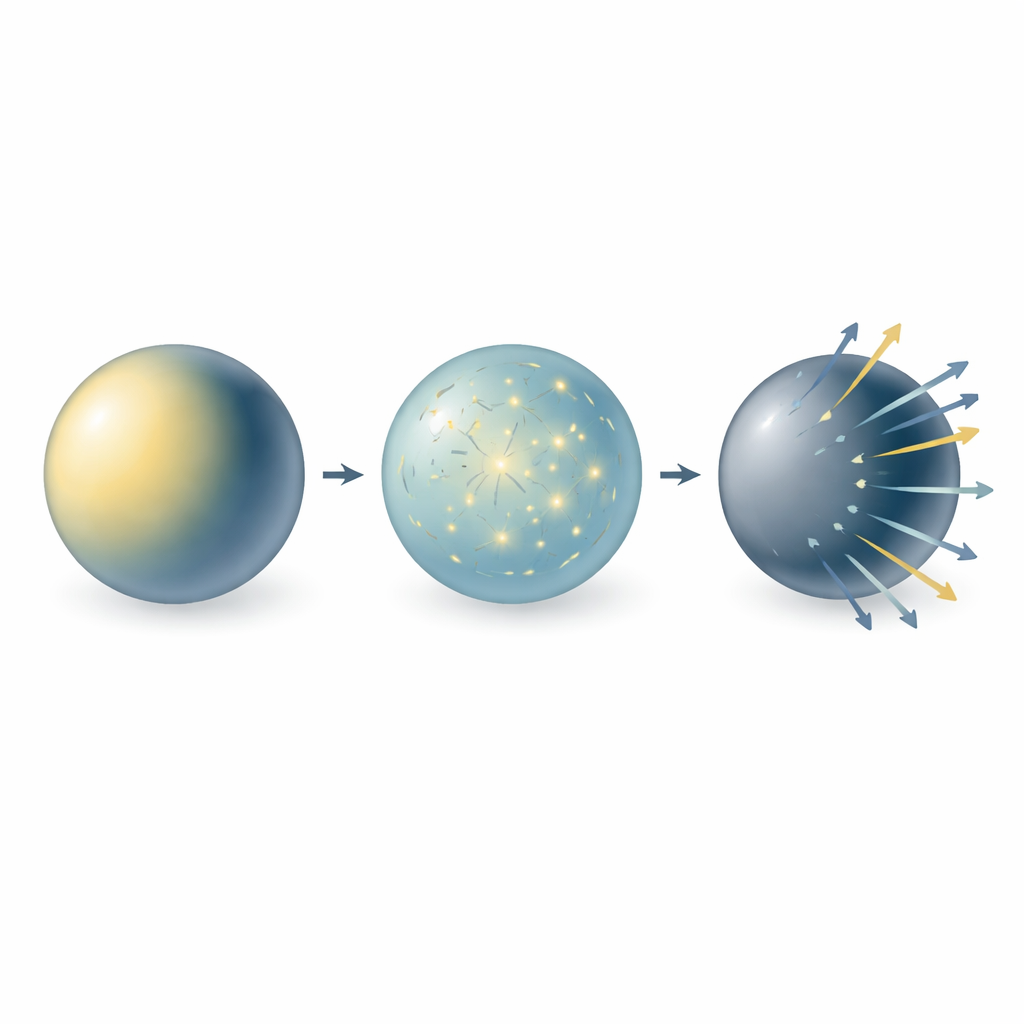
The researchers focus on tyrosine molecules not as isolated gases, but as solid nanoparticles about one hundred nanometers across, suspended as an aerosol. In such particles, light is absorbed as it travels through the material, so the side facing the beam is more strongly illuminated than the far side. Electrons can only escape from a thin outer skin of the particle; those launched inward are reabsorbed. This leads to a “shadowing” effect: more electrons emerge from one side than the other, even if the molecules themselves emit electrons in all directions. By imaging the electron clouds from these particles with circularly polarized light at ultraviolet energies, the team directly measures both the basic shadowing pattern and the extra chiral asymmetry added on top by the photoelectron circular dichroism.
Turning directionality into a simple signal
The key insight of the work is that the combination of directional electron emission and shadowing does more than just distort the angular pattern—it actually changes the total number of electrons that make it out of the particle. If the chiral effect favors electrons moving into the well-lit, forward side, more of them are lost inside the particle; if it favors the shadowed, backward side, more escape. As a result, simply swapping the handedness of the light, or the handedness of the tyrosine, produces a measurable change in the overall electron yield. The authors introduce a name for this: chiral asymmetry of the photoemission yield. Through detailed simulations that match their imaging data, they show that this yield difference can easily exceed the tiny levels expected from conventional circular dichroism and can grow with particle size and with the strength of the underlying directional effect.
From complex instruments to simpler sensors
Armed with these findings, the team outlines how one could measure this yield asymmetry without any electron spectrometer at all. In their proposed setup, a stream of dried aerosol particles made from a chiral solution passes through a beam of circularly polarized ultraviolet light. The emitted electrons and small ions are separated from the much heavier charged particles, and the resulting current of charged particles is measured electrically. Because the current strength changes when the light’s handedness is flipped, it carries a direct signature of the sample’s enantiomeric composition. Calculations indicate that for typical organic particles between about 100 and 500 nanometers across, and for realistic light intensities, the effect should be strong enough to detect reliably with modest equipment.
What this could mean for science and technology
In plain terms, the study shows that the “left–right” sensitivity of swirling light does not have to be read out with elaborate vacuum instruments; it can be converted into a simple change in how many electrons leave a particle. This opens a route to compact devices that assess the handedness and purity of chiral substances in powdered form or as aerosols, even when the molecules are too fragile to vaporize. Such tools could find use in pharmaceutical manufacturing, where product quality depends on the correct handedness, in food and fragrance chemistry, and in environmental monitoring of chiral organic aerosols in the atmosphere.
Citation: Hartweg, S., Božanić, D.K., Garcia, G.A. et al. Linking photoelectron circular dichroism to the asymmetric total photoemission yield measured in aerosol nanoparticles of tyrosine. Nat Commun 17, 2792 (2026). https://doi.org/10.1038/s41467-026-70997-w
Keywords: chiral nanoparticles, photoelectron circular dichroism, tyrosine aerosols, circularly polarized light, photoemission yield