Clear Sky Science · en
Selective conversion of syngas to C4+ long-chain alcohols
Turning simple gas into useful liquids
Modern life relies on special alcohols that go into plastics, detergents, fuels, and many other products, yet making these long-chain alcohols still wastes a lot of energy and carbon. This study shows a new way to turn a simple mix of carbon monoxide and hydrogen, known as syngas, directly into valuable long-chain alcohols with far less waste. By carefully pairing different catalysts in sequence, the researchers steer nearly all of the carbon into useful products while keeping climate-warming carbon dioxide to a minimum. 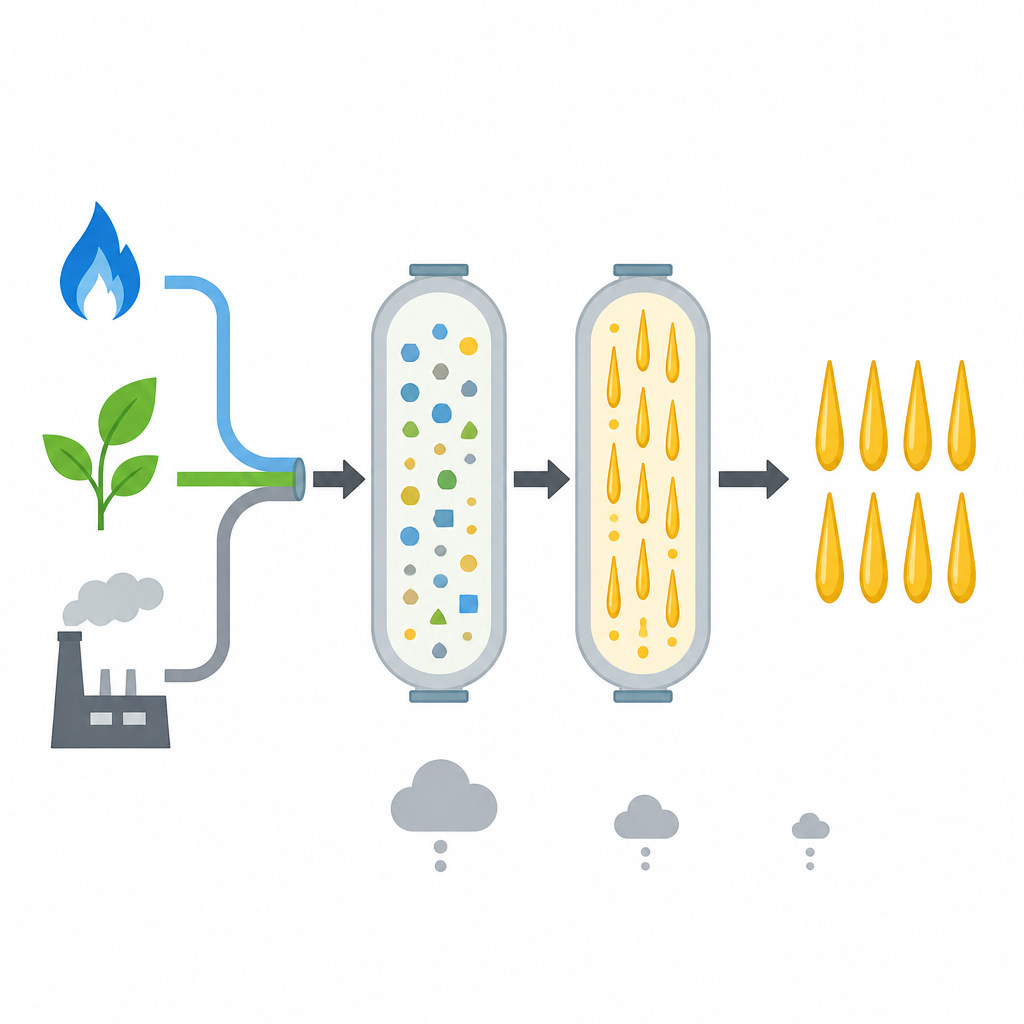
Why long-chain alcohols matter
Alcohols with four or more carbon atoms are quiet workhorses of industry. Butanol, for example, is used to make plastics and can be blended into gasoline, while longer chains are key ingredients in plasticizers, surfactants, and household cleaners. Demand for these chemicals is growing steadily, yet current manufacturing routes are complex and rely on fossil feedstocks and harsh reagents. Traditional processes often require many separation steps, handle hazardous intermediates, and struggle to flexibly use alternative raw materials such as biomass or captured carbon dioxide. A cleaner and simpler path from syngas to these alcohols could cut costs, reduce emissions, and open the door to using more sustainable carbon sources.
Designing a smarter catalytic assembly line
Instead of trying to make the final alcohols in one step, the team designed a kind of molecular assembly line. In the first reactor, they use a cobalt-based catalyst enhanced with manganese and cesium to convert syngas mainly into oxygen-containing molecules and light olefins, rather than into an unselective mix of fuels and gases. Detailed microscopy and electronic-structure calculations show that this catalyst forms tiny regions where metallic cobalt and cobalt carbide touch, further tuned by cesium oxide. These special sites favor the growth and release of the right intermediates while discouraging over-hydrogenation to simple alkanes or waste gases. In effect, the first stage supplies a tailored stream of “half-finished” molecules ready for upgrading.
Finishing the job with two gentle steps
In the second reactor, two different catalysts work together to finish the transformation. Single-site rhodium centers anchored in porous organic polymers add carbon monoxide and hydrogen to the olefins, turning them into aldehydes without aggressively saturating them. A copper–zirconia catalyst then selectively hydrogenates these aldehydes into alcohols, even in the presence of carbon monoxide and water that often poison or sidetrack other catalysts. Extensive testing of many metal combinations showed that this pairing best balances activity and selectivity, keeping unwanted methane, extra alkanes, and methanol to very low levels. The entire process runs in a continuous flow without needing to isolate or distill intermediates between stages. 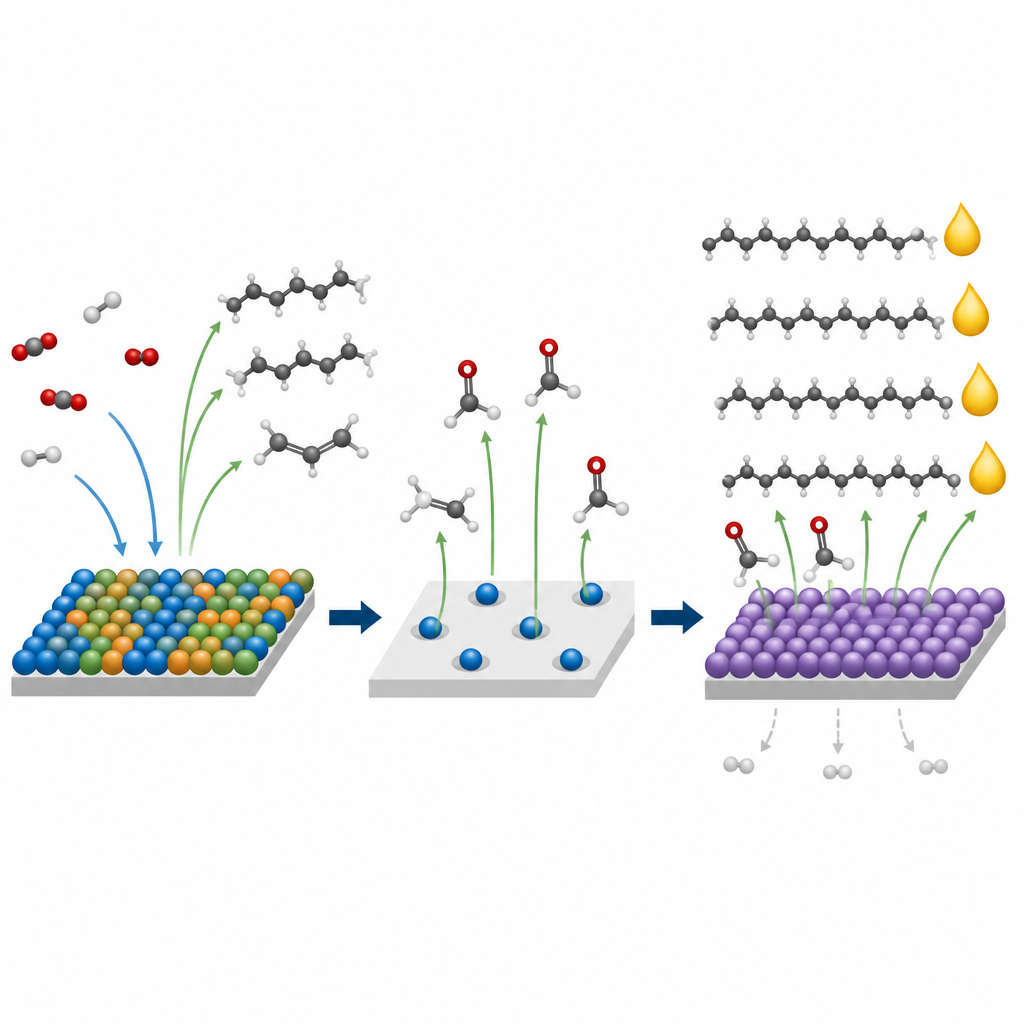
Clean output with minimal waste
By tuning temperatures, pressure, gas composition, and flow rate, the researchers push the system to favor long-chain alcohols. Under optimized conditions, about 80 percent of all alcohol produced has four or more carbon atoms, and half falls into even longer chains of six carbons or more. Only about 1 percent of the carbon ends up as carbon dioxide, while more than 95 percent is locked into useful organic products, with very little methane. Compared with existing routes that either produce a lot of carbon dioxide or mainly short-chain alcohols, this integrated process offers both high selectivity and high carbon efficiency. The system also runs steadily for more than 130 hours, suggesting that it could be scaled to industrial operation.
What this means for future chemicals
For a non-specialist, the key message is that the authors have built a highly efficient chemical factory in miniature, where each catalyst module does a specific job and hands off its products to the next. By guiding how individual atoms add and rearrange, they channel a simple gas mixture into a narrow, valuable set of long-chain alcohols while producing very little waste carbon dioxide. This approach points toward cleaner production of everyday chemicals from flexible feedstocks such as natural gas, biomass, or recycled carbon, and illustrates how smart combinations of catalysts can make industrial chemistry both more targeted and more sustainable.
Citation: Li, Y., Zhao, Z., Jiang, M. et al. Selective conversion of syngas to C4+ long-chain alcohols. Nat Commun 17, 4323 (2026). https://doi.org/10.1038/s41467-026-70994-z
Keywords: syngas conversion, long-chain alcohols, heterogeneous catalysis, carbon efficiency, sustainable chemicals