Clear Sky Science · en
Efficient Pt1Ni single-atom alloy catalyst for hydrogen-free catalytic fractionation of lignocellulose
Turning Plant Waste into Useful Ingredients
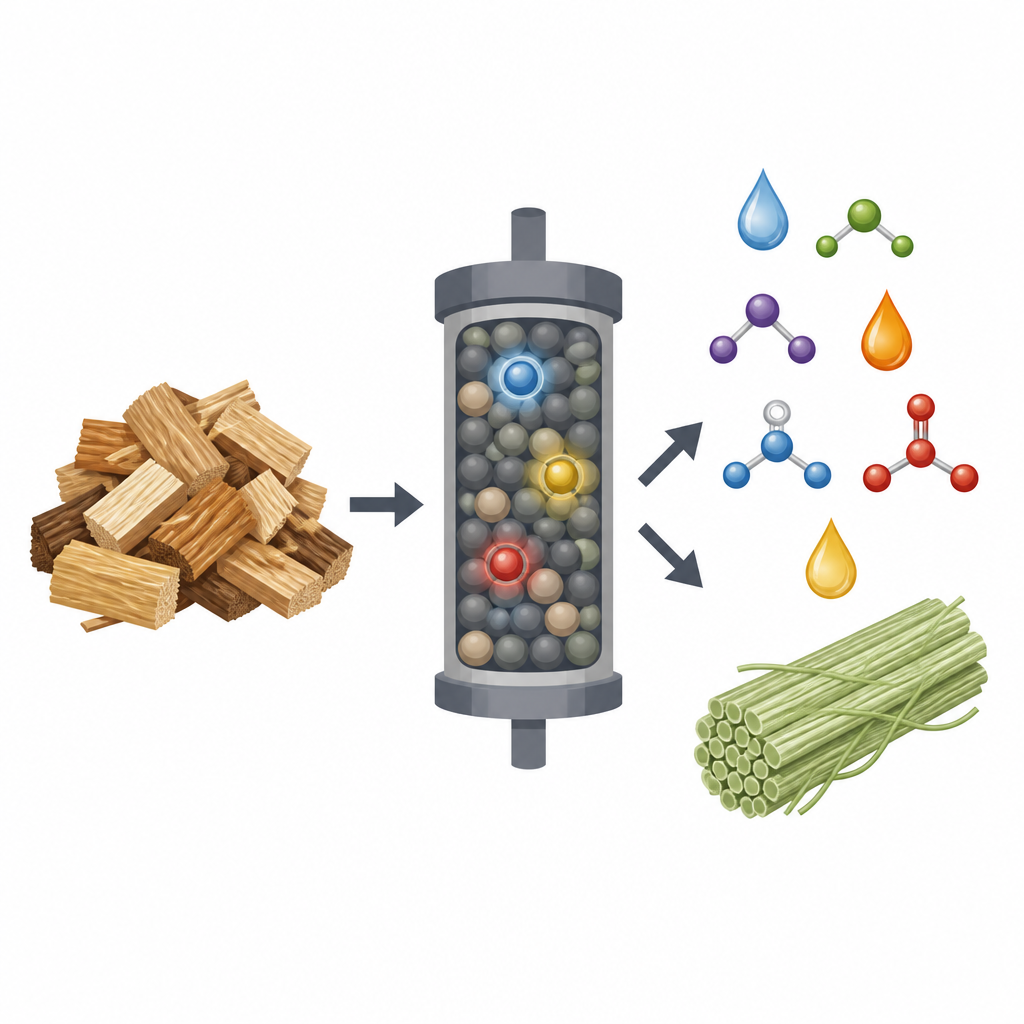
Lignocellulosic biomass, such as wood and crop residues, is often treated as low-value waste or simply burned for heat. Yet it contains complex natural polymers that could be transformed into ingredients for plastics, medicines, and specialty chemicals. This study describes a gentle way to "disassemble" woody biomass in water, using a highly efficient metal catalyst that needs no added hydrogen gas, while keeping the valuable cellulose fibers intact.
Why Wood Is More Than Just Fuel
Wood is built from three main parts: cellulose, hemicellulose, and lignin. Cellulose forms strong fibers that can be turned into paper, textiles, or advanced materials, while lignin is a tangled aromatic polymer that has long been treated as a troublesome by-product. Modern biorefinery concepts aim to use all three components rather than discarding lignin. In particular, chemists want to break lignin into small aromatic molecules called monophenols, which can serve as building blocks for higher-value products. Doing this efficiently, without damaging cellulose and without relying on fossil-derived hydrogen, is a key challenge for sustainable chemistry.
A Smart Metal Design for Clean Conversion
The authors build on a previous approach called self-hydrogen supplied catalytic fractionation, in which hydrogen is generated directly from the biomass itself, mainly from hemicellulose. They design a new catalyst where isolated platinum atoms sit within a nickel surface supported on a robust oxide, forming what is known as a single-atom alloy. Careful imaging and spectroscopy show that, at very low platinum loading, individual platinum atoms are dispersed among nickel atoms rather than clumping into larger particles. This atomic-level arrangement changes how the catalyst binds oxygen-containing groups and helps stabilize metallic nickel that would otherwise be less active under the wet, hot conditions of the reaction.
Gently Taking Lignin Apart in Water
Using birch sawdust as a test material, the Pt1Ni catalyst converts the lignin portion into a high yield of phenolic monomers under mild conditions in water at 140 °C and normal pressure of nitrogen. The process achieves about 51 weight percent of lignin turned into monophenols, close to the theoretical limit, while preserving roughly 90 percent of the cellulose in a solid pulp with high crystallinity. Notably, roughly half of the aromatic products carry a propenyl side chain, which contains a reactive carbon–carbon double bond useful for further chemical tailoring. The catalyst outperforms both pure nickel and higher-loaded platinum systems, delivering far more product per platinum atom and showing good stability over several reaction cycles and with different types of biomass such as pine and wheat straw.
How the Catalyst Steers the Chemical Path
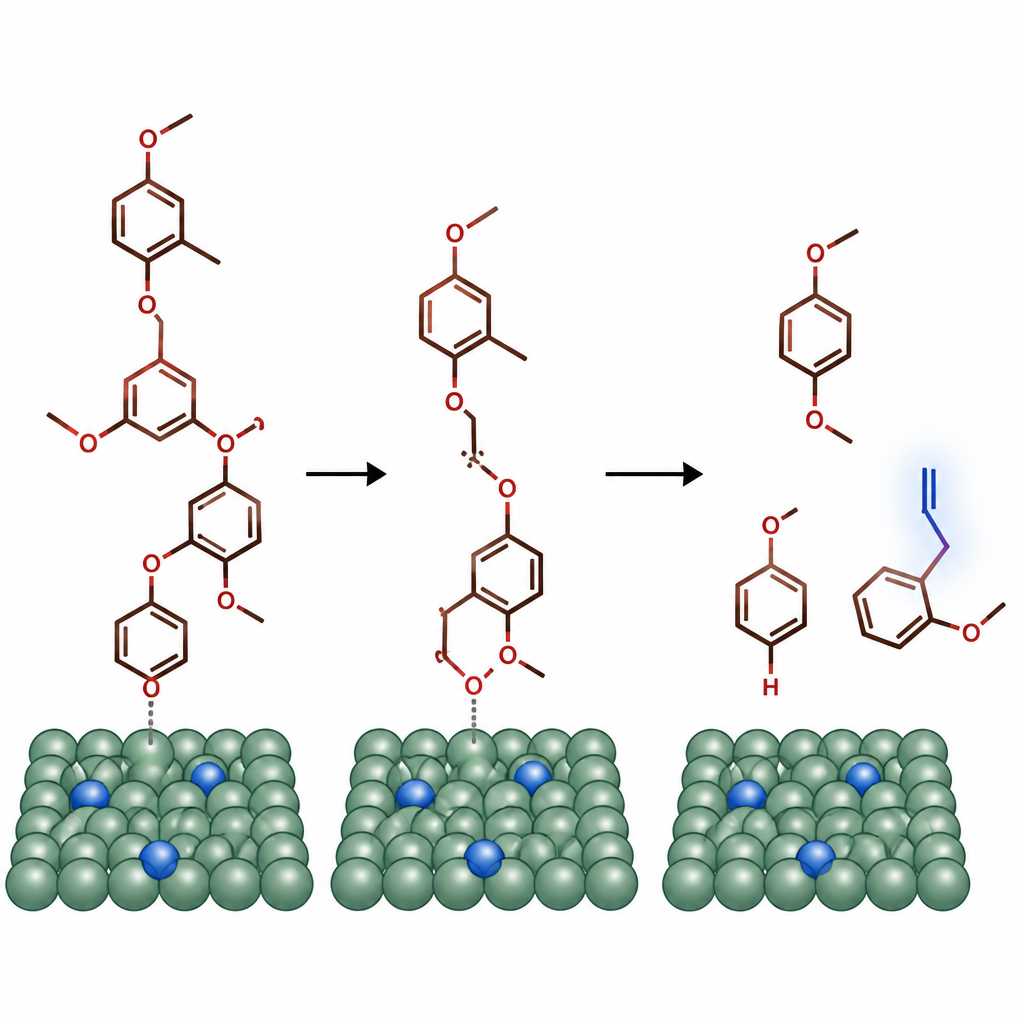
To understand why this catalyst favors valuable unsaturated side chains, the team studies simplified lignin-like molecules and follows their transformation in the presence of the catalyst and a hydrogen source derived from hemicellulose. Experiments reveal three parallel reaction routes that differ in how a particular alcohol group on the lignin fragment is removed. Advanced quantum-chemical calculations show that, on the mixed Pt–Ni surface, nickel sites have a strong affinity for oxygen, which weakens certain carbon–oxygen bonds and lowers the energy needed to break them. This makes pathways that remove a hydroxyl group and then form a carbon–carbon double bond more favorable than those that simply oxidize the alcohol. As a result, the mixed surface tends to generate intermediates that lead directly to propenyl-ended products.
What This Means for Future Biorefineries
In simple terms, the researchers have created a finely tuned metal surface that can unlock the aromatic part of wood in hot water, using hydrogen that comes from the biomass itself, while keeping the useful cellulose backbone intact. By arranging single platinum atoms within nickel, they simultaneously use less precious metal and steer the chemistry toward unsaturated phenolic molecules that are especially versatile as starting points for bioactive compounds, materials, and safer replacements for fossil-derived chemicals. This strategy shows how atomic-level catalyst design can help turn plant waste into a richer palette of renewable products under relatively gentle, hydrogen-free conditions.
Citation: Zhou, H., Xiang, Q., Guo, Z. et al. Efficient Pt1Ni single-atom alloy catalyst for hydrogen-free catalytic fractionation of lignocellulose. Nat Commun 17, 4316 (2026). https://doi.org/10.1038/s41467-026-70993-0
Keywords: lignocellulose, lignin depolymerization, single-atom alloy, biorefinery, phenolic monomers