Clear Sky Science · en
MIC-Drop-seq: scalable single-cell phenotyping of mutant vertebrate embryos
Peeking Inside Tiny Growing Animals
Every animal starts life as a single cell that divides and specializes into many cell types. When genes go wrong during this process, the results can be dramatic or almost invisible to the naked eye. This study introduces a way to read what is happening inside thousands of individual cells in baby zebrafish, all while many different genes are switched off at once. The work gives scientists a powerful tool for tracing how genes shape developing bodies cell by cell.
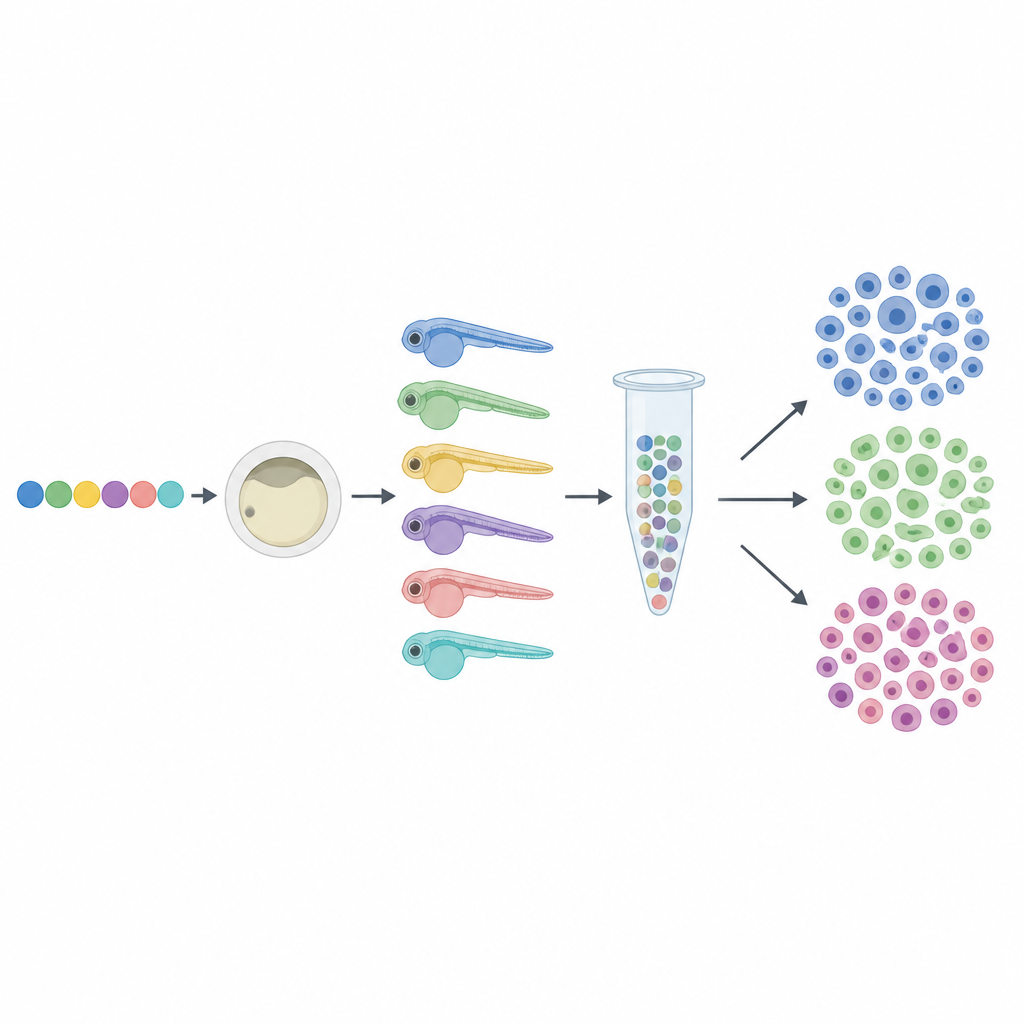
A New Way to Test Many Genes at Once
The researchers built on a method called MIC-Drop, which uses microscopic droplets to deliver CRISPR gene-cutting tools into zebrafish eggs. Each droplet carries a unique set of guides that disables a single target gene and includes a tiny DNA barcode. One droplet is injected into each one-cell egg, so every embryo grows with a different gene knocked out. In this new version, MIC-Drop-seq, the team combines this droplet system with single-cell RNA sequencing, a technology that reads which genes are active inside thousands of individual cells at once.
From Mixed Embryos to Cell-Level Readouts
After the zebrafish embryos develop for one day, they are broken down into a soup of single cells. Instead of studying each mutant embryo separately, all the cells from many embryos are pooled together. Specially designed guide RNAs are captured and sequenced along with the cells’ own RNA, so each cell can be matched back to the gene that was disabled in its original embryo. Using this approach, the scientists recorded both the types of cells present and the activity of thousands of genes in more than 20,000 cells in an initial test, and over 200,000 cells in a larger screen.
Checking That the System Works
To see if MIC-Drop-seq gives reliable results, the team first targeted genes with well known roles in early development. For example, some genes guide the formation of muscle segments along the body, while another is required to form the eyes. When these genes were switched off, MIC-Drop-seq detected the expected loss or gain of specific cell types and the predicted shifts in other genes’ activity. The method also confirmed that CRISPR editing was highly efficient by comparing the fraction of cells carrying the guide RNAs to the amount of edited DNA.
Uncovering Hidden Roles for Many Genes
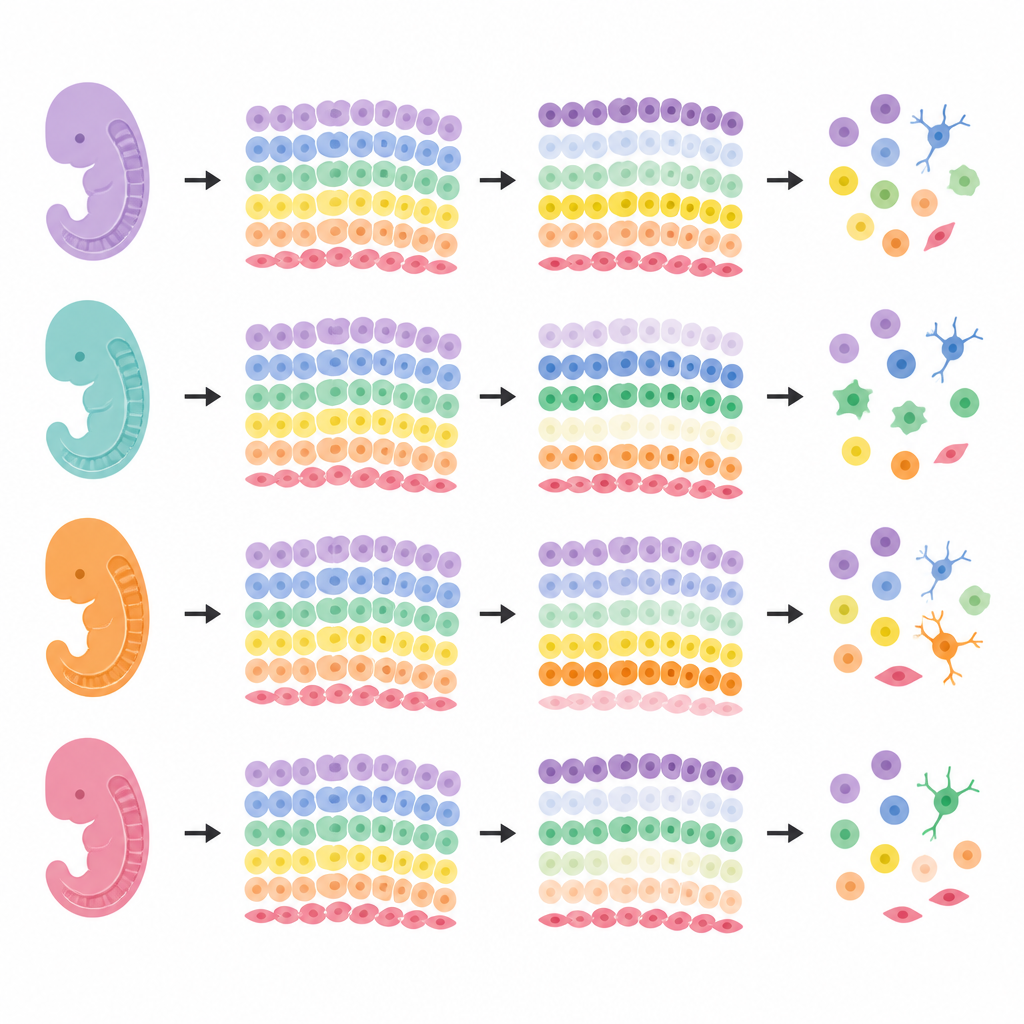
Once validated, MIC-Drop-seq was scaled up to test 50 genes that control when other genes turn on or off during development. In a single experiment, the team profiled more than 220,000 cells spread across 74 distinct cell types. They found that most gene disruptions changed gene activity in a dozen or so cell types, and some also altered how many cells of certain types were present, especially in the developing brain and muscles. The method pointed to new roles for several genes, such as changes in the composition of supporting tissue around future muscles, and shifts in specific brain regions that were later confirmed using traditional staining methods.
How One Cell’s Genes Affect Its Neighbors
A striking insight from the study is how often a gene affects cells that never turn that gene on themselves. By linking their data to existing maps of how embryonic cell types arise over time, the researchers classified changes as direct effects in the same cell type, effects passed along a family line of related cells, or truly indirect effects in other tissues. More than half of the strong changes in gene activity fell into this last “cell-extrinsic” category. In one case, switching off a gene active in skin cells led to abnormal blood vessels and altered blood flow, even though the gene is not used in the vessel cells. This shows that early tissues send signals and forces that shape one another in ways that are hard to predict from single tissues alone.
Why This Matters for Understanding Development
By tying together which gene is disabled, which cell type is affected, and how its gene activity and numbers change, MIC-Drop-seq offers a scalable map from genotype to cell-level outcome in a whole vertebrate animal. For non-experts, this means scientists can now test dozens of genes in parallel and see how each one influences the mix and behavior of cells that build a body, including subtle and indirect effects that do not show up in simple visual checks. The authors suggest that expanding this approach will help decode the complex gene networks that guide animal development and, in time, improve our understanding of developmental disorders and inherited disease.
Citation: Carey, C.M., Parvez, S., Brandt, Z.J. et al. MIC-Drop-seq: scalable single-cell phenotyping of mutant vertebrate embryos. Nat Commun 17, 4738 (2026). https://doi.org/10.1038/s41467-026-70989-w
Keywords: zebrafish development, CRISPR screening, single-cell RNA sequencing, gene regulation, embryonic phenotypes