Clear Sky Science · en
Engineered microbial hydrogels with confined architecture and binary microbes for efficient hydrogen production
Turning Tiny Organisms into Clean Fuel Makers
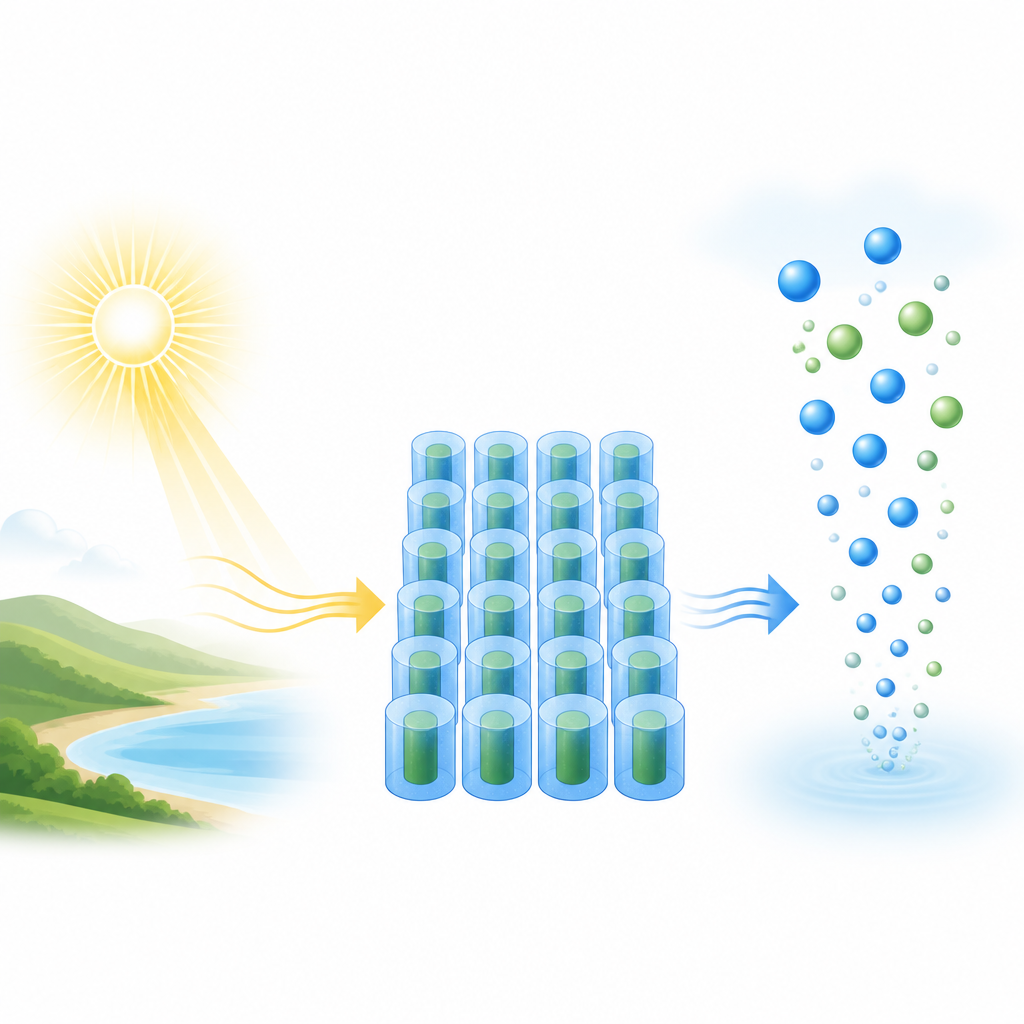
As the world looks for cleaner alternatives to fossil fuels, hydrogen stands out as an attractive option because it releases only water when burned. This study explores a creative way to make hydrogen using living microbes arranged inside soft, water-rich gels. By carefully organizing algae and bacteria in a tiny 3D printed structure, the researchers show how we might squeeze more clean energy out of sunlight while using far less water than traditional methods.
Why Hydrogen from Algae Matters
Hydrogen is often made today from coal or natural gas, which produces large amounts of carbon pollution, or by splitting water with electricity, which can be energy hungry. Microalgae offer a different route: under the right conditions, these microscopic plants can use sunlight to split water and release hydrogen gas. However, the same process that powers their growth also makes oxygen, and that oxygen quickly shuts down the key enzyme that produces hydrogen. Previous attempts to fix this problem used genetic engineering, costly chemicals, or bulky liquid systems that wasted light and water, limiting their usefulness outside the lab.
Building a Living Sponge for Sunlight
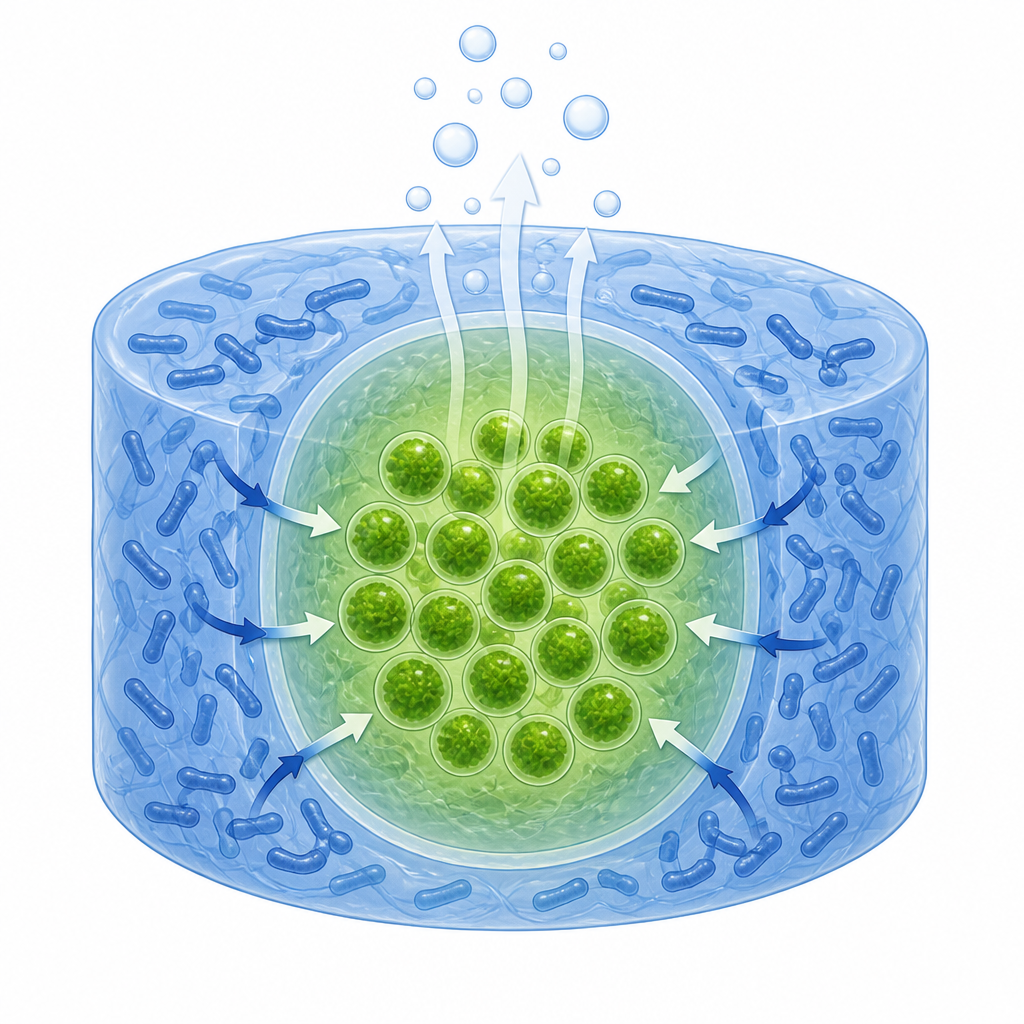
The researchers designed a “living material” that acts like a sponge packed with cooperating microbes. Using coaxial 3D bioprinting, they created core–shell hydrogel fibers where green microalgae occupy the inner core and oxygen-hungry bacteria inhabit the outer shell. The gel is made from food-grade and biocompatible ingredients that form a transparent, flexible scaffold. This transparency helps light penetrate deeply, so algae throughout the structure can absorb sunlight. At the same time, the gel holds just enough moisture for growth, allowing the system to function without being submerged in large volumes of liquid.
Letting Each Microbe Do Its Job
In this setup, each microbe plays a distinct role. The algae use light to split water and generate the electrons needed for hydrogen production, but they also release oxygen. The surrounding bacteria consume that oxygen during their own respiration, keeping the environment inside the gel close to oxygen free. By adjusting the ratio of algae to bacteria, the team found an arrangement where the bacteria removed oxygen efficiently without crowding out the algae or blocking light. This spatial separation reduced competition for nutrients, protected the algae from bacterial overgrowth, and allowed both partners to thrive inside their own zones.
Boosting Hydrogen Output and Saving Water
When tested under light, the printed hydrogel networks produced much more hydrogen than conventional liquid cultures containing the same microbes. The best configuration reached a hydrogen yield of about 1763 milliliters per liter of gel, roughly 78 times higher than a typical mixed liquid culture. The core–shell layout also kept hydrogen production going longer before slowing down, because the bacteria continually consumed oxygen and helped preserve the sensitive hydrogen-making machinery in the algae. The system could be restarted for several rounds of production simply by flushing out air with nitrogen, revealing that the living structure remains active over multiple cycles.
Peeking Inside the Microbial Power Plant
To understand why the algae performed better in this printed environment, the team examined which genes were switched on or off in different culture setups. Inside the structured gel, algae showed higher activity in genes related to light harvesting, energy conversion, and hydrogen-producing enzymes. This suggests that the combination of good light distribution, tailored nutrients, and controlled oxygen levels nudges the algae into a state that favors hydrogen production. In contrast, algae mixed closely with bacteria in a uniform gel lost their green color and showed weaker photosynthetic performance, highlighting the importance of physical separation even in a shared material.
What This Means for Future Green Energy
For non-specialists, the key takeaway is that arranging microbes in the right 3D pattern can dramatically change how they behave and how much useful energy they produce. This study shows that carefully structured living hydrogels can generate hydrogen efficiently while using little water and no genetic modification. Although scaling such systems to industrial levels will require further engineering, the work points to a future where printed living materials, powered by sunlight and microbes, could contribute to cleaner fuel production and other sustainable technologies.
Citation: Li, X., Long, Q., Jiang, M. et al. Engineered microbial hydrogels with confined architecture and binary microbes for efficient hydrogen production. Nat Commun 17, 4303 (2026). https://doi.org/10.1038/s41467-026-70988-x
Keywords: biohydrogen, microalgae, 3D bioprinting, living materials, renewable energy