Clear Sky Science · en
Human-induced intensification of sea surface temperature regime shifts threatens global Large Marine Ecosystems
Why sudden ocean shifts matter to us
Most of the heat trapped by human-made greenhouse gases ends up in the ocean, quietly raising sea temperatures over decades. But hidden within this steady warming are sudden, long-lasting jumps between cooler and warmer conditions that can jolt marine life and the fisheries people rely on. This study shows that such sharp temperature swings have already become far more common in the world’s most productive coastal seas and explains what that means for ecosystems, economies, and climate policy.
Oceans that jump, not just warm
Instead of changing smoothly, sea surface temperatures often flip between cooler and warmer phases that can last for many years. These “regime shifts” ripple through winds, currents, sea ice, and marine food webs. The authors focused on 66 Large Marine Ecosystems, coastal regions that together hold most of the ocean’s biodiversity and support about 80 percent of global fisheries. By combining five long-term temperature records with dozens of climate model simulations, they tracked how often these shifts occur and how strong they are over the past 150 years.
More frequent and stronger jumps in sea temperature
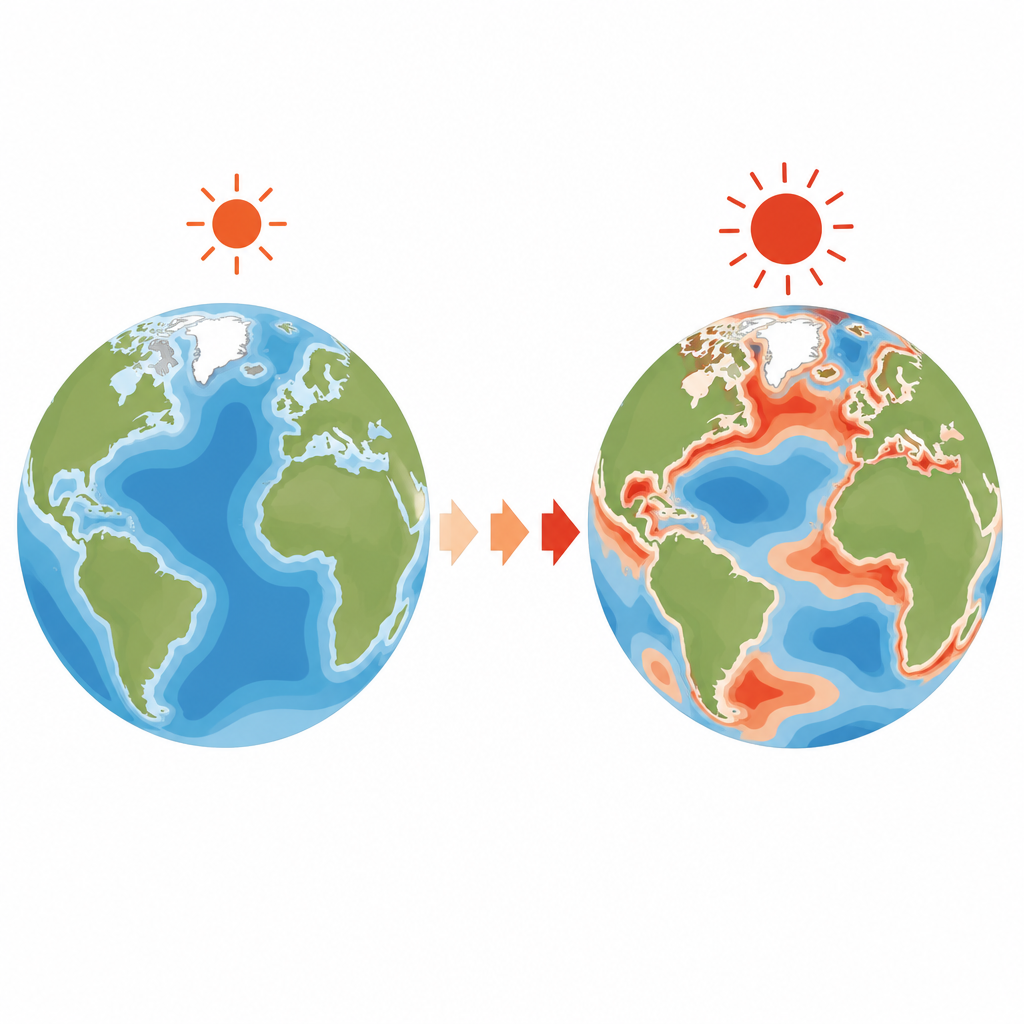
The analysis reveals a striking pattern: since pre-industrial times, the number and size of sea temperature regime shifts in these ecosystems have risen by about 130 to 140 percent. The biggest increases cluster along western boundary currents such as the Gulf Stream and in coastal upwelling zones, which are already known hotspots of rapid warming. Northern Hemisphere seas, including those around Europe, North America, and Asia, now experience more frequent and more intense shifts than those in the Southern Hemisphere, mirroring faster warming in the north. Importantly, these results hold even when long-term warming trends are mathematically removed and when several independent detection methods are used.
Human influence and the fading of cold phases
Climate model experiments help separate natural ups and downs from human influence. Simulations that include greenhouse gas emissions reproduce the observed rise in regime shifts, while those driven only by natural factors show little change. The character of the shifts has also changed: warm jumps have become more common and stronger almost everywhere, while cold jumps have declined sharply. This imbalance means sea temperatures are climbing in a stepwise fashion, with brief plateaus followed by abrupt rises, rather than along a smooth slope. In effect, human warming is reinforcing warm phases and squeezing out the cold ones that once offered temporary relief for cold-loving species.
Future risks for coasts, fisheries, and the Arctic
Looking ahead to 2100, the study examines five different emissions pathways. Without strong climate action, abrupt temperature shifts in coastal seas are projected to increase by another 130 to 180 percent compared with the late twentieth century, with larger jumps in temperature along the way. Under low-emission futures consistent with the Paris Agreement targets, the pattern changes: regime shifts initially grow more frequent but then stabilize or even decline back toward historical levels in many regions. The Arctic is a stark exception. There, shrinking sea ice and rapid local warming drive continued amplification of temperature shifts under every scenario, suggesting that some aspects of Arctic ocean instability will persist even if global warming is limited to 1.5 degrees Celsius.
Cascading impacts on marine life and people
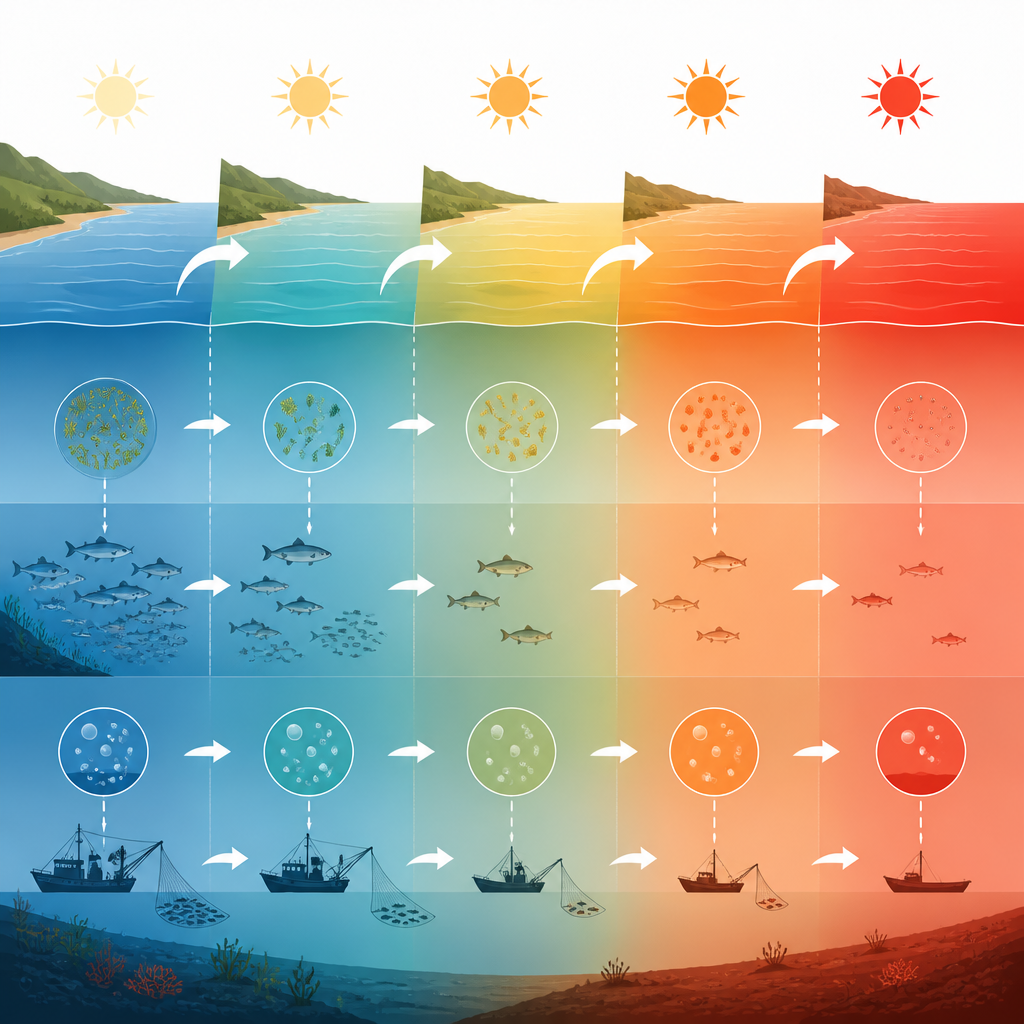
Sudden temperature shifts do not just move thermometers. The authors show that similar jumps are becoming more common in dissolved oxygen, tiny drifting plants and animals, and fish catches across many Large Marine Ecosystems. Roughly one-fifth to nearly half of temperature shifts line up in time with shifts in these ecological measures, and this synchrony is increasing. Regions with more frequent temperature jumps tend to see more abrupt changes in fisheries as well, raising the risk of stock collapses and unstable catches. While fishing pressure and other stresses also play roles, the growing instability of sea temperatures adds another layer of uncertainty for coastal communities, especially in heavily fished and densely populated northern waters.
What this means in everyday terms
For a layperson, the main message is that the ocean is no longer just slowly getting warmer; it is also becoming more jumpy. Productive coastal seas are experiencing larger and more frequent leaps into new temperature states that can last for decades, giving marine life less time to recover and making fisheries harder to manage. Human-made warming is a key driver of this pattern, especially the shift toward persistent warm phases. Strong cuts in greenhouse gas emissions could help steady these swings in much of the global ocean, but the Arctic will likely continue to see growing instability as sea ice retreats. From food security to weather patterns, the findings highlight why limiting warming and preparing for abrupt ocean changes are both essential.
Citation: Xing, Q., Gao, Z., Ito, Si. et al. Human-induced intensification of sea surface temperature regime shifts threatens global Large Marine Ecosystems. Nat Commun 17, 4172 (2026). https://doi.org/10.1038/s41467-026-70986-z
Keywords: sea surface temperature, regime shifts, large marine ecosystems, climate change, fisheries